Kill Bill, Volume 2 (2004) – Blu-ray Disc

Kill Bill, Volume 2 (2004) – Blu-ray Disc

Kill Bill, Vol. 2
****/**** Image A Sound A Extras C+

starring Uma Thurman, David Carradine, Michael Madsen, Daryl Hannah
written and directed by Quentin Tarantino

by Walter Chaw Genre poetry from B-movies’ poet laureate, Quentin Tarantino’s conclusion to Kill Bill is marked by the filmmaker’s carefully-calibrated celluloid insanity, as well as a deceptive maturity that allows a few powerfully-struck grace notes for the cult of femininity and the sanctity of motherhood. Its first portion overwhelming for its craft before lodging in the craw with its ever-present but tantalizingly difficult-to-nail moral code, Tarantino’s epic whole clarifies a dedication to a sort of low, Samuel Fuller/Nicholas Ray tabloid cosmology, grounding itself eventually in the bold, lovely, curiously old-fashioned declaration that the last best reward is to be true to the primal clay of an idea of innate gender roles. The Bride (Uma Thurman) is so named not merely for camp grandeur’s sake, but also to highlight the power of cultural archetypes and their roots in biology.

Kill Bill, Volume 1 (2003) – Blu-ray Disc

Kill Bill, Volume 1 (2003) – Blu-ray Disc

Kill Bill, Vol. 1
****/**** Image A- Sound A Extras C+

starring Uma Thurman, Lucy Liu, Vivica A. Fox, David Carradine
written and directed by Quentin Tarantino

by Walter Chaw There is a palpable, undeniable perversity to Quentin Tarantino’s fourth feature film, a taste for the extreme so gleeful and smart that its references are homage and its puerility virtue. I seem to find a reason between every Tarantino film to dislike him, to cast aspersions on my memories of his films, but I’m starting to think the source of my dislike is jealousy. Tarantino is the director Spielberg is too timid to be: a gifted visual craftsman unafraid of the contents of his psychic closet, and a film brat whose teachers happen to be blaxploitation, samurai epics, and Shaw Brothers chop-socky instead of John Ford and Alfred Hitchcock. And it isn’t that I have aspirations of becoming a filmmaker, it’s just that I want to be as good at something as Tarantino is at making movies.

Hellboy II: The Golden Army (2008)

****/****
starring Ron Perlman, Selma Blair, Doug Jones, John Hurt

written and directed by Guillermo del Toro

by Walter Chaw It’s at the forefront of one’s mind during Hellboy II: The Golden Army (hereafter Hellboy II), Guillermo del Toro’s brilliant dance along an ephemeral tightrope between pop and Puccini, that David Cronenberg and Howard Shore recently converted their remake of The Fly into a full-fledged opera: I can see the same thing happening with a lot of del Toro’s pictures. The director’s said that after his Pan’s Labyrinth “something popped” in regards to his restraint in allowing the menagerie of monsters in his brain free rein over his imagination–and that he endeavoured to bring all the madness of Mike Mignola’s “Hellboy” universe to the big screen with or without a commensurately giant budget. (Of Summer ’08’s blockbusters, Hellboy II, costing around 85 million dollars, might be the most frugal.) The result is a film so crammed to the gills with invention that a bit of background business in a scene set at a bazaar hidden beneath the Brooklyn Bridge (this is the second great genre film this year after Cloverfield to make a pit stop at that particular locale) wherein a creature plays a pipe made out of a tanned human corpse is left uncommented-upon and is somehow ultimately unremarkable. The wonders of Hellboy II as experienced through our avatars Hellboy (Ron Perlman), Liz (Selma Blair), and Abe (Doug Jones, this time vocalizing the character as well)–team members for a covert government agency that deals with supernatural intrusions–are the way the world is, and it’s fascinatingly left for the normals in the audience to crane for a better look.

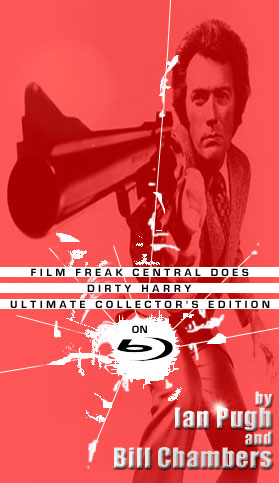
Dirty Harry [Ultimate Collector’s Edition] – Blu-ray Disc

DirtyharrybdstitleDIRTY HARRY (1971)
****/**** IMAGE A- SOUND A- EXTRAS A
starring Clint Eastwood, Harry Guardino, Reni Santoni, Andy Robinson
screenplay by Julian Fink & R.M. Fink and Dean Riesner
directed by Don Siegel

MAGNUM FORCE (1973)
***/**** IMAGE A SOUND A- EXTRAS B+
starring Clint Eastwood, Hal Holbrook, Mitchell Ryan, David Soul
screenplay by John Milius and Michael Cimino
directed by Ted Post

THE ENFORCER (1976)
**/**** IMAGE A- SOUND A EXTRAS B+
starring Clint Eastwood, Tyne Daly, Harry Guardino, Bradford Dillman
screenplay by Stirling Silliphant and Dean Riesner
directed by James Fargo

SUDDEN IMPACT (1983)
*½/**** IMAGE C+ SOUND A- EXTRAS B
starring Clint Eastwood, Sondra Locke, Pat Hingle, Bradford Dillman
screenplay by Joseph C. Stinson
directed by Clint Eastwood

THE DEAD POOL (1988)
***/**** IMAGE A+ SOUND A- EXTRAS B-
starring Clint Eastwood, Patricia Clarkson, Liam Neeson, Evan C. Kim
screenplay by Steve Sharon
directed by Buddy Van Horn

by Ian Pugh SPOILER WARNING IN EFFECT. The barrel of a sniper rifle seeps through a memorial-wall dedication to San Francisco’s finest, and Don Siegel’s Dirty Harry establishes right off the bat that the war on crime is just that: a war; the real question is how to properly fight it when the only real motivators are fear and anger. The film already has its ready-made villain in a fictionalized version of the Bay Area’s own Zodiac Killer, “Scorpio” (Andy Robinson, almost certainly the greatest madman in cinematic history), and the viewer encounters a terrifying golem personifying his frustrations with killers consistently eluding a seemingly-helpless police force and criminals who are caught and released back into society on mere technicalities. Dirty Harry only takes the next logical step by pandering to our basest desires with an equally frightening and chaotic icon: “Dirty Harry” Callahan (Clint Eastwood, at the top of his game), an inspector in the SFPD’s Homicide department who lost his wife to a drunk driver a while back and now takes it out on the rest of criminal society with his .44 Magnum, blasting a hole through any motherfucker unfortunate enough to disturb the peace in his presence. The French Connection‘s Popeye Doyle impressed with his dogged determination, but Harry is the genuine realization of a dick-raising fantasy of the quintessential modern man (notice that the numbers of his radio call sign, “Inspector 71,” reflect the film’s year of release) in that he gives us everything we want without burdening us with the trauma of actually having to become him.

There Will Be Blood (2007) – DVD|Blu-ray Disc

There Will Be Blood (2007) – DVD|Blu-ray Disc

****/****
DVD – Image A- Sound A Extras B+

BD – Image A Sound A+ Extras B+
starring Daniel Day-Lewis, Paul Dano, Kevin J. O’Connor, Ciarán Hinds
screenplay by Paul Thomas Anderson, based on the novel OIL! by Upton Sinclair
directed by Paul Thomas Anderson

by Walter Chaw The jarring, discordant first notes of Jonny Greenwood’s score announce that Paul Thomas Anderson’s There Will Be Blood will realize the promise shown by the auteur’s closest analogue, Punch-Drunk Love. Almost experimental in its marriage of noise and vision, it’s reminiscent in that regard of a Sergio Leone epic about the foundation of a specific aspect of the American character. Pithy that such a thing plays like watching an insect under glass: There Will Be Blood is accurately described as a piece of existential entomology–Kafka somehow married to Upton Sinclair (on whose OIL! the film is formally based). It’s a modern, and modernist, take on The Treasure of the Sierra Madre, starring an actor who may be the best of his generation turning in a performance destined for legend, though I’d offer that when Daniel Day-Lewis actually does go off the rails in making a mad catchphrase out of “I drink your milkshake!”, it’s proof that the rest of his work here is really rather restrained. The best movie of the year if not for No Country For Old Men, it shares with that masterpiece this idea that money corrupts absolutely, its venom catalyzing on contact. Choosing to open with a silent 16-minute introduction that sees Daniel Plainview (Daniel Day-Lewis)–digging for riches by himself in what could be an outtake from Sierra Madre–discovering his share of silver and parlaying it into an oil empire that will eventually leave him alone, misanthropic, and finally insane, Anderson is clearly implying that material pursuits mine the humanity from mortal loam. While he has disdained political reads of the picture, the philosophical ramifications of Anderson’s barren exteriors held up against Plainview’s barren interiors–the both of them with endless potential, it would appear, for bottomless wells of bubbling black–are subtext enough, if not, of course, inextricable from politics.

Blade Runner: The Final Cut (1982/2007) [Four-Disc Collector’s Edition] – DVD

Blade Runner: The Final Cut (1982/2007) [Four-Disc Collector’s Edition] – DVD

****/**** Image A Sound A Extras A+
starring Harrison Ford, Rutger Hauer, Sean Young, Edward James Olmos
screenplay by Hampton Fancher and David Peoples, based on the novel Do Androids Dream of Electric Sheep? by Philip K. Dick
directed by Ridley Scott

by Walter Chaw The prototype for the modern science-fiction film, Ridley Scott’s Blade Runner, through its seemingly endless iterations, through its growing cult of personality and a production history that’s become as familiar as a Herzog shooting mythology, retains its ability to astonish as–along with John Carpenter’s contemporaneous The Thing–the last hurrah for the non-CGI, in-camera effects piece. Tron, The Last Starfighter, and Firefox were destined to be the rule of the day at the expense of matte painters and model-makers, here working out puzzles like how to make a futuristic, mechanized advertising blimp appear to be shooting strobes through the glassed ceiling of the Bradbury. Indeed, it’s almost impossible to watch Blade Runner now without taking its technical brilliance for granted. It looks like it was made in 2007 (particularly in its newest, digitized incarnation); with its lack of the bluescreen artifacts that plague many of its contemporaries, it’s easy to think of a mainframe as the movie’s author.

2001: A Space Odyssey (1968) [Two-Disc Special Edition] – DVD

2001: A Space Odyssey (1968) [Two-Disc Special Edition] – DVD

****/**** Image A+ Sound A Extras B+
starring Keir Dullea, Gary Lockwood, William Sylvester, Daniel Richter
screenplay by Arthur C. Clarke & Stanley Kubrick, based on Clarke’s short story “The Sentinel”
directed by Stanley Kubrick

FFC Must-Own

by Alex Jackson Seeing 2001: A Space Odyssey as a film about evolution is natural but ultimately inaccurate, I think. The Darwinist views evolution as an external response to the world–a survival mechanism–while the Nietzschian views it as an internal, ethical one. Both are touched on in 2001, and both are misleading in that they fail to acknowledge that Man’s evolution in this film is born out of destiny. Out of fate. More appropriate to view evolution here in terms of the lifespan of the butterfly or moth. Guided by a supreme alien intelligence, the species of 2001 evolves from the larva (ape) to the pupa (human) to the butterfly (star child).

Time (2006) – DVD

Time (2006) – DVD

Shi gan
****/**** Image B- Sound A Extras D
starring Sung Hyan-ah, Ha Jung-woo, Park Ji-Yeon
written and directed by Kim Ki-duk

by Walter Chaw Horror is the product of Kim Ki-duk’s Time, the South Korean auteur’s unbelievably unpleasant treatise on misogyny and objectification: the twin crosses he bears in the crucible of his own country’s harshest criticism of him. To see it as the director’s response to his detractors is simplistic, to be sure, and given that other filmmakers’ marches to rhetorical cavalries (Todd Solondz’s Storytelling, Neil LaBute’s The Shape of Things) are so obviously band-aids applied to sucking chest wounds, it’s not a flattering analysis, either. But Time is the species of rebuttal that functions as a prime example of the artist’s essential concerns applied to what are perceived to be his essential blind spots. It’s a Kim picture that clarifies other Kim pictures–a treatise on misogyny that is not in itself misogynistic. It’s self-aware in a way that Kim’s films haven’t been so far, enough on point throughout that common charges of Kim’s wandering attention span are difficult to levy. What elevates Hitchcock into the pantheon has more than a little to do with the fact that his masterpieces are consistently and mainly about his blind spots. You don’t so much dissect Vertigo as Vertigo, with every year and every subsequent viewing, dissects you. Time isn’t Vertigo, but it lives behind the same door in our collective, Jungian cellar. It tackles the big existential question of personal identity by concerning itself topically with the current plastic-surgery fad run amok in South Korea. Peel back its surface to find an underneath writhing with a universal horror of temporariness and mortality.

The Butcher Boy (1998) + The Brave One (2007) – DVDs

The Butcher Boy (1998) + The Brave One (2007) – DVDs

FFC Must-Own

THE BUTCHER BOY
****/**** Image A Sound A- Extras B-
starring Stephen Rea, Fiona Shaw, Eammon Owens, Alan Boyle
screenplay by Neil Jordan and Patrick McCabe, based on the novel by McCabe
directed by Neil Jordan

THE BRAVE ONE
***½/**** Image B- Sound B Extras C+
starring Jodie Foster, Terrence Howard, Naveen Andrews, Nicky Katt
screenplay by Roderick Taylor & Bruce A. Taylor and Cynthia Mort
directed by Neil Jordan

by Walter Chaw Opening with a series of panels from Golden Age comics produced circa the era in which the film is set (i.e., 1962), The Butcher Boy identifies Neil Jordan as a director with a secret yen for superhero fantasies. It certainly jibes with the filmmaker’s affection for protagonists who, for whatever reason, live in private worlds, in fairytale dreamscapes populated by emblems of good and emissaries of evil–worlds where the most colourful places are the interiors of churches, where the characters’ fears and failings alike are assets. Jordan’s films are unfailingly about transformation (though sometimes they’re about the failure to transform adequately, or quickly enough) and heavy with the illness of existential introspection–the Judas strain with which the modern superhero pantheon is sick. His heroes are rendered simple by their duality, confronted by the idea that, for as hollow as it is to change to fit the demands of a particular time and place, it’s equally useless to try to stay the same as the world falls down. Jordan makes the movies Terry Gilliam never quite made until Tideland; far from the compassionate fare many label it, his oeuvre is comprised of harsh little ditties about the voraciousness of the social organism and the bites it takes out of individuals living perpendicular to the absolute mean. For me, all of his films, from The Crying Game to Mona Lisa, from The End of the Affair to Interview with the Vampire, are pointedly concerned with the futility of compensatory measures in the lives of deviants.

Gone Baby Gone (2007) – Blu-ray Disc

Gone Baby Gone (2007) – Blu-ray Disc

****/**** Image A- Sound A Extras B
starring Casey Affleck, Michelle Monaghan, Morgan Freeman, Ed Harris
screenplay by Ben Affleck & Aaron Stockard, based on the novel by Dennis Lehane
directed by Ben Affleck

by Walter Chaw It hurts a little to watch Ben Affleck’s Gone Baby Gone, making the experience tricky because so much of it is so pleasurable. There’s a moment in particular when amateur gumshoes Patrick (Casey Affleck) and Angie (Michelle Monaghan) are flanked by veteran homicide dicks Remy Bressant (Ed Harris) and Nick Poole (John Ashton) at the beginning of an interrogation sequence that made my heart leap with joy. 2007 is shaping up to be the year that saw the best of the early New American Cinema genres resurrected through the prism of our national nightmare of paranoia and discontent; Gone Baby Gone slots in as the doppelgänger-in-spirit to that period’s empty films noir: hard-boiled detectives left knowing less at journey’s end than they did at the start. (Compare the way this picture uses genre as a launching pad instead of as a straitjacket.) The final image is an enduring one–in the days since I’ve seen Gone Baby Gone, it’s hardly left my mind–and where bits of jingoistic garbage like Rendition are rattling bleeding heart sabres with patronizing, simpleminded zeal, here’s a movie that takes the sobering, mature stance that even things that are black-and-white are never black-and-white. Light years ahead of the last adaptation of a Dennis Lehane novel (Mystic River), Gone Baby Gone is about the insanity of agreeing to be absolutely in love in a temporary, capricious universe. It’s about parenthood and, a recurring theme in Lehane’s books, the cult of manhood, too: what defines loyalty and how those tenets are the tenterhooks to which we’re attached to each other in the bedlam of everything else. It’s hollow comfort to discover that once the dust settles, the only thing that makes us men is the handshake agreement to perceive ourselves as something other than animals–if nothing more than animals.

The Assassination of Jesse James (2007) + Johnny Suede (1991) – DVDs

The Assassination of Jesse James (2007) + Johnny Suede (1991) – DVDs

THE ASSASSINATION OF JESSE JAMES BY THE COWARD ROBERT FORD
****/**** Image A Sound A
starring Brad Pitt, Casey Affleck, Sam Shepard, Sam Rockwell
screenplay by Andrew Dominik, based on the novel by Ron Hansen
directed by Andrew Dominik

by Walter Chaw Kiwi director Andrew Dominick’s heroically pretentious The Assassination of Jesse James by the Coward Robert Ford (hereafter Jesse James) is a deflated anti-western in the tradition of Peter Fonda’s The Hired Hand and Terrence Malick’s Badlands. Broadly, it’s a magnification of the Nixonian malaise that infected the early-Seventies, its suggestion that things aren’t much worse now than they were then complicated by three decades of cynicism. As a piece, it’s almost completely sapped of energy, though it isn’t deadpan like Jarmusch’s Dead Man. No, think of it as more of a dirge: not ironic, but post-modern; not a death march, but mournful. It’s how J. Hoberman once (derisively) described Body Heat, a “remake without an original”–Pat Garrett and Billy the Kid corrupted by McCabe and Mrs. Miller, the whole of it shot through with an autumnal soft focus that looks exactly like the reunion sequence that pushes the third act of Bonnie and Clyde. It vaguely resembles an insect caught in an amber sepulchre. Yet despite its obvious pedigree, it is all of itself, infused with the spirit of the now, suffused with author Ron Hansen’s transcendental prettiness (the film is based on his novel), and, as framed by DP Roger Deakins’s painterly eye, overwhelmingly beautiful. Deakins is given the keys to the kingdom here and every moment of Jesse James looks like mythology pulled through a cinematic loom, often leaving the edges of the frame lanolin-indistinct as they trail off into history. I hadn’t thought it possible to see our current crises of faith cast as romantic, but there it is.

Harry Potter and the Order of the Phoenix (2007) – Blu-ray Disc

Harry Potter and the Order of the Phoenix (2007) – Blu-ray Disc

****/**** Image A Sound A+ Extras B+
starring Daniel Radcliffe, Rupert Grint, Emma Watson, Helena Bonham Carter
screenplay by Michael Goldenberg, based on the novel by J.K. Rowling
directed by David Yates

by Walter Chaw It’s a blasted earth, this green that holds Hogwarts now, and during a scene where our hero wizard is being tortured into forgetfulness for his own good, director David Yates cues a blanket of forgetful snow to fall. Harry Potter and the Order of the Phoenix (hereafter Harry Potter 5) is, like its title suggests, a startling return to form for the series after Alfonso Cuarón’s exceptional Harry Potter and the Prisoner of Azkaban was followed by the insipid contribution of rom-com specialist Mike Newell. Gratifyingly complex and deliciously Freudian, a moment where Harry loses the last of his family–mirroring a moment in the third film where, on the banks of a lake, he almost loses himself–is preceded by an identical progression from the third film in which he’s mistaken for his own father. Alas, this time, Harry’s not able to affect positive change in the guise of his dad; it’s the boy becoming the man, frustrated and folded into a world of dread and doom. As drawn in the film, Potter’s universe is like Potter’s Field, a place where strangers and orphans are buried on the eve of war and a child’s unavoidable matriculation into corruption. Harry Potter 5 is dark as pitch: unsettling, unsettled, unresolved, and utterly remarkable.

The Darjeeling Limited (2007)

****/****
starring Owen Wilson, Adrien Brody, Jason Schwartzman, Anjelica Huston
screenplay by Wes Anderson & Roman Coppola & Jason Schwartzman
directed by Wes Anderson

by Walter Chaw If there's a Wes Anderson cult, I guess you should sign me up. His latest, The Darjeeling Limited, represents to me a maturing artist grappling with the stagnation of the relationship between fathers and sons. This notion that the relationship's reconciliation can only be arrived at posthumously is devastating–not because it's bleak, but because more often than not it holds true. Accordingly, Anderson's picture only has the suggestion of a father (unlike the surrogate father of The Life Aquatic or the redeemable father of The Royal Tenenbaums) at its beginning and maybe a spectre of a father played in cameo by Bill Murray, chasing down the titular train in the film's already-emotional prologue. I've offered that my appreciation of Anderson's work in the past has necessitated multiple viewings (if I'd had a second look at The Royal Tenenbaums prior to composing my year-end list in 2001, it wouldn't have had much competition for the top spot), but found The Darjeeling Limited to be affecting from the start. Something to do with a familiarity with Anderson, perhaps, or with Anderson growing up from the precocious scamp of Rushmore into the ravaged visage of Francis Whitman (Owen Wilson), the eldest of the three Whitman brothers, called to India after a year's estrangement on a quest for spiritual discovery in Satyajit Ray country. (Indeed, the film's score is cobbled together from snippets of Ray's music as well as a few choice cuts from The Kinks–the use of "This Time Tomorrow" from Lola vs. the Powerman & the Money-Go-Round, Pt. 1 is nearly as exquisite as the use of the Rolling Stones' "Play With Fire" late in the picture.) More probably, I connected instantly with The Darjeeling Limited, a film about mourning the death of a father, because I've been doing the same thing–imperfectly, badly–for almost exactly four years now.

28 Weeks Later (2007) – DVD

****/**** Image N/A Sound A Extras B
starring Robert Carlyle, Rose Byrne, Jeremy Renner, Idris Elba
screenplay by Rowan Joffe, Juan Carlos Fresnadillo, E.L. Lavigne, Jesús Olmo
directed by Juan Carlos Fresnadillo

Walter Chaw It’s phenomenal. Where 28 Days Later… was saddled with ambition that exceeded its reach and, in Danny Boyle, a director who not only disdained the genre but has otherwise proven himself a grade-A tool as well, Juan Carlos Fresnadillo’s sequel 28 Weeks Later is brutally graceful in its vision of a nuclear family’s dissolution as the metaphor for a broader, collective unrest. The triumph of the picture, though, is that it’s as succinct and eloquent as a heart attack; as a parable of the Iraq War (popularly called “The War in Iraq,” a subtle semantic distancing technique particularly trenchant to this discussion), it’s all about aftermath and occupation. It’s impossible not to compare it to the years and tens of thousands of fatalities since the declaration of “mission accomplished” when the picture begins with the reassurance that everything’s peachy in dead-as-a-doornail England. Repatriation and reconstruction have begun six months after the outbreak of the first film’s “rage virus,” reuniting two kids, Tammy (future superstar Imogen Poots) and Andy (Harry Potter-named Mackintosh Muggleton), with their tightly-wound da’, Don (Robert Carlyle). In an end-of-the-world opening in what only appears to be night (it’s the first of several brilliant reversals), we see how a fissure develops in Don’s marriage to wife Alice (Catherine McCormack), and of how that stress fracture becomes the foundation for the rest of the picture’s relationships and politics.

Eastern Promises (2007)

****/****
starring Viggo Moretensen, Naomi Watts, Vincent Cassel, Armin Mueller-Stahl
screenplay by Steve Knight
directed by David Cronenberg

by Walter Chaw As executed by our pre-eminent insect anthropologist, David Cronenberg’s Eastern Promises is more fairytale than thriller, one that finds new muse Viggo Mortensen as Nikolai, the rising star of an émigré Russian mob family taken root in the heart of London within the red velvet-lined walls of a restaurant innocuously-/romantically-named “Trans-Siberian.” Self-described as “wolfish,” this pack is led by grandfatherly Semyon (Armin Mueller-Stahl), who’s disappointed with his ineffectual son Kirill (Vincent Cassel) and looking to replace him with a surrogate heir. The rot of that familial discord throws its roots back to ferocious opening minutes that see first a vicious throat-slashing, then a fourteen-year-old, pregnant prostitute haemorrhaging on the floor of a drugstore after she’s told that, for Methadone, the pharmacist will need a prescription. Cronenberg’s London is a cess seething beneath a veneer of “normalcy”; regarded as a toxic tabernacle in Spider, the city is transformed here into a garish, meticulously theatrical wonderland. The central problem of the picture has a lot to do with the idea that Cronenberg has again taken a pre-existing script and reordered it along distinctly Cronenbergian lines–that what must have read initially as a sociological text on another facet of the immigrant experience (much like screenwriter Steve Knight’s Dirty Pretty Things) now plays like one of Cronenberg’s investigations into the difficulty of parsing concepts like “normal” and “family” in the crushing crucible of bugs pretending to be human among humans.

Ratatouille (2007)

****/****
written and directed by Brad Bird 

by Walter Chaw Brad Bird’s latest film Ratatouille is the auteur’s affirmation that it’s possible, no matter the station, to find genius among the rabble. It’s charmingly egalitarian, this idea that any class or creed can produce the next Einstein or Baryshnikov, and it seems a direct response to the critics of his The Incredibles, who would say that that superhero film’s mantra of “if everyone is super, no one is” is an embodiment of intolerance and classism. Ratatouille‘s answer is a lot like the one offered by Bird’s feature debut, The Iron Giant: that not only is it possible to overcome one’s basic programming, but also that choice supersedes predestination and, moreover, that a basic morality governs the actions of all things. A lot to put on the doorstep of a film about a rat, Remy (voiced by Patton Oswalt), who wishes he could be a chef in the kitchen of idol Gasteau (Brad Garrett)–but Bird, in the course of just three films (and stints with “The Simpsons” and “The Critic”), has forged a pretty formidable ideology based on, of all alien things, the sociology of common sense. Some people are more gifted than others, some people are assholes, and most people are idiots; just as an understanding of race and gender comes with the acceptance of basic differences, so, too, does understanding within a culture only come through a similar acceptance that some people are super and others are simply background.

The Twilight Samurai (2002) – DVD

The Twilight Samurai (2002) – DVD

****/**** Image D Sound D Extras B
starring Hiroyuki Sanada, Rie Miyazawa, Nenji Kobayashi, Ren Osugi
screenplay by Yôji Yamada, Yoshitaka Asama, based on the story of Shuuhei Fujisawa
directed by Yôji Yamada

by Walter Chaw Unforgiven for veteran director Yôji Yamada and the jidai-geki genre of samurai pictures, The Twilight Samurai is quiet, assured, a masterpiece of contemplative understatement. Its connection to Eastwood’s film is more than just cosmetic, though, more than just another “Old West” film about an aging, widowed warrior called into action for something so quaint as the honour of a woman. No, The Twilight Samurai seems an apologia for the romanticization of violence and, moreover, for the elevation of the cult of masculinity out of the mud of bestial muck–where it at least in some measure belongs–and into realms of ritualistic divinity. There’s a scene in The Twilight Samurai more powerful than its commensurate moment in Unforgiven that emphasizes this point as unassuming hero Seibei (Hiroyuki Sanada), without comment, steps over the flyblown corpse of a rival assassin in silent pursuit of his own quarry. The romance of end-of-era pictures like this (and literature as well; The Twilight Samurai and Unforgiven heavily remind of Cormac McCarthy’s The Crossing) is that they can be pulled into a discussion of the passing away of youth as a man goes from early manhood’s heady intoxication with the concept of chivalry to the more sober appreciation that true grit comes with providing constancy for your children in a world forever tilting towards alien territory. Though Seibei’s nickname, “Tasogare” (“Twilight”), is a jab at his rushing home after clerk-work to tend to his demented mother and two young daughters, there’s poetry in it as a description of a liminal magic hour where change looks not only more possible, but weighted with a lovely, gilded melancholy besides.

Manufactured Landscapes (2006) – DVD

Manufactured Landscapes (2006) – DVD

****/**** Image A Sound A Extras A
directed by Jennifer Baichwal

by Walter Chaw There’s something about Jennifer Baichwal’s profiles of artists. After debuting with a nicely-modulated piece on writer Paul Bowles, Baichwal heard her muse with The True Meaning of Pictures, a profile of Appalachian portrait photog Shelby Lee Adams that, without overtly politicizing the subject, digs gratifyingly deep into the question of where representation becomes exploitation and, trickier still, how the audience might have as much to do with that difficult equation as the essayist himself. With Manufactured Landscapes, Baichwal looks at the work of Canadian photographer Edward Burtynsky, an artist who shoots landscapes of industrial wastelands that reveal men to be astonishingly productive beasts–and destructive, too, in the same procreative stroke. It’s hard to imagine the industry necessary to manufacture the scale of the freighters getting dismantled in the ship-breaking yards to which Baichwal travels with Burtynsky (I’ve heard a similar sense of awe attends a visit to the Vehicle Assembly Building at NASA)–hard to assimilate the amount of Nietzschian will-to-power necessary even to contemplate the construction of titans.

Inland Empire (2006)

****/****
starring Laura Dern, Jeremy Irons, Justin Theroux, Grace Zabriskie
written and directed by David Lynch

by Walter Chaw Nikki (Laura Dern) is an actress landing her dream role opposite Devon (Justin Theroux) in a film directed by the great Kingsley Stewart (Jeremy Irons). Alas the project, “On High in Blue Tomorrows”, has a history in which a previous, doomed production ended as reality seeped into its fiction and the film’s onscreen/offscreen lovers were killed. For a moment, it seems as though David Lynch’s Inland Empire might be as straightforward as a haunted Hollywood genre exercise–but time slips, it’s suddenly the next day, and as one character says to another, you’re sitting over there. Displaced, distracted, the picture is a masterpiece that, for the patient, the active, and the curious, may be the most literal definition of “dread” captured on film. That feeling you get when Henry Spencer contemplates his feral baby in Eraserhead is the same species of disgusted, familiar fascination that infects this film like a murder of maggots.

Philadelphia Film Festival ’07: Zoo

****/**** directed by Robinson Devor by Ian Pugh Constructed as a series of dream-like, blue-tinted re-enactments anonymously narrated (and sometimes acted out in silhouette) by the people involved, Zoo--so named for an apparently in-crowd nickname for "zoophile"--documents a small group of individuals gathered together on a ranch in Washington, one of the few states in the union where bestiality is "not illegal," to hang out and share their love for animals; their illusions of solitude are shattered, however, when one of them dies from a perforated colon after having sex with a horse. The zoophiles are portrayed here as fairly…