Greenberg (2010) – Blu-ray Disc

****/**** Image A Sound A Extras D
starring Ben Stiller, Greta Gerwig, Rhys Ifans, Jennifer Jason Leigh
written and directed by Noah Baumbach

FFC Must-Ownby Walter Chaw The ideal follow-up to his Dorothy Parker-cum-Rohmer shrine Margot at the Wedding, Noah Baumbach’s Greenberg is a deepening of the filmmaker’s examinations of the peculiar voids over which we stretch the niceties of interaction betwixt the miserable intellectual elite. It’s the Algonquin Roundtable reconstituted as wits without an audience: all outrage without an outlet, there’s even this sense of panic attached to Greenberg’s little whorls of nervous intellectualism, as if Jonathan Edwards’s penitents were literati at risk of being cast into the hell of everyone else. Just as ignorance is bliss, the opposite is most assuredly also true, and it’s the product of that deep, consuming contemplation of the navel that is the foundation for Baumbach’s films, from his post-grad Kicking and Screaming through to his portraits of agonizing relational disintegrations The Squid and the Whale and Margot at the Wedding. The anxiety that drives his work is the fear that the armour equipped to defend against the perception of ordinariness doesn’t fit well, and that the discovery of the idiot driving the sage is not merely likely but inevitable. His are films, then, of a certain deep discomfort with the projection of the self–and Greenberg, ironically, is an examination of all of Baumbach’s issues carried off with what seems like absolute confidence. If Baumbach suffers from the same self-doubt as his characters, he’s no longer showing it in his films.

A Scanner Darkly (2006) – Blu-ray Disc

A Scanner Darkly (2006) – Blu-ray Disc

****/**** Image A+ Sound A- Extras C
starring Keanu Reeves, Robert Downey Jr., Woody Harrelson, Winona Ryder
screenplay by Richard Linklater, based on the novel by Philip K. Dick
directed by Richard Linklater

FFC Must-Ownby Walter Chaw Our reality has almost outstripped Philip K. Dick’s paranoid fantasies, and Richard Linklater’s grim A Scanner Darkly is the slipperiest take yet on the war between perception vs. reality in a year that knows United 93. Keanu Reeves, so often woefully miscast, is wonderfully imagined here as a guy in a “scramble suit”: his appearance constantly shifting in a kaleidoscope of mismatched parts–the uniform of future-narcs (seven years from now, announce the opening titles) sent undercover to ferret out the dopers and dealers of Substance D. It’s a hallucinogen that eventually causes a rift in the individual consciousness (the left hemisphere atrophies and the right tries to compensate) and Reeves’ Agent Fred is sent to find out where dealer Donna (Winona Ryder) is getting her shit. But the scramble suits seem mainly used to keep the vice squad’s identities from one another instead of their quarry, meaning that Fred goes underground as himself, Robert Arctor, in full grunge, inhabiting his once-cozy suburban nook with tweaked conspiracy theorists Ernie (Woody Harrelson) and Barris (Robert Downey Jr.). Meaning, too, that Fred is asked to spy on Arctor, and that Barris, in a pair of hilarious scenes, informs on Arctor to Arctor. It’s not the labyrinthine audacity of Dick’s delusions that so enthrals, but rather the mendacity of them. What’s complicated about A Scanner Darkly isn’t the compression of identity or the various plots to which its characters imagine themselves hero and victim, but the idea that reality conforms itself to belief–that because life has stopped making sense to you, life has stopped making sense, period.

I’m Still Here (2010)

****/****
starring Joaquin Phoenix, Antony Langdon, Casey Affleck, Sean “P. Diddy” Combs
screenplay by Casey Affleck and Joaquin Phoenix
directed by Casey Affleck 

by Ian Pugh It’s far too easy to believe that Casey Affleck’s I’m Still Here hinges on whether or not its subject has perpetrated a hoax. Joaquin Phoenix grows a lunatic’s beard, declares he’s quitting acting, and starts planning a hip-hop career? Surely, he can’t be serious. But here’s how it ends, kids: yes, I guess you could call it a “put-on” in the strictest sense of the word–yet at the same time, he is deadly serious. What needs to be understood about Phoenix, and this film, is that there was a kernel of truth to everything the man mumbled through that maniacal persona. I do believe that Phoenix is tired of acting (or, at least, tired of stardom), and, for his farewell performance, he’s blurred the line between actor and role so completely as to obliterate all our preconceived notions of who he is and what he is supposed to represent. The false Phoenix–the bedraggled, abusive prophet spouting non-sequiturs–is, for all intents and purposes, the “real” Phoenix, the iconic artist who pulls a disappearing act by forcing the art and the iconography to consume his entire being. You can’t call I’m Still Here a mockumentary, exactly, because, inside and outside of the “act,” that is precisely what happened. And what came out of it is a harrowing thought exercise about artistic failure and the baggage of celebrity.

The Social Network (2010)

****/*****
starring Jesse Eisenberg, Andrew Garfield, Justin Timberlake, Armie Hammer
screenplay by Aaron Sorkin, based on the book The Accidental Billionaires by Ben Mezrich
directed by David Fincher

by Walter Chaw An asshole movie about an asshole, David Fincher’s The Social Network is an exacting, brutal celluloid treatise on the theory that the only reason anything ever gets made in this world is because some smart guys don’t get laid enough. It’s the misandrous analogue to Camille Paglia’s once-inflammatory assertion in her Sexual Personae that if women were in charge of civilization, we’d still be living in grass huts. Freud at its mud-wallow base, The Social Network isn’t thoughtful–it’s not a conversation unto itself, not much more than pocket philosophizing easily turned into a weapon for either side. In the end, it’s just a series of loose, out-of-sequence vignettes chronicling the creation of a 25-billion-dollar enterprise on the back of a painful break-up and a best friend getting into an exclusive campus club that said 25-billion-dollar enterprise’s creator could not. But it’s good. Good because Fincher and screenwriter Aaron Sorkin have tapped into a vein of male anxiety in a way that feels like mainlining a particularly hot, particularly angry fix. It’s Fight Club again, but with an ending that’s more about the toothed pit at the middle of male loneliness and obsession–drawing that line between genius and psychosis instead of, as in Fight Club, pandering to some notion of a romantic solution capable of soothing eons of atavistic penis crises. It’s Fight Club without Marla.

Animal Kingdom (2010) + Valhalla Rising (2010)

ANIMAL KINGDOM
***½/****
starring Ben Mendelsohn, Joel Edgerton, Luke Ford, Guy Pearce
written and directed by David Michôd

VALHALLA RISING
****/****
starring Mads Mikkelsen, Maarten Stevenson, Gordon Brown, Andrew Flanagan
screenplay by Roy Jacobsen & Nicolas Winding Refn
directed by Nicolas Winding Refn

by Walter Chaw David Michôd’s Animal Kingdom respects its audience, a rare commodity during the best of times. The film flatters us by leaving exposition and backstory to our knowledge of anthropology–in fact, Animal Kingdom is best indicated by its unwavering reserve–a reluctance, almost–to say too much when slow, fluid tracking motions and static, medium-distance establishing shots may suffice. Consider a frankly gorgeous tableau late in the film as three people meet in Melbourne’s National Gallery of Victoria: framed against an open space, Michôd allows an extra beat, then another, before continuing with his family gothic. The story isn’t an afterthought, but the dialogue, however minimal, seems to be. The picture’s told through its actions and its images and, in that way, reminds of a Beat Takeshi film, of all things, what with its focus on criminality and its enthralling slowness. If there’s another indie demiurge to which Michôd pays obeisance, it’s Michael Mann–and the success of the picture (as shrine to masculinity, as introspective character study) suggests that cribbing from Kitano and Mann, if it’s as successful a larceny as this, can be successful in no other way.

The Manchurian Candidate (1962) [Special Edition] + Deathdream (1972) + Uncle Sam (1997) – DVDs|Uncle Sam – Blu-ray Disc

THE MANCHURIAN CANDIDATE
****/**** Image A+ Sound A Extras B+
starring Frank Sinatra, Laurence Harvey, Janet Leigh, Angela Lansbury
screenplay by George Axelrod, based on the novel by Richard Condon
directed by John Frankenheimer

Dead of Night
***½/**** Image A- Sound B Extras A-
starring John Marley, Lynn Carlin, Richard Backus, Henderson Forsythe
screenplay by Alan Ormsby
directed by Bob Clark

UNCLE SAM
**½/****
DVD – Image B+ Sound B Extras A-
BD – Image B Sound A Extras A-
starring Isaac Hayes, Bo Hopkins, Timothy Bottoms, Robert Forster
screenplay by Larry Cohen
directed by William Lustig

by Bill Chambers SPOILER WARNING IN EFFECT. As the zeitgeist is one of those things we tend to discuss in the past tense, you have to wonder whether it’s a vacuum or a barometer. In other words, the point at which culture-mongers finally lunge at a craze is usually once it’s begun shrieking its death rattle, and yet a post-mortem of said craze invariably divulges a complex tapestry of art and politics, the ascription of happenstance to which seems preposterous. Our own Walter Chaw brilliantly observes in recent omnibus reviews pairing Love Me If You Dare with Valentin and Dodgeball with Napoleon Dynamite that leitmotifs are emerging at the box office free of predetermination, and I myself got a faint chill when I became cognizant of having consecutively watched the upcoming DVDs of John Frankenheimer’s 1962 The Manchurian Candidate, Bob Clark’s 1972 Dead of Night (a.k.a. Deathdream), and William Lustig’s 1997 Uncle Sam. The Manchurian Candidate is getting reissued because MGM wants to piggyback the P&A for this summer’s star-studded remake, Dead of Night because it’s a perennial cult fave, and Uncle Sam because Lustig owns the company; three separate objectives, then, for putting out three different pictures all concerning shell-shocked war veterans bringing the violence home with them. Considering the length of time it must have taken to prepare these beautifully mastered, supplement-rich discs, that they coincide with not only each other but also the cooling of patriotic fervour (coupled with the spontaneous theatrical release of Michael Moore’s anti-Dubya Fahrenheit 9/11) is like getting the rare privilege to see the forest for the trees.

Predator (1987) [Ultimate Hunter Edition] – Blu-ray Disc

Predator (1987) [Ultimate Hunter Edition] – Blu-ray Disc

****/**** Image C Sound A Extras B+
starring Arnold Schwarzenegger, Carl Weathers, Jesse “The Body” Ventura, Bill Duke
screenplay by Jim Thomas & John Thomas
directed by John McTiernan

by Walter Chaw Appearing the same year as Stanley Kubrick’s great, enigmatic, dangerous Full Metal Jacket, the brilliant neo-noir of Alan Parker’s Angel Heart, John Hughes’s devastating Planes, Trains & Automobiles, and what many feel is the quintessential film of the 1980s, Wall Street, John McTiernan’s Predator is, in plain truth, one of the two real quintessential films of the decade, a distinction it shares with Back to the Future–pictures, both, that initially appear to toe the Reagan era’s line of worship at the altar of Eisenhower’s mythological Americana only to reveal that lost wars cannot, in fact, be re-fought and that the Good Old Days were always a little violent and randy. It’s a film, this Arnold Schwarzenegger vehicle all of oiled musculature and technological fetishism, of unusual kinetic power and intelligence, one that sets out to sate the popular audience’s hunger for such entertainments in the age of the modern blockbuster before leaving its hero battered, broken, frightened, alone. Its kinship is to movies from the period like Aliens and, yes, Rambo: First Blood Part II–films that understand that when Shane rode away at the end, he was probably just looking for a place to die.

Golden Age Romance on DVD

ROMAN HOLIDAY (1953)
[CENTENNIAL COLLECTION]

***½/**** Image B- Sound B Extras C
starring Gregory Peck, Audrey Hepburn, Eddie Albert, Hartley Power
screenplay by Ian McLellan Hunter and John Dighton
directed by William Wyler

SABRINA (1954)
[CENTENNIAL COLLECTION]

**½/**** Image B Sound B Extras C
starring Humphrey Bogart, Audrey Hepburn, William Holden, Walter Hampden
screenplay by Billy Wilder, Samuel Taylor and Ernest Lehman, based on Taylor’s play
directed by Billy Wilder

LOVE IN THE AFTERNOON (1957)
[TCM GREATEST CLASSIC FILMS COLLECTION: ROMANCE]

½*/**** Image C Sound B
starring Gary Cooper, Audrey Hepburn, Maurice Chevalier, John McGiver
screenplay by Billy Wilder and I.A.L. Diamond, based on a novel by Claude Anet
directed by Billy Wilder

NOW, VOYAGER (1942)
[TCM GREATEST CLASSIC FILMS COLLECTION: ROMANCE]

**½/**** Image A- Sound B Extras D
starring Bette Davis, Paul Henreid, Claude Rains, Gladys Cooper
screenplay by Casey Robinson, based on the novel by Olive Higgins Prouty
directed by Irving Rapper

MOGAMBO (1953)
[TCM GREATEST CLASSIC FILMS COLLECTION: ROMANCE]

*/**** Image C+ Sound B
starring Clark Gable, Ava Gardiner, Grace Kelly, Donald Sinden
screenplay by John Lee Mahin, based on a play by Wilson Collison
directed by John Ford

SPLENDOR IN THE GRASS (1961)
[TCM GREATEST CLASSIC FILMS COLLECTION: ROMANCE]

****/**** Image B Sound B Extras D
starring Natalie Wood, Pat Hingle, Audrey Christie, Warren Beatty
screenplay by William Inge
directed by Elia Kazan
Loveintheaftcap2

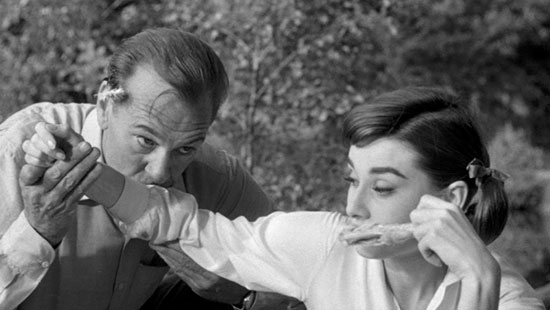
by Walter Chaw SPOILER WARNING IN EFFECT. It’s one of those seminal moments that movies provide the culture with now and again, like the swoop up a little rise to an impossibly fresh John Wayne in Stagecoach, or the intervention of a fortuitous steam vent in The Seven Year Itch, this introduction we have to Audrey Hepburn as she’s whirled around in a barber chair in William Wyler’s Roman Holiday to reveal the pixie-cut heard ’round the world. That she’s adorable is a given–the real issue is whether she’s an actress or just a bundle of inexplicable charisma, a ganglion of celluloid starlight that evaporates under the slightest critical scrutiny. I love Roman Holiday, but I vacillate between indifference and actual dislike of the rest of Hepburn’s films. I don’t find her winsome in Breakfast at Tiffany’s, am irritated by her in Charade, think she’s appallingly twee in Love in the Afternoon. She doesn’t hold her own against Sean Connery in Robin and Marian and gets blown off the screen by Albert Finney, Alan Arkin, and Rex Harrison in Two for the Road, Wait Until Dark, and My Fair Lady, respectively. If you ask me, Audrey isn’t an actress so much as someone you would like to have known and maybe had the opportunity to cuddle, which makes her mega-stardom in the Fifties and Sixties all the more testament to her ineffable appeal. Happening right when Method was rendering personalities like Hepburn déclassé, she was making a career of being terminally anachronistic. It’s Ozzie’s Harriet, sashaying while Rome burns. Instant nostalgia; even when she was introduced for the first time, it must have seemed like ages ago.

Easy Rider (1969) [40th Anniversary] – Blu-ray Disc

Easy Rider (1969) [40th Anniversary] – Blu-ray Disc

****/**** Image A Sound A Extras A
starring Peter Fonda, Dennis Hopper, Jack Nicholson, Luke Askew
screenplay by Peter Fonda, Dennis Hopper, Terry Southern
directed by Dennis Hopper

FFC Must-Ownby Walter Chaw SPOILER WARNING IN EFFECT. It’s not easy to mark the beginning of the Sixties as an idea. Me, personally, as it’s the way I’m wired, I like to use as the starting gun the trilogy of dysfunctional pictures–Psycho, Eyes Without a Face, Peeping Tom–that literally inaugurate the decade, but I’d also accept that 1962’s Cuban Missile Crisis was enough for many of the nearly-disaffected to become completely what-the-fuck disaffected. And if you go with that, then what happens at the end of 1963 with the assassination of JFK is that Zapruder places film as the end-all of Truth. A lot changed with those 26.6 seconds of film–or, should we say, a lot changed back, to a period where the newsreel, no matter how doctored or fabricated, was the primary mass means of information-gathering before television began to encroach on it. A lot of ink’s been spilled about the extent to which movies in the mid-to-late-Fifties tried to outdo the boob-tube with grand Technicolor visions; comparatively little has been written about Zapruder’s 486 colour frames, which stole the thunder of television’s hold on vérité–remember, in 1960, Hitch wanted to shoot Psycho in a televisual style for its implicit realism–as elegantly as a shell fired from a mail-order Carcano. TV achieves a stalemate by broadcasting Vietnam during the dinner hour, yet it doesn’t win outright until the ’90s when it embraces shakycam and film unveils itself once and for all as a magician’s medium: smoke, mirrors, Forrest telling LBJ he needs to piss, and the Titanic going down again to the tune of a tween tearjerker.

Dispatch from the 2010 WWSFF: Midnight Mania – Creepy

Click here to visit the Worldwide Short Film Festival‘s official website.

by Bill Chambers Back in my early twenties, there was one summer job I had where I found myself doodling animals saying inexplicable–and, needless to say, often repulsive–things. It started out as an effort to break the ice with my only co-worker (we spent most of our time locked in a makeshift editing bay together), then escalated into a constant test of her boundaries. I happened across some of these drawings recently, and they are resolutely unfunny: a bunny threatening to kill your mother with an axe, a frog telling a fart joke; in retrospect, I wonder why said co-worker eventually invited me to her wedding. Stockholm Syndrome’s my best guess. Nevertheless, during the subterranean Looney Tune that is Everybody (animated; ds. Jessie Mott; 4 mins.; ½*/****), I began to feel grateful that there was no real public forum to display those cartoons back then, because all I’d really be doing is inviting some asshole on the Internet to dismiss it as adolescent shit. This is adolescent shit. Rendered in crude, impatient watercolours, various deer, bats, goats, etc. are anthropomorphized via cheaply cryptic remarks like “I’m too small in the necessary spaces,” and “You paralyze me with disgust. You’re spilling open like a gelatinous achin’ belly.” To which I reply, by way of Al Pacino in Heat, “Don’t waste my motherfuckin’ time!”

Kick-Ass (2010)

****/****
starring Aaron Johnson, Christopher Mintz-Plasse, Mark Strong, Nicolas Cage
screenplay by Jane Goldman & Matthew Vaughn, based on the comic book by Mark Millar & John Romita Jr.
directed by Matthew Vaughn

by Walter Chaw A wonderfully unlikely amalgam of Hong Kong-era John Woo and Shaolin Soccer/Kung Fu Hustleera Stephen Chow, Matthew Vaughn’s ebullient, often-unconscionable Kick-Ass reimagines Woo’s iconic Tequila as an 11-year-old girl with a purple bob, an incredible potty mouth (she uses the “C” word correctly in a sentence, cunts), and absolutely no remorse in crushing a defenseless douchebag in a car cuber. Hit Girl (Chloë Grace Moretz) is destined to be an icon, a more popular tattoo-parlour fave than Calvin in evoking the cheerful, insouciant lawlessness of misdirected youth. Far from truly groundbreaking, though, sober minds could only identify her as a continuation of that quintessentially American, Huck Finn tradition of children as collective, societal Id and trickster gods. She’s even employed in the picture as a punitive, apolitical, unapologetic champion of order who limits her victims to drug dealers and gangsters, those disturbers of civilization. As her father (Nicolas Cage) clarifies in response to her unconventional upbringing, it’s not his blame to shoulder, but arch-baddie Frank D’Amico’s.

Night Moves (1975) – DVD

****/**** Image B Sound B Extras D
starring Gene Hackman, Jennifer Warren, Edward Binns, Susan Clark
screenplay by Alan Sharp
directed by Arthur Penn

by Walter Chaw On the strength of his scripts for The Hired Hand, Ulzana’s Raid, and Night Moves, Scottish novelist Alan Sharp seems well at home with the better-known, more highly-regarded writers and directors of the New American Cinema. Sharp’s screenplays are marked by a narrative complexity and situations gravid with implication and doom.1 Take the moment in the Arthur Penn-helmed Night Moves where broken-down P.I. Harry Moseby (Gene Hackman, reuniting with Penn for the first time since Bonnie and Clyde), after discovering a body in a sunken wreck off the coast of Florida, watches as his two sleazeball hosts (John Crawford and Jennifer Warren)–who’ve previously exchanged an odd nod and a knowing glance in which something is silently decided about how to handle this new, inquisitive element dropped in their midst–break into a broken tango to a tune on the radio. Harry salutes them in a way that suggests he understands what the hell is going on and shuffles off to bed. It’s one of the most harrowing moments in a harrowing decade of film, and nothing much happens in it except for the look Hackman gives as a damned soul caught on the horns of an unknowable mystery. The seduction scene that immediately ensues reminds in cadence and pace of the dream sequence from Hackman’s earlier The Conversation: “Where were you when Kennedy died?” “Which Kennedy?” “I dunno, any Kennedy.” Hackman is anchored to this period because he so ably portrays the everyman who desires enlightenment against the pervasive belief that there’s no longer hope for anything like enlightenment in this post-Vietnam/post-Watergate dystopia–that the solution to everything that’s wrong in this world is, “Forget it, Jake. It’s Chinatown.” The slow, looping circles the boat “Point of View” describes at the end of the picture constitute perhaps the most trenchant metaphor for all of the New American Cinema.

Where the Wild Things Are (2009) – Blu-ray Disc

Where the Wild Things Are (2009) – Blu-ray Disc

****/**** Image A Sound A+ Extras B-
starring Max Records, Catherine Keener, Lauren Ambrose, Mark Ruffalo
screenplay by Spike Jonze & Dave Eggers, based on the book by Maurice Sendak
directed by Spike Jonze

FFC Must-Ownby Walter Chaw Spike Jonze’s Where the Wild Things Are is the product of an artist who may only be able to assimilate art and the creation of it through the filter of celluloid and the music that animates its flickers. More, there’s the suggestion in its depth of emotion that this may be the only way Jonze knows to communicate at all, and so he tasks it to capture the breadth of human experience. If the “film brats” of the New American Cinema were the first reared on a diet of the French New Wave and critical theory, this new post-modernism to which Jonze belongs consists of artists reared on the entire panoply of popular culture…and maybe nothing else. What other explanation is there for the elasticity and strangeness of films by people like Jonze and Charlie Kaufman, David Lynch, Wes Anderson, and Quentin Tarantino? They create works that strive towards the ineffable, seemingly unaware of film’s limitations and therefore undaunted by ideas of what’s possible.

Toy Story (1995) [Special Edition] + Toy Story 2 (1999) [Special Edition] – Blu-ray + DVD

Toy Story (1995) [Special Edition] + Toy Story 2 (1999) [Special Edition] – Blu-ray + DVD

TOY STORY
**½/**** Image A- Sound A+ Extras A

screenplay by Joss Whedon, Andrew Stanton, Joel Cohen and Alec Sokolow
directed by John Lasseter

FFC Must-OwnTOY STORY 2
****/**** Image A Sound A+ Extras A-

screenplay by Andrew Stanton, Rita Hsiao, Doug Chamberlin & Chris Webb
directed by John Lasseter

by Walter Chaw What time and memory seem to obscure about Pixar’s Toy Story is that it is, for the most part, shrill and unpleasant, though it’s easier to identify now that Pixar’s technical facility is familiar. The picture’s thick with bad behaviour, with everybody’s favourite vintage cowboy doll Woody (voiced by Tom Hanks) acting the spoiled, wounded, ultimately dangerous brat, jilted by his owner for a newer model, Buzz Lightyear (Tim Allen), and determined to murder his rival until some moral compass asserts itself and Woody, grudgingly, comes to Jesus with his inevitable obsolescence. Toy Story plays a weird game with the idea of mortality in that its heroes are toys and, as such, doomed to a kind of infernal immortal half-life during which they can be tortured any number of ways–de-limbed, decapitated and reconstituted, melted, waterboarded we presume–in the name of a child’s development. A memorable moment places our frenemies in a “bad” kid’s bedroom where all the toys have been mutilated (our tiny Dr. Frankenstein provides the tension of the film’s third act)–the message of the encounter retreating into that old kid’s-flick saw that you can’t judge a book by its cover.

TCM Greatest Classic Films Collection: Western Adventures – DVD + Jeremiah Johnson (1972) – Blu-ray Disc

THE WILD BUNCH (1969)
****/**** Image A- Sound A- Extras A+
starring William Holden, Ernest Borgnine, Robert Ryan, Warren Oates
screenplay by Walon Green and Sam Peckinpah
directed by Sam Peckinpah

McCABE & MRS. MILLER (1971)
****/**** Image C+ Sound B- Extras B+
starring Warren Beatty, Julie Christie, Rene Auberjonois, William Devane
screenplay by Robert Altman and Brian McKay, based on the novel McCabe by Edmund Naughton
directed by Robert Altman

THE TRAIN ROBBERS (1973)
1/2*/**** Image B- Sound C Extras F
starring John Wayne, Ann-Margret, Rod Taylor, Ricardo Montalban
written and directed by Burt Kennedy

JEREMIAH JOHNSON
*/****
DVD – Image D+ Sound C- Extras F
BD – Image B+ Sound A- Extras C+
starring Robert Redford, Will Geer, Allyn Ann McLerie, Delle Bolton
screenplay by John Milius and Edward Anhalt
directed by Sydney Pollack

by Walter Chaw From John Ford to Akira Kurosawa to Sergio Leone then back to the United States with Sam Peckinpah’s The Wild Bunch, trace the odd, international lineage of the American western genre as the seeds of its completion are sown by Ford, only to be harvested a few decades down the line with a singular bloodbath south of the proverbial border. You could say that the western was already nearing its completion in the postwar films noir set in the sunshine and bluffs of the Old West: homegrown oaters by Anthony Mann and Fritz Lang; William Wellman’s Yellow Sky and Robert Wise’s Blood on the Moon; Budd Boetticher’s subversive Ranowns; Arthur Penn’s glass darkly Billy the Kid pic The Left Handed Gun; Brando’s filthy One-Eyed Jacks; and even Ford himself with terminal pieces like The Man Who Shot Liberty Valance and The Searchers. But it’s through Kurosawa’s admiration and transfiguration of Ford’s themes–then Sergio Leone’s incandescent prism of dirt and blood that transfigured Kurosawa’s (and Ford’s) ideas about heroics and individualism into something poetically base–from which Peckinpah1 took his cues.

The Gary Cooper Collection: Along Came Jones; Man of the West; The Pride of the Yankees; The Westerner – DVD

ALONG CAME JONES (1945)
**½/**** Image B+ Sound C+

starring Gary Cooper, Loretta Young, William Demarest, Dan Duryea
screenplay by Nunnally Johnson
directed by Stuart Heisler

MAN OF THE WEST (1958)
****/**** Image A- Sound B-

starring Gary Cooper, Julie London, Lee J. Cobb, Arthur O’Connell
screenplay by Reginald Rose
directed by Anthony Mann

THE PRIDE OF THE YANKEES (1942)
**/**** Image B Sound C+ Extras C

starring Gary Cooper, Teresa Wright, Walter Brennan, Dan Duryea
screenplay by Jo Swerling and Herman J. Mankiewicz
directed by Sam Wood

THE WESTERNER (1940)
**½/**** Image B Sound C+

starring Gary Cooper, Walter Brennan, Doris Davenport, Fred Stone
screenplay by Jo Swerling and Niven Busch
directed by William Wyler

by Jefferson Robbins I thought Gary Cooper was broader. The way he carried Hollywood on his shoulders from the silents through the talkies to the threshold of the New Wave, you’d expect him to be broader. Instead, he was the definition of lanky. Where his centre of gravity lay was in his Rushmore of a face: in close-up, he’s an impossible granite monument, like that ever-unfinished Crazy Horse memorial in South Dakota; in full shot, in his prime years, he’s a broomstick supporting a boulder.

The Young Victoria (2009) + Antichrist (2009)

THE YOUNG VICTORIA
**/****
starring Emily Blunt, Rupert Friend, Paul Bettany, Miranda Richardson
screenplay by Julian Fellowes
directed by Jean-Marc Vallée

ANTICHRIST
****/****
starring Willem Dafoe, Charlotte Gainsbourg
written and directed by Lars von Trier

by Walter Chaw SPOILER WARNING IN EFFECT. As the beginning of an emotional history for Queen Victoria, Jean-Marc Vallée’s The Young Victoria makes for an interesting bookend to John Madden’s Mrs. Brown. A lavish, romantic depiction of the monarch’s courtship with future husband Prince Albert (Rupert Friend), it’s the very definition of a quotidian costume drama, skirting over the major issues of the early years of Victoria’s reign to speak in broader terms about her idealism, the problems presented to her by her youth, and the manipulation of her affections by courtly politics. It’s something like the older sister to Sofia Coppola’s Marie Antoinette: less hip, but still in love with its naivety, its evergreen youth. It says something to me that in 2009, there’s a film about Queen Victoria that’s less interested in the stuffiness for which the Monarch is probably most popularly known than in her liberalism, her progressive attitude towards the humanism inspired by first the Colonies, then the French Revolution, then Britain’s own Reform Act, enacted just five years before her coronation. An early film churned up in the wake of the optimism engendered by an Obama presidency? It’s tempting to read it as such, not simply because you do hope this administration is better than the last, but also because, as the decade of the aughts draws a curtain on nine years of increasing outer and inner dark, there’s at least the faint hope for some cloudbusting in the cinema, too.

The Bad Lieutenant – Port of Call: New Orleans (2009); Planet 51 (2009); Me and Orson Welles (2009)

THE BAD LIEUTENANT – PORT OF CALL: NEW ORLEANS
****/****
starring Nicolas Cage, Eva Mendes, Val Kilmer, Alvin “Xzibit” Joiner
screenplay by William Finkelstein, based on the film by Abel Ferrara
directed by Werner Herzog

PLANET 51
*/****
screenplay by Joe Stillman
directed by Jorge Blanco, Javier Abad & Marcos Martinez

ME AND ORSON WELLES
**/****
starring Claire Danes, Zac Efron, Christian McKay, Zoë Kazan
screenplay by Holly Gent Palmo & Vincent Palmo, based on the book by Robert Kaplow
directed by Richard Linklater

by Ian Pugh Playing against his sadistic instincts, police sergeant Terrence McDonagh (Nicolas Cage) saves a man from drowning in a flooded prison during the aftermath of Hurricane Katrina, earning him not only a promotion to lieutenant but also a debilitating spinal injury. A subsequent addiction to prescription painkillers inevitably leads McDonagh to harder drugs and casual abuses of his newfound power as he attempts to solve the murder of a Senegalese drug dealer and his family. Trading Abel Ferrara’s sulphuric New York for a no-less-hellish Louisiana noir, Werner Herzog’s in-name-only remake of Bad Lieutenant is a work of delirious madness. That should come as no surprise from the man who’s spent the last forty years cataloguing human obsession, but I don’t think I’d ever really understood the method behind it until The Bad Lieutenant – Port of Call: New Orleans (hereafter Bad Lieutenant 2). Madness is about possibility, and what better complement to that philosophy than Nicolas Cage, an actor who–at his best, like Herzog–apparently regards the conventions and boundaries of his craft as simple suggestions that must be defied? A quick look at what they’re capable of accomplishing together and you’re a little surprised they haven’t teamed up before. As McDonagh, Cage projects the dangerous unpredictability of Kinski* and the sympathetic brutality of Bruno S.: you don’t fear him, exactly, but you’re afraid of what he might become; you don’t feel sorry for him, but you lament what he could have been. (“I’ll kill ‘im,” he says at one point, the frightening indifference in his voice leaving uncertain if–or how–he plans to act on that idle threat.) Halfway through the film, after the stakes in play are thoroughly established, Cage/McDonagh suddenly adopts a muted, cotton-mouthed accent. Why?

North by Northwest (1959) – DVD|North by Northwest (1959) [50th Anniversary Edition] – Blu-ray Disc

North by Northwest (1959) – DVD|North by Northwest (1959) [50th Anniversary Edition] – Blu-ray Disc

****/****
DVD – Image A Sound B Extras A
BD – Image A+ Sound B+ Extras A
starring Cary Grant, Eva Marie Saint, James Mason, Jessie Royce Landis
screenplay by Ernest Lehman
directed by Alfred Hitchcock

by Walter Chaw Roger Thornhill (Cary Grant) is Alfred Hitchcock’s most mercurial anti-hero, the soup bone reduction of the Master’s wrong-man theme. An advertising executive so at ease with changing his identity at the fall of a hammer, he has, by film’s end, become/done all of the things he’s wrongfully accused of being/doing at the beginning of the film. Indeed, Hitchcock would never again mine the idea of the wrong man with this kind of heat–veering off as he did into a more metaphysical kind of guilt transference à la Vertigo with The Birds, Psycho, and Marnie. As North by Northwest opens, Thornhill gives his regards to a night porter’s wife (“We’re not talkin’!”), steals a cab from a Good Samaritan, and instructs his secretary to send a neglected lover a box of gold-wrapped candy because “she’ll think she’s eating money.” He’s a charmer–and he’s as oily, despicable, and fast-talking as almost every one of Grant’s romantic comedy heroes. Hitch undermines and exploits Grant for the fourth and final time here as a guy we love until we stop for a second to catch our breath and take stock of the myriad ways in which we’ve been bribed, glad-handed, misled, and led-on.

H.P. Lovecraft’s From Beyond (1986) [Unrated Director’s Cut] + Blood and Black Lace (1964) [Unslashed Collectors’ Edition] – DVDs

H.P. Lovecraft’s From Beyond (1986) [Unrated Director’s Cut] + Blood and Black Lace (1964) [Unslashed Collectors’ Edition] – DVDs

From Beyond
**½/**** Image B Sound C+ Extras B
starring Jeffrey Combs, Barbara Crampton, Ken Foree, Ted Sorel
screenplay by Dennis Paoli
directed by Stuart Gordon

FFC Must-OwnSei donne per l’assassino
****/**** Image A- Sound B Extras A+
starring Cameron Mitchell, Eva Bartok, Thomas Reiner, Mary Arden
screenplay by Giuseppe Barilla, Marcel Fonda, Marcello Fondato and Mario Bava
directed by Mario Bava

by Walter Chaw Stuart Gordon’s follow-up to his flat-awesome Re-Animator reunites that film’s Jeffrey Combs and Barbara Crampton with source material by H.P. Lovecraft for From Beyond1, a nominal splatter classic that lacks the energy and cohesiveness of Re-Animator, even as it establishes Gordon as a director with a recognizable, distinctive vision. A picture that arrived concurrently with Clive Barker’s “The Hellbound Heart” (the source material for Hellraiser), it’s useful as a means by which Lovecraft’s and Barker’s fiction can be paired against one another as complementary halves of a symbolist, grue-soaked whole. With the latter’s cenobites, his most enduring contribution to popular culture2, consider that Barker’s vision of an alternate, infernal reality shimmering just beneath the surface of the mundane has its roots in Lovecraft’s Cthulhu Mythos–a dimension of Elder Gods lurking behind the doors of perception. Lovecraft and Barker give description to the indescribable, name to the nameless. They are in pursuit of the sublime, and their quest underscores the idea that any such chase is, at its heart, inevitably a spiritual one.