Species III (2004) [Unrated Edition] + Resident Evil: Apocalypse (2004) [Special Edition] – DVDs

SPECIES III
*/**** Image B Sound B Extras C
starring Robin Dunne, Robert Knepper, Amelia Cooke, J.P. Pitoc
screenplay by Ben Ripley
directed by Brad Turner

RESIDENT EVIL: APOCALYPSE
½*/**** Image A Sound A Extras B
starring Milla Jovovich, Sienna Guillory, Oded Fehr, Thomas Kretschmann
screenplay by Paul W.S. Anderson
directed by Alexander Witt

by Walter Chaw There used to be only two avenues for women in the modern, post-Black Christmas horror genre: they could be the bimbo at the end of the machete, or the virgin wielding one at the end of the movie. After rape/revenge stuff like I Spit on Your Grave and Ms. 45 (and, ultimately, Aliens), though, it became possible for women to be men from the first frame of their ordeals instead of incurring steady masculinization throughout the course of some torturous, highly structured pursuit. What made Roger Donaldson's Species (1995) so interesting is that it transformed the woman's biological urge into the sui generis of the premise: The bad guy in Species was a bad girl named Sil, and Sil wanted to mate really bad (and really badly). But just like her brothers in slasherdom (Jason Vorhees, Michael Myers, Freddy Krueger), that will-to-fuck is largely unrealized–enough so that most academic reads of this horror subgenre involve the acting out of priapic males unable to reach climax through a variety of phallic substitutes. This is acknowledged in The Texas Chainsaw Massacre 2 as Leatherface's titular dick runs out of gas between a girl's legs–and the would-be victim knowing the score strokes it anyway, soothing his bruised male ego.

The Office Special (2003) – DVD

Image A- Sound A Extras B+

by Travis Mackenzie Hoover I suppose the hot streak had to end sometime: "The Office" was so meticulously detailed, so vividly characterized, and so totally uncompromising in making you feel the agony of workaday life, that it can perhaps be forgiven for wanting to give back to the characters it had so spectacularly abused and humiliated. Thus we have "The Office Special", which is smart enough to know that the ride on the gravy train is over but can't bear to leave our heroes in limbo and thus forces a closure that violates everything the series stood for. It's still "The Office" and it's still worth watching, but its movement towards climactic release is incongruous after the two years of droning sameness that went on–hilariously–with no end in sight.

Eloise at Christmastime (2003) – DVD

***/**** Image B Sound B+ Extras B+
starring Julie Andrews, Sofia Vassilieva, Kenneth Welsh, Debra Monk
screenplay by Elizabeth Chandler, based on the book written by Kay Thompson & illustrated by Hilary Knight
directed by Kevin Lima

by Travis Mackenzie Hoover Last year around this time, I was expressing my surprise (and perhaps embarrassment) at having actually enjoyed Disney's first Eloise TV movie, Eloise at the Plaza. For once, the Mouse House had perpetrated something that was cleverly conceived, skilfully shot, and lacking in the mushy sentiment that oozes out of many a Disney enterprise. But the jaded cynic in me was wary of the sequel, Eloise at Christmastime, which, if only to salvage my integrity, I hoped would be a cheap quickie riding on the success of the original. No such luck: Eloise at Christmastime is every bit the effervescent piece of fluff that its predecessor is. Once again director Kevin Lima has sized up the limitations of the material and obscured them with a fleet-footed visual wit, creating one of the few Christmas specials you can watch without wincing.

Alexander (2004)

*/****
starring Colin Farrell, Angelina Jolie, Val Kilmer, Jared Leto
screenplay by Oliver Stone and Christopher Kyle and Laeta Kalogridis
directed by Oliver Stone

Alexanderby Walter Chaw SPOILER WARNING IN EFFECT. Oliver Stone's Alexander is packed tight to the girders with catchphrases like "By the sweet breath of Aphrodite" and "By Apollo's eye" and "By Dionysus yours is the very soul of Prometheus!" It's stuffed to the gills with sword-and-sandal histrionics and props that become kitsch artifacts the instant they're rolled out for display in this awards season's gaudiest rummage sale. If it's not going to set anybody's codpiece on fire, Alexander at least lays claim to being one of the funniest movies of the year. It would have worn the title Oliver! more comfortably, opening as it does with Virgil's "fortune favours the bold" and ending, after a ridiculously long time, with the not-stunning revelation that what Stone has done is imagine the travails of a fourth-century B.C. Macedonian king as his very own. Conspiracies abound, popularity in the court of public opinion fades, bottomless campaign budgets are squandered in faraway lands for mysterious personal reasons, Oedipus rears his travel-worn head, and gay subtext begins to feel a little homophobic because it's subtext. Rosario Dawson in all her animalized glory? No problem. Colin Farrell giving Jared Leto a little peck on the cheek? Not in this house, buddy.

D.A.R.Y.L. (1985) – DVD

½*/**** Image B Sound D
starring Mary Beth Hurt, Michael McKean, Kathryn Walker, Colleen Camp
screenplay by David Ambrose & Allan Scott and Jeffrey Ellis
directed by Simon Wincer

by Walter Chaw D.A.R.Y.L. is nigh unwatchable mid-Eighties fantasy dreck–toss this one on the scrap pile with Condorman and Krull. Its main character, a "Data Analyzing Robot Youth Lifeform" acronymistically nicknamed Daryl (Barret Oliver), is lost in an opening helicopter chase like the dog in John Carpenter's The Thing before the film proceeds to rip-off every other '80s sci-fi flick that preceded it (Starman, E.T., The Last Starfighter, War Games, Firefox, and on and on). Daryl is discovered by a kindly elderly couple (the requisite Superman steal), placed in the foster care of preternaturally sunny Mr. & Mrs. Richardson (Michael McKean and Mary Beth Hurt), and then goes on to be really good at Atari, baseball, and picking up bad habits from his chubby, sewer-mouthed little pal Turtle (Danny Corkill). Then the MIBs come a-knockin', natch.

Straw Dogs (1971) – DVD

****/**** Image B Sound B
starring Dustin Hoffman, Susan George, Peter Vaughan, T.P. McKenna
screenplay by David Zelag Goodman and Sam Peckinpah, based on the novel The Siege of Trencher's Farm by Gordon M. Williams
directed by Sam Peckinpah

by Walter Chaw Straw Dogs is about an evil man who has so divorced himself from animal logic that he's become monstrous. He's cruel to his wife, comparing her to a child when she's lonesome and an animal when she's amorous, and he blames her for his detachment from himself. She gets impatient during foreplay if he chooses to take a moment to set his alarm or remove his watch, ergo she must be a nymphomaniac of low breeding. At one point, she mischievously changes a "plus" sign on his chalkboard to a minus and he changes it back so that it looks like a crucifix: the instrument of his martyrdom, the faith of his castration–the ideology that seeks to isolate him from his bestial nature. Finally, when she wishes to run away, he loses his grip on carefully-nurtured civilization, slaps her across the face, and orders her upstairs to the bedroom in the same way that Victorian women were banished from the room upon outliving the delight provided by their servile domesticity. This monster moves to a small Cornish village, where he insists on the creature comforts of home, paid for by a grant to study mathematics, of all things. And in the village the monster ultimately finds himself amongst men of a truer nature.

Finding Neverland (2004)

**/****
starring Johnny Depp, Kate Winslet, Julie Christie, Radha Mitchell
screenplay by David Magee, based on the play "The Man Who Was Peter Pan" by Allan Knee
directed by Marc Forster

Findingneverlandby Walter Chaw Marc Forster's Finding Neverland is well-traveled territory: a historical melodrama that's been over-scored to the point of diabetes and overwritten to the point of retardation. The presumption isn't that we're unfamiliar with J.M. Barrie's play "Peter Pan", but that we're incapable of understanding that this adaptation of Alan Knee's play "The Man Who Was Peter Pan", now three degrees removed from history, lives and dies by its conveyance of the idea that the dagger of make-believe is mightier than the mundane sword of reality. How better, after all, to tell the tale of the man who created one of the darkest, most brilliantly subversive attacks on the status quo than to return him to the land of storytelling and mythmaking? Forster seems to get it–the film looks ravishing and the casting of sprightly, ethereal Johnny Depp as Barrie is a stroke of genius, but both actor and director are betrayed by a project that side-steps the disturbing issues at hand in its suggestion of this Barrie's suspected paedophilic tendencies and his inability to grow up. "Peter Pan" is the shadow; the tedious and evasive Finding Neverland is the candle. The J.M. Barrie estate is upset that the film isn't accurate. They should be upset that it isn't very good.

I’ll Sleep When I’m Dead (2004) – DVD

***½/**** Image A Sound B
starring Clive Owen, Charlotte Rampling, Jonathan Rhys Meyers, Malcolm McDowell
screenplay by Trevor Preston
directed by Mike Hodges

by Walter Chaw Mike Hodges has only made a handful of films in the last three decades, even disowning a couple of them along the way because they were taken from him and edited to accommodate someone else's vision. Hodges's first film is the legendary revenge flick Get Carter featuring a never-better Michael Caine, and his latest, I'll Sleep When I'm Dead, functions very much as a bookend to his directorial debut: it's the tale of a man of few words on a mission to avenge a wrong. Reuniting Hodges with Clive Owen, star of his modest hit Croupier, I'll Sleep When I'm Dead is beautifully-lensed by long-time DP Michael Garfath in a manner that, although the picture was shot in London, looks extraordinarily like an Edward Hopper painting. Hodges, beyond being a narrative stylist, has evolved into something of a visual stylist as well. In this way, he suggests a British Wim Wenders.

The Clearing (2004) + Before Sunset (2004) – DVDs

THE CLEARING
*½/**** Image B+ Sound B+ Extras B-
starring Robert Redford, Helen Mirren, Willem Dafoe, Alessandro Nivola
screenplay by Justin Haythe
directed by Pieter Jan Brugge

BEFORE SUNSET
***½/**** Image A Sound B+ Extras B-
starring Ethan Hawke, Julie Delpy
screenplay by Richard Linklater & Julie Delpy & Ethan Hawke
directed by Richard Linklater

by Walter Chaw Nothing much happens in Pieter Jan Brugge's The Clearing–so little happens, in fact, that it's difficult to pinpoint what all the to-do was about by film's end. Laid-off everyman schlub Arnold Mack kidnaps car rental magnate Wayne Hayes (Robert Redford) from the front gate of his palatial estate. He leads Hayes through the woods to meet up with his partners-in-crime, having a heart-to-heart concerning the dissatisfactions of modern living along the way. Hayes's wife Eileen (Helen Mirren) and grown children (Alessandro Nivola and glassy-eyed Melissa Sagemiller) gather with disaffected FBI agent Fuller (Matt Craven) to field ransom demands and likewise have heart-to-hearts about the dissatisfactions of modern living. Brugge plays with time in interesting ways: the events of the first day with Wayne and Arnold are intercut with the events of several weeks with the Hayes clan. But the picture's biggest trick is making ninety minutes seem like an eternity.

Alfie (2004)

*½/****
starring Jude Law, Marisa Tomei, Omar Epps, Nia Long
screenplay by Elaine Pope & Charles Shyer, based on the play and screenplay by Bill Naughton
directed by Charles Shyer

Alfie2004by Walter Chaw I haven’t liked any of the six films that Charles Shyer directed before his remake of Lewis Gilbert’s Alfie, so I guess there’s something to the auteur theory after all. Minus one fab performance from the suddenly omnipresent Jude Law, Shyer’s Alfie is a toothless affair–not surprising given modern cinema’s propensity for turning out lifeless twaddle, but somewhat dismaying given that the film’s source material is one of the most scabrous flicks in the annals of misogyny captured on celluloid. Contrasting the 1966 and 2004 versions of Alfie would be like an essay on how the movies have lost their edge over the course of the past four decades: we’ve moved from the medium cool of Sixties films, with their yearning to break free from the oppression of the Fifties, to the stagnant pond of the now, with its films too scared to offend the priggish States, filthy as they are with the descendants of pilgrims and Puritans. Come to think of it, a comparison between the two pictures also functions as an examination of the general difference between Europe and America–or an overview of religiosity in all its florid and degenerative influences on art.

Festival Express (2004) [2-Disc Set] – DVD

***/**** Image A- Sound A (DD)/A+ (DTS) Extras B
directed by Bob Smeaton

by Travis Mackenzie Hoover JULY 30, 2004. We are so inundated with directives to be entertained that we've lost track of those few entertainments that don't smack us hard in the face with their laboured irrelevance. Simple, innocent pleasures have been replaced by exercises in industrial power that make you feel guilty for looking anywhere beyond them or for anything milder than their artificial amplifications. Surrounded as I find myself by these faceless giants (i.e., virtually every studio film released this summer), I find I am thankful for anything that features some fine music, a few good stories, and a wistful memory of a more innocent time before the entertainment industry was totally corrupted–something like the rock documentary Festival Express. If the film boasts of no miracles, neither does it have any pretenses of miracle-making. It asserts the pleasures of pleasure-making instead of the crushing weight of its force.

Deathwatch (2002) – DVD

**½/**** Image B Sound A Extras C+
starring Jamie Bell, Ruaidhri Conroy, Laurence Fox, Torben Liebrecht
written and directed by Michael J. Bassett

by Travis Mackenzie Hoover SPOILER WARNING IN EFFECT. Reading the blurb on the keepcase for Deathwatch, I had to wonder: what kind of individual sets a horror film in World War I? The connection isn't obvious until you see the movie, whereupon you realize that this most pointless of military adventures provides an ideal location for the nihilism and futility that defines the genre. The conflict here serves as proof of the original sin that will result in the retributive deaths of the cast (whether they actually deserve it or not); simply put, it's a slasher movie, but with Kaiser Wilhelm instead of sex. The association is so suggestive that Deathwatch threatens to say things about the Great War that I've never really seen on film before–but alas, it doesn't fully grasp the potential of the link, forcing us instead to contend with fairly standard combat intrigue and officer-bashing as we wait for another flash of intelligence. Still, it's a cut above most straight-to-disc fare (it opened theatrically in the UK), and at its best it has a dank resonance setting it apart from the war and horror movie rabbles.

Head in the Clouds (2004); Bright Young Things (2003); Vera Drake (2004)

HEAD IN THE CLOUDS
*/****
starring Charlize Theron, Penélope Cruz, Stuart Townsend, Thomas Kretschmann
written and directed by John Duigan

BRIGHT YOUNG THINGS
**½/****
starring Emily Mortimer, Stephen Campbell Moore, James McAvoy, Michael Sheen
screenplay by Stephen Fry, based on the novel by Evelyn Waugh
directed by Stephen Fry

VERA DRAKE
***½/****
starring Imelda Staunton, Richard Graham, Eddie Marsan, Anna Keaveney
written and directed by Mike Leigh
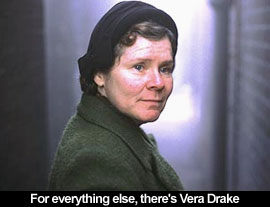
Headyoungveraby Walter Chaw There's a certain fascination embedded in our images of wartime England. When a film comes birthing across the pond this time of year, dripping with prestige and a whiff of stuffiness, what can it be but awards fodder laden with lovely sets, sepia-stained cinematography, handsome wool and silk costumes, and largely European casts that remind of how venal American mainstream casts tend to be by comparison? Something about the Blitz still intoxicates–perhaps England's steadfast refusal to surrender their island sanctuary to the barbarians at the gate tickles at our national self-delusion, trading on the belief, once ironclad, that our borders were as sacrosanct, or that our intentions in establishing a New World Order were ever that noble. Now, without the comfort of our own inviolate island sanctuary (what was Manhattan pre-9/11 than that–and what was it after but the biggest metaphor for the irony of capitalist arrogance since The Titanic?), there's just that much more reason for moth-balled middlebrow arthouse audiences to snuffle up great pinches of mid-twentieth century British pluck and remember from the cloistered perspective of a cloth chair a when that never existed–at least never for them.

DIFF ’04: Being Julia

*½/****starring Annette Bening, Catherine Charlton, Jeremy Irons, Michael Gambonscreenplay by Ronald Harwood, based on the novel Theatre by W. Somerset Maughamdirected by István Szabó by Walter Chaw Shrill and unlikeable, Being Julia is reasonably assessed as an at least thematically faithful adaptation of W. Somerset Maugham's soulless novel Theatre, just as it's fair to compare it to the acclaimed Mephisto, director István Szabó's other condemnation of the stage. But that doesn't mean it's any good. Annette Bening plays Julia Lambert, a grand dame of London's West End accurately labelled a cold, evil bitch by her emotionally-unavailable actor husband, Michael (Jeremy…

Candyman (1992) [Special Edition] – DVD

***½/**** Image B+ Sound B+ Extras A-
starring Virginia Madsen, Tony Todd, Xander Berkeley, Kasi Lemmons
screenplay by Bernard Rose, based on “The Forbidden” by Clive Barker
directed by Bernard Rose

by Walter Chaw Clive Barker’s fiction drips of sex, reeks of it. Squint and you can see sex rising off of it like steam from a fresh-slain carcass. His best work, stuff like the short stories “In the Hills, the Cities” and “Human Remains,” or his audacious retelling of the Christian myth Imajica, are engorged with sensuality–alight with perversity and all manner of fetishistic penetrations. When translated into film, however, Barker’s work (including that which the author has shepherded to celluloid himself) takes on a certain seediness that undermines the essential elegance of the writing. Something about Barker’s prose makes the rawest obscenity seem privileged–the pleasure/pain principle of his cenobites in print, for example, is made the grail, whereas on the silver screen, it dips dangerously towards kitsch and cult camp. Barker in writing batters defenses and leaves you prostrate before it; Barker projected feels formal, overdone, even ridiculous. The burden of fantasy for the reader is on the reader, but for the moviegoer, it’s on the filmmaker.

DIFF ’04: Stage Beauty

**/****starring Billy Crudup, Claire Danes, Tom Wilkinson, Rupert Everettscreenplay by Jeffrey Hatcher, based on his play "Compleat Female Stage Beauty"directed by Richard Eyre by Walter Chaw A Samuel Pepys quotation opens Stage Beauty, something about how in the seventeenth century, Ned Kynaston was the most beautiful woman on a stage that forbade women from strutting and fretting their hours. Playing Desdemona in a mannered production of "Othello", Kynaston (Billy Crudup) is king of the roost, oblivious to the crush of his ahistorical assistant, Mrs. Margaret "Maria" Hughes (a sort of well-cast Claire Danes), the first lady of the theatre, who…

The Motorcycle Diaries (2004)

***/****
starring Gael García Bernal, Rodrigo De la Serna, Mía Maestro, Mercedes Morán
screenplay by Jose Rivera, based on the books Notas de viaje by Ernesto Guevara and Con el Che por America Latina by Alberto Granado
directed by Walter Salles

by Walter Chaw Adapting respective memoirs by then-young Cuban-by-way-of-Argentine revolutionary Ché Guevara (Gael García Bernal) and his best friend Alberto Granado (Rodrigo De la Serna) that documented their Kerouac-ian odyssey down the spine of South America to find the soul of their country, Walter Salles’s The Motorcycle Diaries is difficult at best. It’s a road movie and a good one, as far as it goes, but it lacks the fire of change of something like Easy Rider in its substitution of a picaresque travelogue lightly spiced with delightful romantic misunderstandings for Peter Fonda’s swiftly tilting planet and deserts of the real. Easy Rider talks about the dying of the light; The Motorcycle Diaries talks about how doe-eyed Ernesto Guevara became Ché, the Hoffa of Latin America and eventually the most reproduced and mass-marketed image since Marilyn Monroe’s.

Wimbledon (2004)

*½/****
starring Kirsten Dunst, Paul Bettany, Kyle Hyde, Robert Lindsay
screenplay by Adam Brooks and Jennifer Flackett & Mark Levin
directed by Richard Loncraine

by Walter Chaw If you go see Wimbledon, the umpteenth edition of Tired Romantic Comedy Theater, it's only because you have a checklist in your head and aren't content with a film that doesn't satisfy every contrivance. There's the meet-cute, the unlikely match, the handsome rival, the gay best friend, the falling-in-love montage, the plot conflict (spouse, parents), the break-up montage, the public apology, the triumphant reunion. Director Richard Loncraine's tepid foray into Richard Curtis territory is rife with the kind of familiar hallmarks that lull throngs of lonesome Mia Farrows to the warm embrace of The Purple Rose of Cairo–a brief respite from the used paperback bookstores that rely on a steady trade of romance novels the way that independent movie stores rely on porn. In fact, there's not that much of a difference between Wimbledon and porn: plot is predictable and secondary to the performers, who provide whatever interest there might be in the enterprise. Everything else is plug and play, so to speak.

The Mangler (1995) – DVD

*/**** Image A Sound B Extras C-
starring Robert Englund, Ted Levine, Daniel Matmor
screenplay by Tobe Hooper, Stephen Brooks and Peter Welbeck
directed by Tobe Hooper

by Walter Chaw I think there's probably profit in taking the tactic that Tobe Hooper's The Mangler is his shot at the lurid comic book genre and, more specifically, the weird self-abnegating prosthetics opera of Warren Beatty's Dick Tracy. But I'm not the guy to do it. Sufficed to say that Robert Englund appears in fright latex, affecting equal parts Dr. Strangelove and Lionel Barrymore's Mr. Potter as Mr. Gartley, the decrepit, despotic owner of an old industrial steam laundry that features as its centerpiece the massive, four-story long Hadley Watson Model-6 Steam Ironer & Folder, which sits in the middle of his brick sweatshop belching steam like the boiler in The Overlook Hotel.

TIFF ’04: I ♥ Huckabees

i ♥ huckabeesI Heart Huckabees**/****starring Dustin Hoffman, Isabelle Huppert, Jude Law, Jason Schwartzmanscreenplay by David O. Russell & Jeff Baenadirected by David O. Russell by Bill Chambers David O. Russell's debut feature Spanking the Monkey now bears the mark of Kane. (Citizen, that is.) A funny, caustic mood-piece that heralded the Second Coming of Hal Ashby, it was also an impossible thing to live up to--or down, for that matter, Spanking the Monkey's mother-son incest plot in some ways a modern correlative to Citizen Kane's taboo-shattering demystification of William Randolph Hearst. Russell's work since (Flirting with Disaster, Three Kings) has…