TIFF ’03: Bon Voyage

*½/****starring Isabelle Adjani, Gérard Depardieu, Virginie Ledoyen, Yvan Attalwritten and directed by Jean-Paul Rappeneau by Bill Chambers "And I'll huff, and I'll puff, and I'll boorrre the hell out of you." Jean-Paul Rappeneau's Bon Voyage labours harder than any film in recent memory to entertain, but the result is so draining I don't remember grooving with it once. In the opening scene, the latest vehicle for champagne starlet Viviane Denverts (Isabelle Adjani, who at 48 should be too old to play an ingénue, but looks at least half her age--it's quite miraculous, really) leaves rapt the attendees of a French…

The Experiment (2001) – DVD

Das Experiment
**/**** Image B+ Sound B+
starring Moritz Bleibtreu, Christian Berkel, Oliver Stokowski, Wotan Wilke
screenplay by Don Bohlinger, Christoph Darnstädt, Mario Giordano, based on the novel by Black Box by Giordano
directed by Oliver Hirschbiegel

by Walter Chaw Midnight Express with pretensions, Oliver Hirschbiegel's The Experiment is based loosely on Zimbardo, Haney, Banks, and Jaffe's "Stanford Prison Experiment," conducted in 1971 to test the reactions of twenty-four ordinary college students–some cast as prison guards, others incarcerated in a mock prison–paid fifteen dollars a day for their participation in the study. Having to end the experiment after only six days because of pathological prisoner reactions and sadistic guard reactions, the "Stanford Prison Experiment" remains one of the more ethically shaky mindfucks in Stanford's proud tradition of such things (my favourite of them being the one where experimenters tested men's "performance anxiety" while urinating in public restrooms)–a topic dramatic enough to merit a cinematic treatment, without question, but a treatment served poorly by the formula embellishments favoured by The Experiment.

TIFF ’03: Elephant

***½/****starring Alex Frost, Eric Deulen, John Robinson, Elias McConnellwritten and directed by Gus Van Sant by Bill Chambers Though it ultimately garnered Gus Van Sant the Best Director prize (in addition to the Palme d'or), Elephant's lukewarm reception among ink-slingers at last May's Cannes Film Festival confirms the dulled senses of the critical establishment--that a contemporary masterwork can practically blind with its colour scheme and still go unrecognized as such by cinema's ambassadors is more terrifying than anything in Van Sant's searing interpretation of the Columbine atrocity. The first film intended for theatrical exhibition to be screened in Academy ratio…

Burnt Offerings (1976) – DVD

**/**** Image C+ Sound D+ Extras C
starring Karen Black, Oliver Reed, Burgess Meredith, Eileen Heckart
screenplay by William F. Nolan and Dan Curtis, based on the novel by Robert Marasco
directed by Dan Curtis

by Walter Chaw Plodding, ugly, moribund, Burnt Offerings is bolstered by a few great campy turns from a game cast that includes Oliver Reed, Karen Black, and Bette Davis in a performance that runs counter to the self-loathing roles of her Baby Jane/Sweet Charlotte days. Finding its way to the DVD format just a couple of weeks before another haunted house flick (Cold Creek Manor) debuts on the big screen, veteran television director Dan Curtis's horror quickie is one of those comfortable relics that doesn't scare so much as mildly chill, offering countless opportunities to shout at the screen without any sort of discernible payoff–until the end, that is, but even that shocker of a conclusion has been telegraphed since at least the midway point of the first act, muffling its surprise.

Confidence (2003) – DVD

***½/**** Image A Sound A Extras A
starring Edward Burns, Rachel Weisz, Andy Garcia, Dustin Hoffman
screenplay by Doug Jung
directed by James Foley

by Walter Chaw The urban surfaces of Americana are lent the sheen of Edward Hopper's neon isolationism by cinematographer Juan Ruiz Anchía in the appropriately named Confidence, which finds director James Foley back on noir ground, where his footing is firmest. It's the same effect generated by Foley/Anchía's Glengarry Glen Ross, here in Confidence used to mellifluous affect rather than staccato at the service of a caper flick if not the equal to Jules Dassin's seminal contributions to the genre, at least several times better than the slickified nonsense (The Score, the Ocean's Eleven remake) and sinkholes of talky illogic (Heist) of recent fare. A successful heist film as rare as a film that uses Edward Burns correctly in a sentence, Confidence is proof positive–if proof were needed–that James Foley, when he's at the top of his game, is at the top of the game.

Out for a Kill (2003) – DVD

*/**** Image A- Sound A-
starring Steven Seagal, Michelle Goh, Corey Johnson, Kata Dobó
screenplay by Dennis Dimster
directed by Michael Oblowitz

by Bill Chambers The other day, my friend and I were at the CNE, Toronto's annual expo of overpriced amusements, when we got a hankering for the raw sewage peddled inside its flea-market-sized food court. Where we wound up eating was at Kentucky Style Chicken, one of the many transient take-outs named for maximum copyright infringement and serving a synthetic mock-up of the already-inedible. Out for a Kill exists in the same spirit: Steven Seagal's first direct-to-video production in weeks, its designation combines the titles of his early pictures Hard to Kill and Out for Justice while mixing and matching nearly every trend, past and present, of the martial arts genre, on whose outskirts Seagal has toiled throughout his film career. Here, imitation isn't the sincerest form of flattery, it's a cloaking device–"Doesn't this remind you of something?" vs. "Boy, does this stink." You know something? Sometimes I get a hankering for movies I know I'll regret, too.

Four Faces West (1948) + Blood on the Sun (1945) – DVDs

FOUR FACES WEST
*/**** Image B Sound B+
starring Joel McCrea, Frances Dee, Charles Bickford, Joseph Calleia
screenplay by C. Graham Baker, Teddi Sherman; adaptation: William Brent and Milarde Brent, based on the novel by Eugene Manlove Rhodes
directed by Alfred E. Green

BLOOD ON THE SUN
**½/**** Image F Sound B+
starring James Cagney, Sylvia Sidney, Porter Hall, John Emery
screenplay by Lester Cole, with additional scenes by Nathaniel Curtis
directed by Frank Lloyd

by Travis Mackenzie Hoover Auteurism giveth, auteurism taketh away. It’s generally assumed that if we gravitate to the director with the greatest skill and the most obvious “personal” style, we will be doing ourselves a big cultural favour and putting ourselves on the side of the angels. And indeed, we generally strive for the power and aesthetic purity of those “originals,” as they give us the most pleasure. But if we declare–regardless of whether that personality has anything to say or says anything halfway coherent–that the only criterion of value in a film is a director’s personality, we will be shutting ourselves off from the other thing that artists do, which is interpreting the world for us. And sometimes lesser filmmakers take on subjects that great artists ignore–creating, if not brilliant analyses, something to stand for or against.

The Medallion (2003)

½*/****
starring Jackie Chan, Lee Evans, Claire Forlani, Julian Sands
screenplay by Bey Logan, Gordon Chan, Alfred Cheung, Bennett Joshua Davlin, Paul Wheeler
directed by Gordon Chan

Medallionby Walter Chaw I think it's fair at this point to say that I'm no longer so much a Jackie Chan fan as I really like a few Jackie Chan movies. His career has taken a rather conspicuous downturn since he reintroduced himself to Hollywood almost a decade ago, just after his last great film Drunken Master 2, scraping and bowing and remixing a few of his Hong Kong hits with English-dubs (and why is it that Asian films are the only ones consistently re-voiced for North American release?) and consenting to play ethnic Kato caricature to a string of Yank comedians for inexperienced directors and that screaming idiot Brett Ratner.

Dirty Pretty Things (2003); Shanghai Ghetto (2003); Camp (2003)

DIRTY PRETTY THINGS
***/****
starring Audrey Tautou, Sergi López, Chiwetel Ejiofor, Sophie Okonedo
screenplay by Steve Knight
directed by Stephen Frears

SHANGHAI GHETTO
**/****
directed by Dana Janklowicz-Mann & Amir Mann

CAMP
*½/****
starring Daniel Letterle, Joanna Chilcoat, Robin de Jesus, Steven Cutts
written and directed by Todd Graff

by Walter Chaw Stephen Frears, like antipodean director Phillip Noyce before him, found the Hollywood waters to be a touch turgid and so in 2000 went back to the small country where he first rose to prominence. For Frears, who made his first resonant mark with a fantastic quartet of films–My Beautiful Laundrette, Walter and June, Prick Up Your Ears, and Sammy and Rosie Get Laid–in the mid-’80s, the return to his homeland presaged a return to his interest in England’s bottom caste and immigrant class, first with the grim, slight Liam and now with the trancelike, nightmarish Dirty Pretty Things. Its title both a reference to smarmy hotel manager Juan’s (Sergi López) philosophy of hotel management (“Our guests are strangers–they leave dirty things, we make them pretty things”) and the idea that the “pretty things” might be the film’s pretty heroes, Nigerian refugee Okwe (Chiwetel Ejiofor) and Turkish illegal Senay (Audrey Tautou), dirtied by the realities of blue-collar London. The struggle between the pragmatism of Juan’s outlook and the idea of sullied purity of Okwe and Senay is really all you need know about the picture–it’s a piece composed of equal parts social realism and fairytale martyrdom, with either part watered down by the other.

The Hunted (2003) [Widescreen] – DVD + William Friedkin: Films of Aberration, Obsession and Reality – Books

THE HUNTED
***/**** Image A Sound A Extras B
starring Tommy Lee Jones, Benicio Del Toro, Connie Nielsen, Jenna Boyd
screenplay by David Griffiths & Peter Griffiths and Art Monterastelli
directed by William Friedkin

WILLIAM FRIEDKIN: FILMS OF ABERRATION, OBSESSION AND REALITY
FFC rating: 9/10

written by Thomas D. Clagett

by Walter Chaw Hot on the heels of Bruce Willis’s bwana wish-fulfillment fantasy Tears of the Sun comes William Friedkin’s The Hunted, a film that introduces its titular fugitive in a flashback to Kosovo at the height of the Albanian genocide. The parsing of historical atrocity functioning as shorthand for backstory to what is essentially a pretentious action movie is distasteful, the insertion into that history of elite American soldiers righting wrongs un-righted to this day a kind of unspeakable arrogance late unique of Yankee cloth. That being said, The Hunted is a cheerfully ridiculous movie that manages over the course of its running time to entertain with a series of action set-pieces that recall Friedkin’s work in The French Connection. Though riddled with plot impossibilities and stunning coincidences, the picture, courtesy, perhaps, of Caleb Deschanel’s magnificent cinematography, reminds of the nearness of nature and violence of John Boorman’s Deliverance; of the kineticism of Doug Liman’s The Bourne Identity; and of the premise and execution of a little-read Rex Miller novel called S.L.O.B.. If it also reminds of the creaky Abraham/Oedipus by way of Robert Bly wilderness dynamic of Mamet’s appalling The Edge, so be it: the fun parts outweigh the infuriating ones.

Identity (2003) [Special Edition] – DVD

***/**** Image A Sound A Extras B
starring John Cusack, Ray Liotta, Amanda Peet, Alfred Molina
screenplay by Michael Cooney
directed by James Mangold

by Walter Chaw Although by the end it isn’t nearly as interesting as it is clever, James Mangold’s take on the slasher genre Identity is a tricky little beast that fits in peculiarly well with the recent trend of deconstructive horror films (such as The Ring and Soft for Digging). Its use of Hughes Mearns’s haunting “Antigonish” (1899, “I was going up the stair/I met a man who wasn’t there!/He wasn’t there again today!/I wish, I wish he’d stay away!”) reminds of Dario Argento’s nursery dirge in Deep Red, while the film’s telescoping storytelling style evokes, of all things, the caper genre. With its title suggesting a certain high-mindedness, when a character glances for a swollen moment at Sartre’s Being and Nothingness, it tells too much of what the film will be about: the philosopher’s existential definition of consciousness projected onto reality and the dangers of mauvaise foi (bad faith), the process by which people, within themselves, elude responsibility for what they do. Still, the film is such a professional exercise on every level that its obviousness–better, its literalness–can be forgiven.

Mondays in the Sun (2002); Freaky Friday (2003); The Eye (2002)

Los Lunes al sol
**/****
starring Javier Bardem, Luis Tosar, José Ángel Egido, Nieve de Medina
screenplay by Fernando León de Aranda, Ignacio del Moral
directed by Fernando León de Aranda

FREAKY FRIDAY
**/****
starring Jamie Lee Curtis, Lindsay Lohan, Harold Gould, Mark Harmon
screenplay by Heather Hach and Leslie Dixon, based on the novel by Mary Rodgers
directed by Mark S. Waters

Jian gui
*½/****
starring Angelica Lee, Lawrence Chou, Chutcha Rujinanon, Yut Lai So
screenplay by Jo Jo Yuet-chun Hui, Oxide Pang & Danny Pang
directed by Oxide Pang & Danny Pang
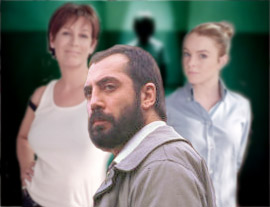
Mondaysfreakyeyeby Walter Chaw Fernando León de Aranda's Mondays in the Sun is probably best described as a Spanish version of Fred Schepisi's Last Orders: a journal of a depressed nation's aging gentry, ferrying one of their own on to the great symbolic hereafter. It aspires to the sort of myth of Vittorio Di Sica's neo-realism, portraying the plight of the dispossessed working class in its unadorned splendour, succeeding by the end only to be a repetitive tattoo around the threadbare theme of men defined by work and destroyed by obsolescence. A castration melodrama in several anecdotal horizontal movements, Mondays in the Sun loses steam and tests patience by making its one point to exhaustion. A scene where the great Javier Bardem rails at the fable of the grasshopper and the ants ("This is bunk! It has no sympathy for someone who is born a grasshopper instead of an ant!") says almost all there is to say about the film, while a lingering close-up of Bardem's battered mug in all its injured brute eloquence is, by itself again, enough.

Final Destination 2 (2003) [infinifilm] – DVD

**/**** Image A- Sound A- Extras B+
starring Ali Larter, A.J. Cook, Michael Landes, Terrence ‘T.C.’ Carson
screenplay by J. Mackye Gruber & Eric Bress
directed by David Richard Ellis 

by Walter Chaw Earning some marks for a gratuitous tit shot and a few graphic kills, the mystical gorefest Final Destination 2 is an unusually mordant excuse to knock off a few good-looking caricatures. Philosophically speaking, it develops its mythology with a series of rules so Byzantine that rather than spend a surplus of time trying to unravel what’s going on, it’s best just to settle comfortably into the realization that the ones we’ve marked for death are, in fact, marked by Death in the film. The most interesting thing about the picture, in fact, is that it is self-reflexive for genre fans, who’ve made it something of a matter of course to pick out the heroine and the meat bags from the rest of the cattle. In our way, we become the avatars of the Grim Reaper, laying our bony fingers on each inevitable victim in turn. The audience, in a very direct way, becomes that invisible cold wind that announces the arrival of doom–Final Destination 2 is almost interactive.

May (2003) – DVD

***/**** Image A- Sound A Extras B-
starring Angela Bettis, Jeremy Sisto, Anna Faris, James Duval
written and directed by Lucky McKee

by Walter Chaw Lucky McKee takes a look at the end of the world and it comes half-blinded before a student version of Claire Denis’s Trouble Every Day and a poster-shrine to Dario Argento’s Opera. The apocalypse in May is the end of cinema, a self-consuming contemplation of itself as the product of genre, and so its touchstones are films that consider the horror of unnatural progeny, inappropriate consumption, and, of course, the literariness of “Frankenstein”‘s exhumation and reconstitution tropes. When May (Angela Bettis) pleads at the picture’s conclusion to be seen, more than the plaintive cry of a child molded by fear into something strange, it’s an understanding that the life of cinema is like the span of any beast: naivety into optimism into cynicism into contemplation into, finally, a breed of facile irony fed by the mordancy of existence at its extremity.

Blood, Guts, Bullets & Octane (1998) – DVD

Blood, Guts, Bullets and Octane
*/**** Image B+ Sound A-
starring Joe Carnahan, Dan Leis, Ken Rudolph, Dan Harlan
written and directed by Joe Carnahan

by Travis Mackenzie Hoover It’s not the band I hate, it’s their fans. The celebrated (if overrated) efforts of both David Mamet and Quentin Tarantino spawned a lot of half-baked imitators in their heyday in the ’90s, people who didn’t understand the masters’ cruel ironies or obsessive cinephilia, respectively, but sure thought that it was cool wear a suit while pointing a gun and saying “fuck.” Few of them, however, made films as dire and unpleasant as Joe Carnahan’s Blood, Guts, Bullets & Octane (hereafter Octane), which takes the male territorial-pissing formula of scores of Mamet-tino flicks and pushes it to an astonishingly crude extreme. There’s no wit to the dialogue, no style to the imagery and no grace in the performances–just eff this and eff that and oh-God-I’m-shot. If you needed a reason for the Nineties to end, here it is; the passing of this kind of cinema is ample incentive to enter the new century.

Miranda (2002) – DVD

**/**** Image B Sound A- Extras D+
starring Christina Ricci, John Simm, Kyle MacLachlan, John Hurt
screenplay by Rob Young
directed by Marc Munden

Mirandadvdcapby Travis Mackenzie Hoover There was a time (from the late-'70s to the late-'80s) when the UK cranked out tart, intelligent films that put their American counterparts to shame. People like Stephen Frears, Hanif Kureshi, Alan Clarke, Mike Leigh, Terence Davies, Neil Jordan, Derek Jarman, and Sally Potter could be counted on to raise hell in the name of motion pictures; whatever their relative merits, they were interested in cinema and not career opportunities, and their commitment to a reality outside of their aesthetics gave them soul and punch. (Even when they made a thriller, like John Mackenzie's The Long Good Friday, it was an anti-Thatcher thriller.) Then the '90s happened, and what was called "the multiplex generation" sprang up: suddenly we were doomed to the likes of Danny Boyle and Guy Ritchie, who made films with flashy visuals that failed to obscure their essential vacuity. And so it is with Marc Munden's Miranda, a well-shot, smartly-designed film with an empty space where its brain should be, leaving us with something that looks good, goes down easy, and is instantly forgotten.

Cowboy Bebop: The Movie (2001) [Special Edition] – DVD

***/**** Image A Sound A Extras C
screenplay by Keiko Nobumoto
directed by Shinichiro Watanabe

by Walter Chaw Yôko Kanno’s soundtrack for Cowboy Bebop: The Movie (hereafter Cowboy Bebop) is a jubilant a blend of funk, jazz, blues, soul, and punk that soars even though it’s a pale shadow of the “bebop” innovated by Charlie Parker, Dizzy Gillespie, Thelonious Monk, and Bud Powell (and Kenny Clarke and Max Roach) in Minton’s Playhouse in the early 1940s. It functions as something of a brilliantly mellifluous backbone to the film and the series that spawned it–chimeric and socially significant, again like Bird’s bebop, in that the 26-episode Japanese television series became one of the most recognized and revered crossovers in animated series history. The bebop idea of riffing on a melody to the extent that the melody becomes unrecognizable (with an attendant introduction of dozens of beats to the standard four-beat bar) carries through in the frenetic kineticism of series that also, by its format, mirrors jazz bebop’s compact agility (generally carried by quartet and quintet arrangements)–making a feature-length film, then, a strange place for the “Cowboy Bebop” franchise to go.

The Hard Word (2002)

*½/****
starring Guy Pearce, Rachel Griffiths, Robert Taylor, Joel Edgerton
written and directed by Scott Rogers

Hardwordby Walter Chaw You’d think that POME (“Prisoners of Mother England”) would be better at making a crime drama, but Scott Roberts’s hyphenate debut The Hard Word is a flaccid ripper of Kubrick’s The Killing thick in avuncular vernacular and notably thin of any real meat. Between a few funny throwaways (a character refers to Philip K. Dick’s A Scanner Darkly, Dick’s autobiographical survey of paranoia and drug psychosis, as a primer for modern marriage), and some decidedly David Lynch-ian violence, the picture feels a lot like a mish-mash of post-mod noir ideas (the butcher, the redeemed femme, cannibalism) arranged with little respect for rhyme and reason. Style over substance, the whole thing is delivered in accents so under-looped and thick that it occasionally falls out as a cast of Brad Pitt’s Snatch pikeys performing Tarantino outtakes.

Phone Booth (2003) – DVD

**½/**** Image B+ Sound A Commentary A
starring Colin Farrell, Kiefer Sutherland, Forest Whitaker, Radha Mitchell
screenplay by Larry Cohen
directed by Joel Schumacher

by Walter Chaw Responsible for some of my favourite weirdo low-tech cult films (Q, God Told Me To, It’s Alive!), underground auteur Larry Cohen’s output is a lollapalooza of high-concept hokum invested equally in the Catholic and the apocalyptic. Joining forces with master hack Joel Schumacher (who’s made a mean schlock classic or two himself–Flatliners, The Lost Boys, The Incredible Shrinking Woman) on the unfortunately-timed sniper fantasy Phone Booth, Cohen’s script reveals the man up to his old tricks: a barely feature-length product (about seventy-five minutes without credits) set inside a confessional-cum-8th Avenue phone booth that mires an anti-hero in an old-school oasis amidst our sterile technological wasteland. What should have been an agreeable bit of nonsense, however, gets tangled up in Cohen’s desire to proselytize, transforming the potential for a paranoid piece of B-sociology into something empty and pretentious–a tale directed by an idiot, full of some admittedly innovative sound design and a surplus of Method fury.

Hollywood Homicide (2003)

**/****
starring Harrison Ford, Josh Hartnett, Keith David, Lena Olin
screenplay by Robert Souza & Ron Shelton
directed by Ron Shelton

by Walter Chaw The kind of movie where a cop who calls himself “Smokey” is referring to Smokey Robinson (more to the point, the kind of movie where Smokey Robinson makes a cameo), Ron Shelton’s Hollywood Homicide is a diary of decline made by aging filmmakers and aimed at an aging audience. Shelton returns to the old guy/young guy/slut dynamic of Bull Durham while Harrison Ford turns in what is possibly the first “old guy” performance of his career–one that pings poignantly off his patented “weary bemusement” shtick before a finale (a comedy of humiliation) that functions as the only part of the film that really works. Sandwiched between the standard buddy/too-convenient-crime caper formula set-up and that deliriously good conclusion is a laboured exercise in forced bonhomie and a mysterious existential melancholy that feels a great deal like a tired exhalation. Hollywood Homicide is an extraordinarily average film that has something of a distinct, dark intimation nudging at its corners. A shame the Ron Shelton of today is not the Ron Shelton of Cobb.