The New York Ripper (1982) – Blu-ray Disc

The New York Ripper (1982) – Blu-ray Disc

**/**** Image A Sound A- Extras B-
starring Jack Hedley, Almanta Keller, Howard Ross, Paolo Malco
screenplay by Gianfranco Clerici, Vincenzo Mannino, Lucio Fulci, Dardano Sacchetti
directed by Lucio Fulci

by Bryant Frazer The box art for this Lucio Fulci sleazefest describes it as “The Most Controversial Horror Film Ever Made,” which is a stretch. “Notorious” would be a better word. The New York Ripper‘s main claim to fame is its reputation as a sadistic, gory, and generally misogynist giallo–the Italian term referring to a combination of the crime and horror genres (basically a whodunit with slasher elements) that became popular in the 1960s and endured through the 1970s. Released in 1982 and styled after the psychologically ambitious thrillers of Hitchcock, it bears roughly the same relationship to the gialli film cycle that, say, Touch of Evil does to film noir. If the Fulci film isn’t exactly as self-aware as the Welles one, it still functions as a capper, a fitting culmination of a particular form.

Cirque du Freak: The Vampire’s Assistant (2009)

**/****
starring John C. Reilly, Ken Watanabe, Josh Hutcherson, Salma Hayek
screenplay by Paul Weitz and Brian Helgeland, based on the “Cirque du Freak” series of books by Darren Shan
directed by Paul Weitz

by Ian Pugh Maybe it’s a cop-out to dismiss Cirque du Freak: The Vampire’s Assistant (hereafter The Vampire’s Assistant) with that banal X-meets-Y idiom (“Twilight collides with The Golden Compass!”), but what other choice does one have? Three weeks before little brother Chris continues the Twilight saga, Paul Weitz gets the ball rolling on another vampire property based on another popular series of novels for young adults–and getting the ball rolling is more or less all he does. It’s a handy parallel to Chris’s own The Golden Compass in the sense that you’re expected to immerse yourself in a fantasy world where no one does anything of particular note and nothing is accomplished. People are bitten, people are transformed, and the fulfilment of legends is foretold–but when the credits roll, can you say you’ve actually seen anything? In its own laborious foundation-laying, Harry Potter and the Sorcerer’s Stone still managed a dreaded brush with Voldemort; what does The Vampire’s Assistant have to offer? Willem Dafoe and Ken Watanabe under pounds of latex–made up to look like Vincent Price and Incredible Hulk nemesis The Leader, respectively–standing around, making bold pronouncements with the implied message that they’ll have more to do if the powers-that-be greenlight the next instalment.

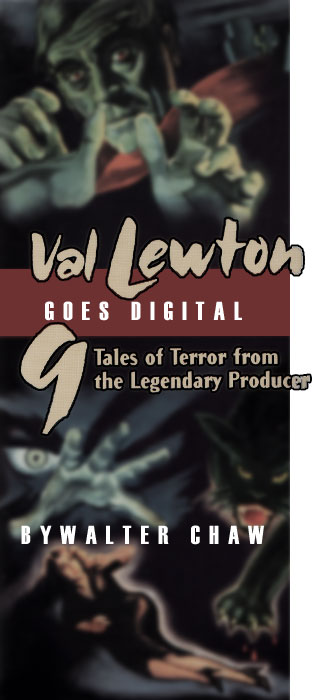
The Val Lewton Horror Collection – DVD

VlewtontitleCAT PEOPLE (1943)
****/**** Image B Sound C+
starring Simone Simon, Kent Smith, Tom Conway, Jane Randolph
screenplay by DeWitt Bodeen
directed by Jacques Tourneur

THE CURSE OF THE CAT PEOPLE (1944)
****/**** Image B+ Sound B
starring Simone Simon, Kent Smith, Tom Conway, Jane Randolph, Ann Carter
screenplay by DeWitt Bodeen
directed by Gunther V. Fritsch and Robert Wise

I WALKED WITH A ZOMBIE (1943)
****/**** Image C Sound B-
starring James Ellison, Frances Dee, Tom Conway
screenplay by Curt Siodmak and Ardel Wray
directed by Jacques Tourneur

THE LEOPARD MAN (1943)
***½/**** Image C- Sound B-
starring Dennis O’Keefe, Margo, Jean Brooks, Isabel Jewell
screenplay by Ardel Wray, based on the novel Black Alibi by Cornell Woolrich
directed by Jacques Tourneur

THE SEVENTH VICTIM (1943)
****/**** Image C+ Sound C
starring Tom Conway, Jean Brooks, Isabel Jewell, Kim Hunter
screenplay by Charles O’Neal and DeWitt Bodeen
directed by Mark Robson

THE GHOST SHIP (1943)
***½/**** Image A- Sound B
starring Richard Dix, Russell Wade, Edith Barrett, Ben Bard
screenplay by Donald Henderson Clarke
directed by Mark Robson

THE BODY SNATCHER (1945)
***½/**** Image C- Sound C+
starring Boris Karloff, Bela Lugosi, Henry Daniell, Edith Atwater
screenplay by Phillip MacDonald and Carlos Keith
directed by Robert Wise

ISLE OF THE DEAD (1945)
*/**** Image B- Sound B-
starring Boris Karloff, Ellen Drew, Marc Cramer
screenplay by Ardel Wray & Josef Mischel
directed by Mark Robson

BEDLAM (1946)
*½/**** Image B- Sound B-
starring Boris Karloff, Anna Lee, Billy House, Richard Fraser
screenplay by Carlos Keith and Mark Robson
directed by Mark Robson

VAL LEWTON: THE MAN IN THE SHADOWS (2007)
**½/**** Image N/A Sound N/A
directed by Mark Robson

by Walter Chaw SPOILER WARNINGS IN EFFECT. It’s not too much to speak of Val Lewton as the American Jean Cocteau. An enigmatic figure with his hand, like Cocteau, in more than one media (a novelist, he often did uncredited work on the screenplays for his films), the movies produced under his RKO watch are a repository of dream sleep, enough so that an overview of his key pictures–something made possible by Warner’s rapturous DVD collection of his horror fare–uncovers a treasure trove of indelible nightmare images. Where Cocteau affected a studiedly casual mien and came to film in his sixties, however, Lewton (who died at 47) seems the product of financial expediency and, perhaps more impressively, stamped the products of his hand despite roadblocks placed in his way. Yet the similarities are striking: Above and beyond the dreamscapes affected, there’s a common fascination with masks and false identities; an obsession with budding sexuality turned subtly aberrant; and a cycle of seduction tied to corruption in the move from innocence to experience. I see in these recurrent themes a man fascinated by the blinds that men throw before them to deny the unknowable tides governing their emotions and actions. It’s that illusion of civilization that informs Lewton’s pictures; the horror of them is in the ripping away to expose the insect underneath.

Law Abiding Citizen (2009)

*½/****
starring Gerard Butler, Jamie Foxx, Bruce McGill, Colm Meaney
screenplay by Kurt Wimmer
directed by F. Gary Gray

by Ian Pugh SPOILER WARNING IN EFFECT. The most that can be said for Law Abiding Citizen is that it understands the dichotomy of Gerard Butler, the Scottish beefcake whose schizoid career has him playing a screaming grunt one month and a kindly, rough-around-the-edges dad/love interest the next. After murdering a notable percentage of Philadelphia’s legal system, Butler’s black-ops such-and-such Clyde Shelton warns that, if he is not immediately released with all charges against him dropped, he will “KILL. EVERYONE.” Coming from a character who is initially introduced to us as Joe Average, that priceless bit of leaden melodrama almost single-handedly consigns Law Abiding Citizen to the “camp” drawer–but, improbably, it’s also an uncomfortable moment that perfectly captures Butler’s nebulous, malleable status as a movie star. The dumb joke/terrifying conjecture being that, with 300 still lingering in the air, you have no idea how far he’ll go in “killing everyone.” Is it a coincidence that the film should give Clyde comic-book disguises with which to evade capture and lure his prey? Of course not, because Butler belongs in a comic book. It’s not just his cold stare or his steel jaw, it’s the fact that, at the mercy of practically any working writer, he can represent anything or anyone, villain or hero, with preposterous ease. This time, he’s concocting bloody, convoluted vengeance against the men who destroyed his family and the system that doled out questionable justice–and in so doing, he becomes an amalgam of the Joker, the Riddler, and the Abominable Dr. Phibes.

2009 TIFF Bytes #3: A Gun to the Head; Genius Within: The Inner Life of Glenn Gould

Too long for Twitter, too brief for the capsule page, some quick takes on films screened at this year’s TIFF:
A Gun to the Head (d. Blaine Thurier)
Those who, like me, missed Male Fantasy, the sophomore feature of Blaine Thurier, may find themselves at a loss to distinguish between Thurier’s growth as a filmmaker and advancements in digital video since his directorial debut, the better-in-retrospect Low Self Esteem Girl. Thurier’s latest, the Vancouver-lensed A Gun to the Head, is comparatively polished, yet the film, with its focus again on suburban drug culture, feels dismayingly unevolved coming from someone who leads a prolific life that includes a steady gig as the keyboardist for the indie-rock supergroup The New Pornographers–even as it cops to a certain anxiety about abandoning comfortable milieux via Trevor (Tygh Runyan), a newlywed struggling with the demands of marriage in the face of his old freedoms. Basically a bush-league Mikey and Nicky, the picture has Trevor ferrying paranoid cousin Darren (Paul Anthony) all over town on a drug run just to avoid the dinner party his wife (Marnie Robinson, the spitting image of Jordana Spiro) is throwing back home; eventually the two run afoul of Darren’s suppliers, who have already shown themselves capable of murder. I will say that Thurier is good with actors–this cast really brings it, with the suddenly-vivacious Sarah Lind a particular standout. (Revealing hidden comic chops, she plays a nasal-voiced bimbo who only picked up the word for “um” on her trip to Japan.) Lead baddie Hrothgar Mathews unfortunately bears a sometimes-striking resemblance to Glenn Gould the same year a documentary about the famous pianist plays alongside A Gun to the Head at the TIFF. Which leads me to… (**/4, by the way.)

TIFF ’09: Mother

Madeo ***/**** directed by Bong Joon-ho by Bill Chambers Bong Joon-ho's deliciously serpentine Mother is the story of an aging mom (Kim Hye-ja, awesome) who has supported her mentally-challenged son, Yoon Do-joon (Bin Won), into adulthood; monitoring him from afar while chopping roots, she's so watchful that she doesn't notice herself cutting off her own finger. She even sleeps in the same bed with him, though Bong doesn't sink to Bad Boy Bubby depths of depravity. When Yoon Do-joon is scapegoated in the killing of a schoolgirl, Mother makes it her sole (soul? Seoul?) mission in life to prove his…

2009 TIFF Bytes #1.5: White Material

Too long for Twitter, too brief for the capsule page, some quick takes on films screened at this year's TIFF: White Material (d. Claire Denis) This is Claire Denis's very own Gone with the Wind, and she seems to denote it as epic by shooting it in 2.35:1 widescreen. Headstrong Maria (Isabelle Huppert) struggles to keep the Vial coffee plantation operating in the midst of an African civil war despite accumulating exit cues. Her entire workforce heeds the evacuation call she chooses to ignore. She finds a severed animal's head among the beans. Her son (Nicolas Duvauchelle) goes mad after…

Obsessed (2009) – Blu-ray Disc

*/**** Image A- Sound B+ Extras C
starring Idris Elba, Beyoncé Knowles, Ali Larter, Christine Lahti
screenplay by David Loughery
directed by Steve Shill

by Bryant Frazer When Hollywood types assimilate exploitation tropes and tactics, they start concocting films like Obsessed, in which Skinny White Bitch Ali Larter runs seriously afoul of Virtuous Black Woman Beyoncé Knowles by throwing herself at Good Husband Idris Elba. In fact, Obsessed is less a movie than it is a marketing plan, calculated to snare audiences entranced by its whiff of sex, celebrity, and dysfunctional race relations. Sure, those are movie-ready elements, but when they’re mixed up by filmmakers as staidly unimaginative as the audience they’re targeting, the recipe has a distinctly unsavoury flavour combination–gutless as well as tasteless.

Fatal Attraction (1987) + Indecent Proposal (1993) – Blu-ray Discs

Fatal Attraction (1987) + Indecent Proposal (1993) – Blu-ray Discs

FATAL ATTRACTION
**/**** Image B+ Sound B Extras A
starring Michael Douglas, Glenn Close, Anne Archer, Stuart Pankin
screenplay by James Dearden
directed by Adrian Lyne

INDECENT PROPOSAL
½/**** Image C+ Sound B Commentary C-
starring Robert Redford, Demi Moore, Woody Harrelson, Oliver Platt
screenplay by Amy Holden Jones
directed by Adrian Lyne

by Walter Chaw Adrian Lyne films live and die by the success of their moments of poignant epiphany. It’s why 9½ Weeks and Jacob’s Ladder work and Flashdance and Indecent Proposal do not–why his obvious and constant pandering to cultural stereotypes and softcore eroticism identifies him as the premiere commercial director of his time (more so than even Ridley Scott, who sometimes tries not to be a ponce), trafficking in easy images and the kind of strained tableaux you’d expect to see in a first-year photography classes (explanation as well for why his films are almost invariably blockbusters): a pair of Converse sneakers on a lonesome, foldout kitchen table; seagulls on a fog-shrouded pier; long shots down cluttered, penthouse-suite corridors; rubbing off to a slideshow1; dogs and bunnies… Adrian Lyne flicks are about what happens when dicks slip into chicks, oops; it’s not possible to make fun of them, because how do you make fun of an artifact that has no intrinsic weight, tells no compelling tale, and imparts no particular insight?

9 (2009)

**/****
screenplay by Pamela Pettler
directed by Shane Acker

by Walter Chaw There’s something missing from Shane Acker’s 9, and I’m having a hard time putting my finger on it. I think it’s that for as much as I like my nihilism, there’s a flavour to this year’s variety of Apocalypse that suggests to me the only thing left to win is the Wasteland. There’s no moral stake in scrambling for scraps, just this Pyrrhic duty to compete, lust fast-cooling on the proverbial sheets, damp and rumpled as they are from a lot of impotent thrusting. So 9 exists in an Industrial Revolution Steamboy alternate universe, ended when an evil fascist dictator creates, with the help of a scientist (Alan Oppenheimer–weird, non?), a sentient machine capable of building other machines to do its bidding. Imagined as a weapon of peace, no surprise that it turns on Man and apparently kills all living creatures, blots out the sun, and spends its time hunting down little burlap rag dolls animated with the scientist’s–wait for it–soul. It’s the second Terminator film of the summer, in other words, as well as the second to mention the idea of horcruxes after Harry Potter 6. Accordingly, it’s a pretty empty, if visually startling, picture. Based on a celebrated, Oscar-nominated short, 9 hasn’t made the transition to feature-length with much of an emotional, or intellectual, payload to justify its extended runtime. The best comparison is to Ralph Bakshi’s Lord of the Rings, alas: the seed of something left fallow.

Adventureland (2009) + Alien Trespass (2009)|Adventureland (2009) – Blu-ray + Digital Copy

Adventureland (2009) + Alien Trespass (2009)|Adventureland (2009) – Blu-ray + Digital Copy

ADVENTURELAND
***½/**** Image A- Sound A- Extras B
starring Jake Eisenberg, Kristen Stewart, Martin Starr, Margarita Levieva
written and directed by Greg Mottola

ALIEN TRESPASS
***/****
starring Eric McCormack, Jenni Baird, Robert Patrick, Dan Lauria
screenplay by Steven P. Fisher
directed by R. W. Goodwin

by Ian Pugh In everyone’s life, there’s a summer of ’42, but of course it was never as wonderful as you remember. Although Greg Mottola’s Adventureland is set in 1987, that’s almost incidental–it really takes place in that hazy cloud known as “the past,” full of fly-by-night jobs rife with fraud and deceit, fairweather friends who sock you in the crotch, and, of course, the music that brings to mind painful experiences perhaps best left forgotten. (Funny to think that this might be the ideological inverse of another great 2009 film about memory, The Uninvited: unhealthily obsessive instead of unhealthily in denial.) The key to understanding the film, I think, lies in Falco‘s New Wave anthem “Rock Me Amadeus,” here serving as an inescapable nightmare at the titular amusement park, where it’s pumped through the sound system ad nauseam (“Can you give me an ice pick that I can just jam into my ears?”). But then the romantic confusion driving the plot unravels in a series of betrayals, and that same song becomes a damning elegy. Seems strange that the director of Superbad, an instant classic of maturity-through-childishness and nostalgia-without-precedent, should deliver something so angry and contradictory for a follow-up. Perhaps it is strange–but Adventureland is also a more honest, more personal, and, most importantly, more mature film than Superbad.

Duplicity (2009) – DVD

*½/**** Image B Sound A- Commentary B+
starring Clive Owen, Julia Roberts, Tom Wilkinson, Paul Giamatti
written and directed by Tony Gilroy

by Walter Chaw Tony Gilroy’s droll, deadly dull Duplicity is the kind of movie Cary Grant made in the Sixties: wheel the old dear out in a nice suit and have him recite reams of dialogue to some woman in various scenic locales. It’s not an elderly movie, it just seems that way. The “some woman” in this scenario is Julia Roberts (fresh from Maria Shriver’s face-sharpener), making her umpteenth triumphant return to the silver screen on the sloping, mopey, rumpled, shoulders of fading A-lister Clive Owen, who apparently can’t say “no” lately to would-be prestige pictures abandoned in the doldrums of the first part of the year.

District 9 (2009)

****/****
starring Sharlto Copley, Jason Cope, Nathalie Boltt, Sylvaine Strike
screenplay by Neill Blomkamp and Terri Tatchell
directed by Neill Blomkamp

by Walter Chaw An unlikely marriage of Alien Nation and David Cronenberg’s The Fly, Neill Blomkamp’s remarkable District 9 is that occasional genre picture that’s both topical and so good it made my stomach knot. Set in South Africa, it opens by rejecting the Eurocentrism of most science-fiction pictures. Here, the little green men don’t hover over the Lincoln Memorial or the Eiffel Tower, but rather Johannesburg, where the malnourished, crustacean-like denizens (they’re called, derogatorily, “prawns”) of a giant mothership are quickly relegated to a barbed-wire enclosed slum, the titular “District 9.” Its parallel to Alien Nation is obvious, down to that film’s equation of aliens with Chinese immigrants in San Francisco; these are the “bestial” blacks of Afrikaner nightmares: physically powerful, engaged in illicit activities, and blamed for every casualty outside their heavily-segregated “district.” But where Alien Nation identified the threat to that immigrant community as an insidious ghost of its traditional past (an opium allegory? How 18th-century), District 9 satirizes the numbing effect of cable news networks, as well as the dangers faced by any outcast culture trying to eke out subsistence existences on the fringes of majority society. In a very real way, District 9 is a film about not only the corrosive potential of grossly overfed public perception, but also the immigration debate that rages on worldwide.

Sleuth (2007) – Blu-ray Disc

*/**** Image B+ Sound A- Extras B
starring Michael Caine, Jude Law
screenplay by Harold Pinter, based on the play by Anthony Shaffer
directed by Kenneth Branagh

by Walter Chaw Call it an actor’s workshop, if you must, but it’s more like an actor’s mausoleum, and the Anthony Shaffer source material, as punched-up by Harold Pinter just prior to Pinter’s death in the classic unfilmable Pinter style, is hopelessly stagebound and déclassé. It’s old people playing at Patrick Marber, falling into the exact trap that most adaptations of Ian McEwan have fallen: mistaking the author fucking with us for great insights into the human condition. Sleuth, Kenneth Branagh’s reboot of Joseph L. Mankiewicz’s museum piece starring Laurence Olivier and a thirty-six-years-younger Michael Caine, brings Caine back in the Olivier role, with Jude Law once again taking over for Caine after the Alfie remake. It’s terrible stuff, stiff and laboured and crippled by self-importance, self-aggrandizing camera trickery, and foreground symbolism that fails from its Osterman Weekend surveillance paranoia all the way through to its willing suspension of disbelief in a pair of performances that never for a moment feel like anything but performances. Most disappointingly, there’s a conspicuous lack of fun in a picture that seems more interested in the antagonists’ psychology than in exploiting the possibilities of a piece surgically tuned to being a lark. Excavations of male psychology beyond the urge to gamesmanship have absolutely no place in Sleuth: you can talk about why guys lay their dicks on the bar, but you shouldn’t do it for an entire feature. Branagh’s strength as a director of Shakespeare is as an ambassador for the Bard’s latent themes of sociological aggression and animism, while his Dead Again proved that even without Shakespeare, his ear for the operatic could carry the day in an artfully campy supernatural melodrama. But in applying his anthropologist’s touch to Sleuth, he’s met his match: there’s nothing to unearth because the dig site is, frankly, sterile.

Dollhouse: Season One (2009) – DVD | Blu-ray Disc

DVD – Image N/A Sound N/A Extras N/A
BLU-RAY – Image A- Sound B Extras B
“Ghost,” “The Target,” “Stage Fright,” “Gray Hour,” True Believer,” “Man On the Street,” “Echoes,” Needs,” “A Spy In the House of Love,” “Haunted,” “Briar Rose,” “Omega”

“Epitaph One,” “Echo”

by Jefferson Robbins They’re committing a grand social experiment over there at FOX, using some of the most loyal genre lovers in fandom as their rhesus monkeys. The disease they seek to wipe out, it appears, is the intermediary of the critic. Take much-abused, much-adored TV creator Joss Whedon; kick dirt in the face of his latest brainchild, “Dollhouse”, when the poor thing is too weak to stand; and then, upon achieving maximum buzz by holding back longed-for portions of the resulting science-fiction series, release them through a hidden proxy and pretend it’s a leak. It’s pandering to geeks’ idea of the Internet as a wild frontier, where the dispossessed can build a community and you can’t stop the Signal, man. Meanwhile, for critics with a yen to stay independent of the studio’s manipulation, they send out watermarked, shit-quality burns minus the fourth disc in the “Dollhouse” home video release. That missing platter features basically all the supplements any reasonable person would expect with their purchase, as well as the original, scrapped pilot “Echo” and the unaired thirteenth episode, “Epitaph One.” So any critical analysis–like the one I’m about to perform–can be written off as sour grapes, spilt milk, the breast-beating of a self-appointed arbiter of good taste who’s just mad because he didn’t see it first.

CJ7 (2008) – Blu-ray Disc

CJ7 (2008) – Blu-ray Disc

**½/**** Image A Sound A- Extras C+
starring Stephen Chow, Xu Jiao, Huang Lei, Kitty Zhang
screenplay by Vincent Kok, Tsang Kan Cheong, Sandy Shaw Lai King, Fung Chih Chiang, Lam Fung

directed by Stephen Chow

by Bryant Frazer Lord knows we need inspired lunatics like Stephen Chow. Chow is a genial, graceful physical comic in the mode of Jackie Chan, yet even sillier, if you can imagine that. Like Chan, he makes movies that feel conspicuously alien in a Hollywood context, in large part because he’s expert in a discipline that Hollywood has lately devalued. In the U.S., the dominant style of comedy is verbally oriented, with quips, awkward characters, and contrived situations driving the gags. For Stephen Chow, comedy is largely body-oriented. It’s not that he doesn’t script situation comedy–a movie like God of Cookery, with its parody of celebrity-chef competitions (and John Woo movies!), is built on an elaborate sitcom frame–but that he’s more obsessed with performance. Chow is preoccupied with people’s faces, their body types, the way they approach one another, and how they stand in conversation or confrontation. By the time he did Shaolin Soccer and Kung Fu Hustle, it was easy to see how he found the newly-affordable field of digital VFX work to be an avenue for extending the reach of a physical gag, using digital doubles to subject characters to the kind of strain and abuse that wouldn’t fly with real actors.

Sunshine Cleaning (2009); The Last House on the Left (2009); Race to Witch Mountain (2009)|Race to Witch Mountain – Blu-ray + DVD + Digital Copy

Sunshine Cleaning (2009); The Last House on the Left (2009); Race to Witch Mountain (2009)|Race to Witch Mountain – Blu-ray + DVD + Digital Copy

SUNSHINE CLEANING
**½/****
starring Amy Adams, Emily Blunt, Alan Arkin, Jason Spevack
screenplay by Megan Holley
directed by Christine Jeffs

THE LAST HOUSE ON THE LEFT
**½/****
starring Garret Dillahunt, Sara Paxton, Monica Potter, Tony Goldwyn
screenplay by Adam Alleca and Carl Ellsworth, based on the motion picture written and directed by Wes Craven
directed by Dennis Iliadis

RACE TO WITCH MOUNTAIN
*½/**** Image A- Sound B+ Extras C
starring Dwayne Johnson, AnnaSophia Robb, Carla Gugino, Ciarán Hinds
screenplay by Matt Lopez and Mark Bomback, based on the book Escape to Witch Mountain by Alexander Key
directed by Andy Fickman

by Ian Pugh SPOILER WARNING IN EFFECT. Norah (Emily Blunt) is a sort of overripe Juno MacGuff: older but no wiser, quick-witted but shiftless. As she sticks her hand underneath a railroad track, pulling it out just before a train passes, the question is clear: why is she here, doing something so unbelievably stupid, when she should be out trying to get a life? Turns out this game of chicken reminds her of the day she and her sister Rose (Amy Adams) discovered that their mother committed suicide. Christine Jeffs’s Sunshine Cleaning feels like a response to a recent spate of smarmy little indie films in the sense that it bothers to explore the self-aware idiosyncrasies typically taken for granted, and it comes to the startling conclusion that perhaps these “personality quirks” aren’t the building blocks of individualism, but rather signposts for unresolved trauma and budding mental illness. (Given how contradictory this film is to the Little Miss Sunshine mentality (and Alan Arkin’s presence makes the comparison inevitable), can we assume that its title is a double entendre?) You may laugh when Rose’s son Oscar (Jason Spevack) is kicked out of school for licking his teacher’s leg, or when her father Joe (Arkin) hustles unsuspecting business owners with one get-rich-quick scheme after another, yet the lingering question is whether or not they’d engage in “funny” behaviour if not for their inherited anguish. “It’s tough raising a kid by yourself, huh?” Joe tells Rose after she asks him to babysit at an inconvenient time. “Try two.” The attempt to mine humour from these tragic aftermaths doesn’t make Sunshine Cleaning a morbid film, exactly–but it definitely makes for a haunted one.

Southland Tales (2007)

Southland Tales (2007)

½*/**** Image A Sound A Extras C-
starring Dwayne Johnson, Seann William Scott, Sarah Michelle Gellar, Justin Timberlake
written and directed by Richard Kelly

by Walter Chaw Call it professional vanity, or just vanity vanity, but I like to be the iconoclast. I want to be the one who understands the movie nobody else seems to understand–the lone champion of Unleashed as a sharp critique of popular East/West relationships, for instance. There are times, I think, it’s the only reason I go to films that are riding waves of negative buzz or frankly otherwise lacking much cause for confidence. Southland Tales, Richard Kelly’s follow-up to his cult classic Donnie Darko, had the bad buzz (from a legendarily jeered screening at Cannes) but a great pedigree despite the extent to which Kelly had begun to cast Donnie Darko as a fortuitous accident through his DVD commentary for that film, his ill-wrought Director’s Cut of the same, and his script for the excrescent Domino.

Valkyrie (2008) – DVD

***/**** Image N/A Sound B Extras A
starring Tom Cruise, Kenneth Branagh, Bill Nighy, Terence Stamp
screenplay by Christopher McQuarrie & Nathan Alexander
directed by Bryan Singer

by Walter Chaw Tight as a drum, deadly serious, and a mild corrective not to the enduring misconception that there were no men of conscience in Hitler’s Germany, but rather to sickly, condescending awards-season bullshit like Defiance, The Reader, and The Boy in the Striped Pyjamas, Bryan Singer’s Valkyrie swoops down like its titular winged avatar to deliver the Holocaust melodrama to a minor kind of Valhalla. It’s sober-minded and fact-based, with another handsome-destroying performance by Tom Cruise (though he only loses one eye here after losing both in Minority Report) that places him in uneasy orbit alongside Warren Beatty as another pretty boy aspiring for seriousness through mutilation of the self. It’s a sober thriller, and because the outcome is never in doubt in a historically-based plot to assassinate Hitler, it lives and dies by its ability to sound smart and cast well.

The Ruins (2008) – Blu-ray Disc

The Ruins (2008) – Blu-ray Disc

***/**** Image A Sound A+ Extras A
starring Jonathan Tucker, Jena Malone, Shawn Ashmore, Laura Ramsey
screenplay by Scott Smith, based on his novel
directed by Carter Smith

by Walter Chaw Based on a novel by the guy who wrote A Simple Plan and directed by first-timer Carter Smith, The Ruins was lost in the shuffle of a seeming barrage of beautiful-tourists-getting-slaughtered splatter flicks, which may prove to be one of the many genre legacies of the ugly-American, difference-abhorrent Bush Jr. administration. (Not to mention that the flick could easily be read as an eco-horror picture. Lots of legacies, that W., all of them fertile for the horror genre.) What distinguishes it from the Hostels and the Turistas‘ and Club Dreads is a seriousness in its execution and a feeling that there’s nothing happening in the film that is a result of stupidity or even caprice–that the gauntlet our gorgeous heroes go through is only the best example of the futility of our evolution since The Blair Witch Project. It’s a fable of that Sophoclean idea that knowledge brings no profit to the wise, and though it might be a reach, it feels in this time and place like a story about how knowing that we’re going to get blown up by an angry young man over a large body of water doesn’t do a thing to prevent it from occurring. It’s a film that talks about hopelessness and, like in a powerful moment from Marcus Nispel’s The Texas Chainsaw Massacre, the youth of its cast suddenly bespeaks a squeezing-off of potential rather than just tits-and-ass exploitation. Closer to the point, the titillation you feel during the prologue of our cast bathing on a Mexican beach before embarking on their bloody, intimate deaths is brutally punished. The destruction of beauty in The Ruins (the title finally makes sense) becomes allegory for a collective fear of suffering: just as porn works on some level as a fantasy of “if she’ll do that, she’ll do me,” The Ruins works on the level of, If it could happen to these kids, smart and beautiful, then it sure as shit is going to happen to me.