Hot Docs ’18: The End of Fear
***/****
directed by Barbara Visser
Hot Docs, the Canadian International Documentary Festival, runs April 26-May 6, 2018 at Toronto’s Bloor Cinema. Visit the fest’s official site for more details.
by Angelo Muredda Barnett Newman’s divisive abstract painting “Who’s Afraid of Red, Yellow and Blue III” becomes both a forensic site and a compelling structural absence in Dutch conceptual artist Barbara Visser’s debut feature The End of Fear. What might have been an annoyingly palatable art doc about Gerard Jan van Bladeren’s vandalism of the painting in 1986 (van Bladeren was so outraged by the work’s abrasive shock of red, dramatic asymmetry, and obstinate refusal of representationalism that he decided he had to slash it) and subsequent failed restoration becomes something more slippery and interesting care of Visser’s puckishness as not only a filmmaker but also a presence on screen, where we see her coolly hiring a hungry grad student to create a close reproduction of her own, apparently in the filmmaker’s name. Though the project suffers at times from the preciousness of its noncommittal form–spanning everything from the expected talking heads lecturing about the painting’s mixed critical reception and tabloid history to process-based interludes of Visser’s hired gun hard at work, to abstract top-down tableaux of unnamed, black-clad gallery workers mapping out the painting’s history on the jet-black floor with masking tape and archival photos–for the most part its free-roaming approach to questions of valuation, ownership, and work in contemporary art feels playful in the right way, opening up a number of avenues for discussion out of what feels like genuine curiosity.
Hot Docs ’18: McQueen
**½/****
directed by Ian Bonhôte and Peter Ettedgui
Hot Docs, the Canadian International Documentary Festival, runs April 26-May 6, 2018 at Toronto’s Bloor Cinema. Visit the fest’s official site for more details.
by Angelo Muredda Ian Bonhôte and Peter Ettedgui’s McQueen opens, as any look at Alexander McQueen, the queer, working-class, Stratford-raised ruffian turned couturier might well be expected to, with an aesthetic contradiction. The opening credit sequence, which unfolds as a series of smooth pans and tilts across extreme close-ups of baroque, CG-kissed headgear and flower-enmeshed skulls, soon gives way to ratty old videotape of the designer in his pre-Givenchy days, punning on “haute couture” and looking more like a hired hand than like one of the most influential designers of the late twentieth century. The contrast arguably makes for an easy rhetorical move and a reductive treatment of a mercurial man. But in McQueen’s case, the clichéd approach to the departed artist as a divided self–a schlubby guy who made impossible clothes for people who might never have been in his orbit in another life–feels appropriate and true, and marks a fair introduction to the equal attention the filmmakers pay to Lee, the unassuming and devoted family member, friend, learner, and tailor, and McQueen, the image-maker who channelled his own dark history and mental-health struggles into his creations.
Hot Docs ’18: 306 Hollywood
**/****
directed by Elan Bogarín & Jonathan Bogarín
Hot Docs, the Canadian International Documentary Festival, runs April 26-May 6, 2018 at Toronto’s Bloor Cinema. Visit the fest’s official site for more details.
by Angelo Muredda Grief becomes an occasion for pontificating about the nature of memory and archives in 306 Hollywood, Elan and Jonathan Bogarín’s surprisingly aloof portrait of their charming grandmother’s trash palace of a home in the months and years after her death. Following an academic talking head’s advice that “Physical evidence helps to preserve a memory”–and a less convincing authority’s insistence that a dead person’s soul lingers in their newly-vacated home for about eleven months after their death–the filmmakers take it upon themselves to turn their grandmother’s house inside-out, the better to immortalize her through the spectral traces they log on camera. The Bogaríns, who appear onscreen in both archival and present-day footage and who take turns narrating the more essayistic stretches of the film, insist upon framing their project as a work of archaeology, library science, and grief work at various points. Too often, though, the result feels like a pair of talented visual and film artists’ distant elevator pitch for a feature, a portfolio of their respective aesthetic inclinations and intellectual influences rather than a cohesive text with something pressing to say about loss and detritus.
Hot Docs ’18: We Could Be Heroes
**½/****
directed by Hind Bensari
Hot Docs, the Canadian International Documentary Festival, runs April 26-May 6, 2018 at Toronto’s Bloor Cinema. Visit the fest’s official site for more details.
by Bill Chambers Oy, that title. It thankfully proves somewhat ironic, although disability docs would be wise going forward to avoid sentimental trigger words like “heroes,” Bowie homage or not, if they don’t want to be stigmatized as inspiration porn. The problem with We Could Be Heroes is that it’s easier to peg what it isn’t than what it is. Director Hind Bensari follows Moroccan athlete Azzedine Nouiri as he trains for the 2016 Rio Paralympics. He’d already set a world-record for shot put at the 2012 games, but some extracurricular research tells me that Englishman Scott Jones bested him just a year later. Bensari prefers an elliptical, direct-cinema approach that forgoes these expositional niceties, which I think is a misstep when we see wheelchair user Nouiri ambulatory without any sort of elucidation. There are spectrums of disability that transcend the naked eye, but try telling that to the idiots who memed a woman in a wheelchair standing up to reach a bottle up high in a liquor store with jokes about her faking it. Nouiri is not faking it–classified as an F34 athlete (meaning he has “moderate to severe hypertonia in both legs”), he credits his disability, in a rare autobiographical aside, to keeping him off drugs in his junkie neighbourhood, though that begs the intervention of a filmmaker follow-up question, too. (“Why?”) Bensari respects her subjects’ reserve to the point of seeming incurious to a near perverse degree. As a conspicuously-disabled individual who’s subjected to 20 Questions pretty much every time he leaves the house, I wish more people were like her; as someone tasked with reviewing We Could Be Heroes, I wish she were less reverential. She has a habit of lingering long enough to normalize her subjects, which some may find suitably profound, but not a Frederick Wiseman length of time, which would allow the idiosyncratic details of the challenges they face to emerge organically.
Hot Docs ’18: Transformer
***/****
directed by Michael Del Monte
Hot Docs, the Canadian International Documentary Festival, runs April 26-May 6, 2018 at Toronto’s Bloor Cinema. Visit the fest’s official site for more details.
by Angelo Muredda Bodybuilder and ex-marine Janae Marie Kroczaleski’s negotiation of the gender-fraught world of weightlifting after coming out as trans is given a refreshingly straightforward, fly-on-the-wall treatment in Michael Del Monte’s Transformer. The story of a world-championship-winning power builder, affectionately nicknamed “Kroc,” taking some critical early steps in presenting herself socially and professionally as a woman after a long and successful career in two of the most masculinist professions possible reads on paper like the stuff of an exploitative human-interest story. But Del Monte resists the temptation to amp up the inherent drama of a perfectly well-adjusted and engaging person’s life, or to linger, as other woke cis appropriators of trans stories have done, on the metaphorical dimensions of his subject’s transformation by fixating on either her past or the moment of transition. Instead, he recruits Janae as a collaborator in her story in the present, allowing her frank voice and the particular issues she faces today–about whether to maintain or tweak her muscular frame through clothes and exercise regimes, for instance, or whether to undergo vocal-cord surgery–to steer him in more fruitful directions.
Hot Docs ’18: Golden Dawn Girls
***½/****
directed by Håvard Bustnes
Hot Docs, the Canadian International Documentary Festival, runs April 26-May 6, 2018 at Toronto’s Bloor Cinema. Visit the fest’s official site for more details.
by Bill Chambers The eponymous Golden Dawn girls are three women connected by marriage or blood to Greece’s relatively new but steadily growing Golden Dawn party. They’ve taken centre stage in the absence of the party’s male superintendents, who are all incarcerated. (As Norwegian director Håvard Bustnes says at the outset: More on that later.) The Golden Dawn party evolved from a far-right newspaper into a fascist movement, though its affiliates rabidly resist the Nazi stigma. Nazis, they say, were German–this is Greece. Nazis were National Socialists, Golden Dawn-ers are Social Nationalists. My favourite defense comes from Dafni, mother of jailed member Panagiotis Iliopoulos, who insists that her son couldn’t be a Nazi because he was born after WWII. In footage from a TV interview, Golden Dawn spokesman Ilias Kasidiaris claims complete ignorance of this “Hitler” fellow when questioned about his “Sieg Heil” tattoo–“hail victory” simply seemed like a good message to spread via his arm. Asked why he had it written in German instead of Greek, then, he says the German font was an aesthetic preference. They have an answer for everything–never a good one, but typically one so literal-minded it shuts down discourse. Bustnes valiantly tries, over and over, to get them to budge, to confront their reflection–the image they present to the world.
Hot Docs ’18: Won’t You Be My Neighbor?
**/****
directed by Morgan Neville
Hot Docs, the Canadian International Documentary Festival, runs April 26-May 6, 2018 at Toronto’s Bloor Cinema. Visit the fest’s official site for more details.
by Angelo Muredda It says a lot about the ideological thinness of the Resistance™ against the current American administration that the basic dignity of a lifelong conservative-values Republican gets elevated to the most rarefied heights in Morgan Neville’s Won’t You Be My Neighbor?. Though nominally a celebration of the life and storied career of children’s broadcaster Fred Rogers, anchored in present-day talking-head interviews with collaborators and friends that threaten at times to bludgeon the delicate and achingly sincere archival footage of Rogers’s show “Mr. Rogers’ Neighborhood”, Neville’s film has a bit more teeth as a manifesto for how children’s educational programming that resists the trends of busyness, noise, and violence can function as a form of public service, instilling values like neighbourly stewardship and mutual respect.
Film Freak Central Does the 2018 Ann Arbor Film Festival
by Alice Stoehr “I can’t imagine what you must think of me!” laughed Cecelia Condit. The audience had just seen her groundbreaking shorts Beneath the Skin (1981) and Possibly in Michigan (1983 (left)), plus a swath of her 21st-century work, and she seemed a bit sheepish about her own films’ morbid sense of humour. Between the murders, masks, and nursery rhymes, a streak of dark whimsy runs through them, orienting her as a woman in the world. Condit’s a garrulous storyteller in life as in her art and was forthright about the layers of autobiography in her work. Annie Lloyd (2008) shows her mother pressing leaves between pages at the end of her life. Within a Stone’s Throw (2012) has Condit herself hiking Irish hills in the aftermath of her mother’s death. Images of carrying and collecting recur across these films, a motif that suggests both affection and the assertion of control. These are rough-hewn fables that plumb the possibilities of video.
Telluride ’17: Loving Vincent
*/****
written by Dorota Kobiela, Hugh Welchman, Jacek Dehnel
directed by Dorota Kobiela, Hugh Welchman
by Walter Chaw I love stop-motion animation. William Blake referred to the “infernal method,” talking about etching plates with acid and how each print of his work would be touched by him, the artist, to better imbue it with life. Stop-motion animation to me is evidence that there’s something to the idea of a transference of vitality through human contact. It’s why I was curious about Dorota Kobiela and Hugh Welchman’s insane Loving Vincent, a feature-length film composed of over 65,000 hand-painted oil paintings, animating Van Gogh’s most famous paintings and making characters of his subjects. It’s a fascinating experiment, the product of one of those late-night bull sessions fuelled by cigarettes and whiskey where aspiring artist-types and freshman cosmology students get profound with one another. Consider Loving Vincent to be the cold reality of the morning after. Over 100 artists laboured over 10 years to essentially make a tedious rotoscope cartoon held together, barely, by an embarrassing screenplay dependent on loads of exposition and a repetitive flashback device. It’s an endurance test of rare sadism.
Telluride ’17: First Reformed
****/****
starring Ethan Hawke, Amanda Seyfried, Cedric Kyles, Victoria Hill
written and directed by Paul Schrader
by Walter Chaw The title character of Robert Bresson’s Diary of a Country Priest is consumed by his inconsequence. Determined to make a difference, he can’t even make an impression on the vile inhabitants of the little town that is his parish. It consumes him. It kills him. No one notices. There’s nothing to notice. Bresson doesn’t even bother to show it. The priest’s voiceovers become more urgent, though his faith never flags. He develops terrible stomach pains he seeks to soothe with an austere diet of bread soaked in wine: the Host, I guess, that nourishes communion with the holy spirit, but also the cancer in his gut that consumes him. His last words? “All is grace.” Paul Schrader, raised in the Dutch Calvinist Christian Reformed Church, which basically believes that Christians don’t earn their salvation but rather receive it as a gift they don’t deserve, has made it his life’s work to react against his faith–and to live it, too, when reaction fails. Towards the end of his new film, First Reformed, the priest, Toller (Ethan Hawke), writes on his church’s whiteboard “Will God Forgive Us?,” which is less Calvinist–God already has forgiven us–than a sign of a faith in severe crisis. Schrader’s riffed on Bresson’s film before with his script for Taxi Driver, still his best-known work despite a career littered with masterpieces of individual fears, men in isolation from God, and spiritual self-loathing. In Taxi Driver, the Priest is a sociopath driving through a Times Square hellscape, praying for the apocalypse to come as a purifying, obliterating rain. He tries to kill himself, but becomes a hero instead. First Reformed is either less cynical or more cynical than that. It’s complicated.
TIFF ’17: Man Hunt + Happy End
ManHunt
**/****
starring Zhang Hanyu, Masaharu Fukuyama, Qi Wei, Ha Jiwon
screenplay by Nip Wan Fung, Gordon Chan, James Yuen, Itaru Era, Ku Zoi Lam, Maria Wong, Sophia Yeh, based on the novel Kimiyo funnu no kawa wo watare by Juko Nishimura
directed by John Woo
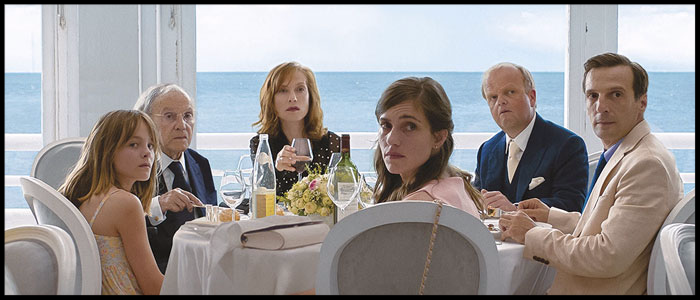
HAPPY END
**/****
starring Isabelle Huppert, Jean-Louis Trintignant, Mathieu Kassovitz, Toby Jones
written and directed by Michael Haneke
by Bill Chambers About five seconds into John Woo’s Man Hunt (no relation to that Fritz Lang movie with George Sanders in a cave), there’s a freeze-frame. Followed shortly by another. It’s glorious. Digital filmmaking has no doubt made it easier for Woo to be himself, as has being back in Asia: Hollywood never did warm to his Peckinpah flourishes, nor his melodramatic flair. But something is off in Man Hunt, which finds Woo returning, a touch desperately, to the Heroic Bloodshed genre in the form of a gloss on The Fugitive. (Officially, it’s a remake of a Ken Takakura vehicle variously known as Manhunt and Hot Pursuit.) Chinese Du Qiu (Zhang Hanyu) is a hotshot lawyer for a pharmaceutical company that frames him for the murder of an alleged lover (Tao Okamoto, bestowing her iconic look on a role that doesn’t thank her in return) to protect its secrets; Japanese Yamura (Masaharu Fukuyama) is the hotshot Inspector sent after Du when he escapes custody. Du repeatedly eludes Yamura’s clutches, but over the course of the chase they build a rapport that transcends lawful and cultural barriers and, à la Hard-Boiled, unite against a common enemy, corrupt CEO Yoshihiro Sakai (Jun Kunimura). I should mention the two female super-assassins hot on Du’s trail, since Woo’s daughter Angeles plays one of them. For better or worse, this is personal filmmaking.
TIFF ’17: Brad’s Status
**½/****
starring Ben Stiller, Austin Abrams, Jenna Fischer, Michael Sheen
written and directed by Mike White
by Angelo Muredda Nobody captures the insidiousness and pervasiveness of depressive thinking quite like Mike White, who returns to the middle-aged professional anxiety and panic-inducing Impostor Syndrome of “Enlightened” with Brad’s Status, a quiet, obstinately minor film that largely unfolds through the emotionally-stunted protagonist’s daydreaming voiceover critiques of his own minimal actions onscreen. Brad’s Status positions itself as a lower-middle-class American B-side to Éric Rohmer in its focus on one man’s interrogation of his own moral failings, a modest goal it mostly pulls off.
Telluride ’17: Lady Bird
**½/****
starring Saoirse Ronan, Laurie Metcalf, Tracy Letts, Lucas Hedges
written and directed by Greta Gerwig
by Walter Chaw Greta Gerwig’s solo hyphenate debut bears the influence of erstwhile collaborator Noah Baumbach’s urbane micro-comedies–Hal Hartley’s, too, along with some DNA borrowed from Ghost World and Welcome to the Dollhouse for spice. It’s a talky domestic drama featuring a precocious, strong-willed iconoclast who has named herself “Lady Bird” (Saoirse Ronan) and is, as a character, the best description of the film that houses her. She’s smart but not book-smart and, in the end, not smart enough to avoid having her heart broken by a couple of bad decisions on her way out of senior year in high school and the great grey beast Sacramento. She tells her first boyfriend, Danny (the already-great Lucas Hedges), that she’s from the “wrong side of the tracks,” which, when he lets it slip in front of Lady Bird’s mom Marion (Laurie Metcalf), obviously hurts Marion’s feelings a lot, but she bites her lip. When he does it, he’s there to pick up Lady Bird for Thanksgiving at his grandmother’s place. His grandmother lives in the nicest house on the other side of the tracks and, to feel better about her life, Lady Bird tells her shallow new “bestie” Jenna (Odeya Rush) that it’s Lady Bird’s own house. A miserabilist story about the horror of adolescence that is obviously helmed by a first-timer, Lady Bird is redeemed by a cast so sterling that I actually wished the film were longer. It’s that kind of movie.
TIFF ’17: The Florida Project
***/****
starring Willem Dafoe, Brooklynn Kimberly Prince, Bria Vinaite, Caleb Landry Jones
written by Sean Baker & Chris Bergoch
directed by Sean Baker
by Angelo Muredda “Stay in the future today,” a motel sign ironically beams early in The Florida Project, Sean Baker’s gorgeous, ebullient, and, as the kids say, problematic follow-up to his profile-raising Tangerine. The film is a contemporary fable about a cast of poor people, mostly kids, whose transient lives are lived in Kissimmee, Florida against the looming backdrop of Disney World. Their cheap motel rooms, hosted in a purple monstrosity semi-teasingly named The Magic Castle and negotiated week-to-week at best, serve as a temporary respite from homelessness, their inability to invest in a more permanent future rubbed in their faces daily by the tourists just passing through on their way to somewhere better. Dire as that might seem, Baker turns this downbeat ‘America today’ premise into the stuff of everyday beauty and wonder by lining up his brightly-lit but cool pastel aesthetic with the way his 6-year-old protagonist, Moonee (Brooklynn Kimberly Prince), sees the run-down souvenir shops, ice-cream parlours, and rival motels around her as a kind of raggedy jungle gym.
TIFF ’17: Molly’s Game
*½/****
starring Jessica Chastain, Idris Elba, Michael Cera, Kevin Costner
screenplay by Aaron Sorkin, based on the memoir by Molly Bloom
directed by Aaron Sorkin
by Angelo Muredda You can thank anyone who came out of Steve Jobs yearning for Aaron Sorkin’s take on a sociopathic female protagonist with quixotic interests for Molly’s Game, the loquacious screenwriter/producer/playwright’s rancid directorial debut. Apart from some questionable onscreen graphics and stats that turn the film’s opening set-piece–a breakneck tour through the early history of subject Molly Bloom (not the one you’re probably thinking of)–into a gaudy arcade game, Sorkin the director shows some rare restraint, playing some seriously-overwritten material straight. That isn’t to say he’s an especially promising filmmaker, only that he mostly stays out of his cast’s way as actors like Jessica Chastain and Idris Elba stomp through mic-drop punchlines about money–Wall Street bro fist-pumpers like “I had just made three thousand dollars in one night”–and hyper-stylized speeches that tell us what their maestro really thinks about feminism, gossip, and overcharging prosecutors.
Telluride ’17: First They Killed My Father
First They Killed My Father: A Daughter of Cambodia Remembers
***½/****
starring Sreymoch Sareum, Kompheak Phoeung, Socheata Sveng, Dara Heng
screenplay by Loung Ung & Angelina Jolie
directed by Angelina Jolie
by Walter Chaw Angelina Jolie gets a lot of shit for being Angelina Jolie. She’s mocked for adopting children from places in the world that need more kindness and attention. Her behaviour as a young woman is brought up constantly to shame her. Her recent separation from Brad Pitt is held up as proof of…something. I haven’t liked her previous films as director, but I saw no malice in them. I suggested after Unbroken that she should stop making movies, maybe focus on her philanthropy. It’s a good thing I don’t know what I’m talking about. First They Killed My Father, adapted from Loung Ung’s memoir by Ung herself (with Jolie), is a beautiful, elliptical, child’s-eye war film that lands somewhere between Empire of the Sun and Come and See. Jolie is the prime example of a child of extreme privilege who has awakened to that privilege, who still stumbles now and again in her more self-aggrandizing moments but for all that hasn’t started a weird product catalogue and advised women to steam their vagina. It’s galling to hear about sensitivity from someone who’s new to it, I think; easier to go after her for an acting exercise reported in VANITY FAIR where she had auditioning Cambodian children hold money, ask them what they would use the money for, and then ask them to react to the money being taken away from them. Who could defend that sort of cruelty? No one could. I’m doubtful it happened that way.
TIFF ’17: Motorrad
Telluride ’17: Darkest Hour
***/****
starring Gary Oldman, Kristin Scott Thomas, Lily James, Ben Mendelsohn
screenplay by Anthony McCarten
directed by Joe Wright
by Walter Chaw Joe Wright’s propulsive, compelling, awards-season prestige biopic Darkest Hour finds Gary Oldman in fine fettle, delivering a rousing performance as WWII-era Winston Churchill, from the moment of his usurpation of Neville Chamberlain (Ronald Pickup) for the Prime Minister-ship through to the beginning of the evacuation of Dunkirk. It’s a film about the suddenly-controversial position of not appeasing Nazis and the importance of rhetoric as a skill in our leadership. (Churchill uses Cicero as reference material.) It’s about principles and erudition. A shame that both seem suddenly in such short supply. When Churchill addresses Parliament in his famous “We will never surrender” speech, chief political rival Viscount Halifax (Stephen Dillane) mutters that Winston’s just mobilized the English language. Trapped as we are now as a nation under an illiterate, sub-human moron and Nazi sympathizer who is some combination of demented and narcissistic, I confess I got emotional a time or two imagining there were once leaders in the world of whom we could be proud and behind whom we could rally. A shame that it seems so much like quaint science-fiction as we work through our forever-war scenarios and jockey for battle against Southeast Asia again. Darkest Hour, in other words, feels aspirational rather than historical, finding its greatest tensions in the disagreement within Churchill’s war council over whether or not the British Empire should “hear out” the Nazis in order to avoid conflict, or whether they should make a stand and, should they be defeated, at least be defeated knowing the empire stood for something. Churchill says that great civilizations that fought and were conquered tend to rise again–but civilizations that capitulate tend to be swallowed by history. Call Darkest Hour a warning about the poison diminishing the United States, though I doubt we’re listening.