Head in the Clouds (2004); Bright Young Things (2003); Vera Drake (2004)
HEAD IN THE CLOUDS
*/****
starring Charlize Theron, Penélope Cruz, Stuart Townsend, Thomas Kretschmann
written and directed by John Duigan
BRIGHT YOUNG THINGS
**½/****
starring Emily Mortimer, Stephen Campbell Moore, James McAvoy, Michael Sheen
screenplay by Stephen Fry, based on the novel by Evelyn Waugh
directed by Stephen Fry
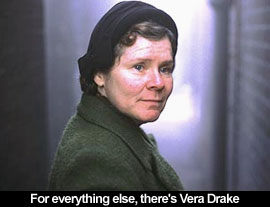
VERA DRAKE
***½/****
starring Imelda Staunton, Richard Graham, Eddie Marsan, Anna Keaveney
written and directed by Mike Leigh
by Walter Chaw There's a certain fascination embedded in our images of wartime England. When a film comes birthing across the pond this time of year, dripping with prestige and a whiff of stuffiness, what can it be but awards fodder laden with lovely sets, sepia-stained cinematography, handsome wool and silk costumes, and largely European casts that remind of how venal American mainstream casts tend to be by comparison? Something about the Blitz still intoxicates–perhaps England's steadfast refusal to surrender their island sanctuary to the barbarians at the gate tickles at our national self-delusion, trading on the belief, once ironclad, that our borders were as sacrosanct, or that our intentions in establishing a New World Order were ever that noble. Now, without the comfort of our own inviolate island sanctuary (what was Manhattan pre-9/11 than that–and what was it after but the biggest metaphor for the irony of capitalist arrogance since The Titanic?), there's just that much more reason for moth-balled middlebrow arthouse audiences to snuffle up great pinches of mid-twentieth century British pluck and remember from the cloistered perspective of a cloth chair a when that never existed–at least never for them.
The Alamo (2004) [Widescreen] – DVD
ZERO STARS/**** Image B- Sound A Extras C+
starring Dennis Quaid, Billy Bob Thornton, Jason Patric, Patrick Wilson
screenplay by Leslie Bohem and Stephen Gaghan and John Lee Hancock
directed by John Lee Hancock
by Walter Chaw There's an old joke from "Hee Haw" about crossing a potato with a sponge: "It didn't taste too good, but boy did it soak up the gravy!" In John Lee Hancock's appalling and sidesplitting The Alamo, Billy Bob Thornton as Davy Crockett tells a gruesome variation on that punchline, only as an actor's moment (and with the "grease" off of slaughtered and incinerating Indians substituted for gravy). "Now, when someone passes me the potatoes, I just pass them right on." An interesting lesson taught about genocide and cannibalism: it's not the commission of atrocity to be mourned, it's the loss for a taste for French fries that's really the tragedy. The Alamo is essentially how "Hee Haw" saved the world–every time Davy pops his head above the titular fort's ramparts, visions of Roy Clark and Buck Owens popping out of a cornfield dance in your head. There are moments when, I kid you not, I looked to see if there was a price tag dangling, Minnie Pearl-style, from Jim Bowie's (Jason Patric) hat.
DIFF ’04: Green Hat
The Final Cut (2004)
*/****
starring Robin Williams, Mira Sorvino, James Caviezel, Mimi Kuzyk
written and directed by Omar Naim
by Walter Chaw It's interesting to me in an esoteric way that Robin Williams consistently seeks out projects that position him as some sort of levitating guru detached from the travails of the common man, floating above the madding crowd with a beatific smile on his god's-eye mug. Think of, among the many shrinks, ex-shrinks, serial killers, and genies Williams has played, his "Wizard of Oz"-ian Dr. Know from A.I., his demented developer Sy from One Hour Photo, or his sainted Dr. Chris from What Dreams May Come. By all accounts, Williams is a nice fellow–a little manic and arrested, perhaps, but pleasant and even philanthropic. So what is it about the camera that turns him into an auto-consumptive egoist with a bizarre saviour complex, into this sad clown, velvet or otherwise, who finds humour in tragedy (so the theory goes) but lately has worked pretty hard at just being gloweringly melancholic in "psychological thrillers" long on sterile atmosphere and short on any sort of resonance? Williams has this air of feeling sorry for humanity that doesn't seem pious as much as it seems self-satisfied and superior. I'm not sure what the holy land for his crusade is, but I hope that he and Kevin Spacey conquer it soon so they can get back to not being irritating pricks with delusions of Christ.
DIFF ’04: Kontroll
A Home at the End of the World (2004) – DVD
*/**** Image A Sound A- Extras D
starring Colin Farrell, Dallas Roberts, Robin Wright Penn, Sissy Spacek
screenplay by Michael Cunningham, based on his novel
directed by Michael Mayer
by Walter Chaw Glib, facile, essentially misguided, and exhibiting a kind of misunderstanding about film craft that sends exactly the opposite of the intended message in every scene, Michael Mayer's directorial debut A Home at the End of the World is a trial from start to finish. It makes appalling soundtrack choices first in establishing period, then in demolishing mood, and finally in screwing up the chronology enough so that the viewer is left completely unmoored. If you're using a jovial Seventies soundtrack to place your film in the Seventies, it's a really bad idea to start using a classic Motown soundtrack when your picture actually moves forward in time. (Not even mentioning what a perverse boner it is to accompany the discovery of a dead father with "Me and Julio Down By the Schoolyard.") Add to that a screenplay by The Hours scribe Michael Cunningham that displays the same kind of top-heavy, more or less off-base pretension and disdain for such outmoded values as loyalty and generosity, and what you have is a recipe for a very particular kind of disaster.
DIFF ’04: Being Julia
DIFF ’04: Rick
The Alamo (1960) – DVD
**/**** Image A- Sound A-
starring John Wayne, Richard Widmark, Laurence Harvey, Frankie Avalon
screenplay by James Edward Grant
directed by John Wayne
by Travis Mackenzie Hoover I freely admit that the prospect of a conservative historical epic directed by John Wayne initially sent a wave of panic rippling through my body. Having endured his offensive and tedious Vietnam opus The Green Berets, I was fearful of another impoverished mise-en-scène serving as the frame for Wayne's patented all-American bellicosity. (Unlike those crack commandoes, liberal critics can only stand so much.) So I was relieved to discover that The Alamo was at once more abstract and better-looking than The Green Berets and therefore more tolerable to sensitive lefty eyes–the film assumes that you're red-blooded enough to root for some American heroes, thus leaving the dubious reasons why unmentioned. Still, it lacks the articulateness to bring its jingoistic fervour to life, and it's sufficiently sluggish and monotonous to test the patience of all but the most uncritical super-patriots.
DIFF ’04: Tradition of Killing Lovers
DIFF ’04: The Woodsman
DIFF ’04: Stage Beauty
DIFF ’04: Imaginary Crimes
DIFF ’04: À Tout de Suite
Shall We Dance (2004)
½*/****
starring Richard Gere, Jennifer Lopez, Susan Sarandon, Stanley Tucci
screenplay by Audrey Wells, based on the screenplay by Masayuki Suo
directed by Peter Chelsom
by Walter Chaw Shall We Dance sits on the screen like an unwelcome dinner guest, or a corpulent toad. It's a remake of a mediocre-but-popular Japanese film that jettisons the question mark after "Dance" on its title screen, the inflectionless phrase squatting there as this movie's moniker a curiously apt description of the dismal marionette's-waltz to follow. The only thing more inscrutable than Jennifer Lopez's self-effacing slide into the territory of Melanie Griffith's mumbling kewpie doll career is the filmmakers' concept of Richard Gere as a comic actor capable of carrying off long takes and haughty deliveries. After all, it's hard enough to believe that the glowering, pinched vision of J.Lo staring fixedly out a dance-studio picture window at Chicago's hurtling elevated train would serve as an invitation instead of a dire warning. The romance of the El has gone decidedly downhill since Tom Cruise, Rebecca DeMornay, and Tangerine Dream took a ride in Risky Business.
DIFF ’04: Kinsey
DIFF ’04: Unknown Soldier
Raising Helen (2004) [Widescreen] – DVD
½*/**** Image A Sound A- Extras C
starring Kate Hudson, John Corbett, Joan Cusack, Hayden Panettiere
screenplay by Jack Amiel & Michael Begler
directed by Garry Marshall
by Walter Chaw I made a promise to myself after The Other Sister to never watch another Garry Marshall film, but I guess I don't have enough self-respect. Raising Helen is repellent in the way of roadside carrion: it just sort of lies there stinking, making it hard to find the energy to attack it. (Something about beating dead horses and all that.) To endure Raising Helen is to surrender to the quintessence of that which is wrong with our culture, to the definition of a term like "disposable culture," and to the self-knowledge that what you really want from your entertainment is the comfortable affirmation of schmaltzy emotions provoked countless times before by countless identical romantic comedies. Going to this movie is the equivalent of giving up on an intellectual and emotional life. Raising Helen will only appeal to and attract people with pathologically little patience for films that challenge them in any way, that elicit genuine reactions and are thus threatening for their potential to penetrate the carefully constructed layers of numb denial that make unexamined lives liveable–films that provide anything like insight into any level of existential verity. It is the lowest rung on the escapist ladder, representative of some wholly self-contained fantasy world where the racial make-up of Queens is 99% WASP and 1% quirky East Indian, and where Kate Hudson's incandescent choppers are Leading Lady material.
Cannonball (1976) – DVD
**/**** Image A Sound A- Extras A-
starring David Carradine, Bill McKinney, Veronica Hamel, Belinda Balaski
screenplay by Paul Bartel and Donald C. Simpson
directed by Paul Bartel
by Travis Mackenzie Hoover On paper, Cannonball is a no-brainer, with the thought of re-teaming Death Race 2000 director Paul Bartel and star David Carradine looking as tantalizing as it does obvious–the gravitas of the latter having so successfully anchored the satirical jabs of the former. Alas, Roger Corman's low threshold for resisting an easy buck seems to have saddled Cannonball with the thing that interested Bartel the least, forcing him to shoehorn his attempts at spoofery into a road-race format where they don't really belong. Thus the film is constantly at cross-purposes with itself, crushing the satire under the wheels of expediency and diluting the adrenaline rush with comedic asides that now lack relevance. The result jerks forward like a beginning driver trying to pop a wheelie. A few choice bits hint at a better movie, but that's it.