Telluride ’18: White Boy Rick + Shoplifters
WHITE BOY RICK
***/****
starring Matthew McConaughey, Jennifer Jason Leigh, Jonathan Majors, Richie Merritt
written by Andy Weiss and Logan & Noah Miller
directed by Yann Demange
Manbiki kazoku
****/****
starring Lily Franky, Ando Sakura, Matsuoka Mayu, Kiki Kilin
written and directed by Hirokazu Kore-eda
by Walter Chaw Yann Demange's follow-up to his bruising, brilliant '71 is this ersatz Donnie Brasco true-crime epic. White Boy Rick details the rise and fall of underage drug kingpin/FBI informant Richard Wershe, Jr. (Richie Merritt–excellent), dubbed "white boy" by the black Detroit gang into which he inculcates himself as first a sort of mascot, then trusted lieutenant, then deep-cover betrayer, then ultimate usurper. White Boy Rick establishes Demange firmly as a formidable technical director. A scene set in a roller disco circa 1984 is as beautiful, lyrical, and effortless an evocation (and affectionate amplification) of time and space as the Cornelius Bros and Sister Rose dance sequence from BlacKkKlansman. A sudden spinout on an icy road later on carries with it the harsh kinetic immediacy and strong knowledge of space of Demange's '71. The film looks right and feels right. There's a scene at a drive-in where Rick takes a date to watch Footloose: a film that couldn't possibly be more alien to Rick's reality. Crucially, White Boy Rick behaves in the right way, too, demonstrating restraint when appropriate, naturalism where appropriate, and expressionism, especially in a sequence where Rick's junkie sister Dawn (Bel Powley, also excellent) is taken from a crackhouse against her will down a red-lit corridor strobed with shadows.
Mishima: A Life in Four Chapters (1985) [The Criterion Collection] – Blu-ray Disc
***½/**** Image A Sound A- Extras A-
starring Ken Ogata, Kenji Sawada, Yasosuke Bando, Toshiyuki Nagashima
written by Paul Schrader and Leonard Schrader (Japanese screenplay by Cheiko Schrader)
directed by Paul Schrader
by Bryant Frazer A little more than halfway through Mishima: A Life in Four Chapters, a fragmented, multifaceted cinematic biography of Japanese writer Yukio Mishima, Mishima expresses nostalgia for an afterlife that existed only in the distant past. “The average age for men in the Bronze Age was 18 and, in the Roman era, 22,” Mishima reckons aloud, in voiceover. “Heaven must have been beautiful then. Today it must look dreadful.” Like the rest of the film’s narration, the passage is quoted from Mishima’s published work, in this case an article he wrote in 1962, eight years before his death at the age of 45 by seppuku. “When a man reaches 40, he has no chance to die beautifully,” Mishima continues. “No matter how he tries, he will die of decay. He must compel himself to live.” In 1984, when he made this film, Paul Schrader was 38 years old. He had just come off the commercial misfire that was 1982’s Cat People, a straightforward studio assignment he tailored to address his signature concerns about sex and death, putting them in the context of a dark fairytale with intimations of incest and bestiality. It wasn’t a good experience. Coked out of his mind for much of the shoot, Schrader fell into a dead-end affair with Nastassja Kinski that he hoped was something more; she wanted nothing to do with him after the movie wrapped, and Cat People‘s disappointing box-office receipts closed the door on his Hollywood career. He thought of suicide. He scurried away from Hollywood, heading first to New York and then to Japan, in search of a life change. That’s where Mishima came in.
Telluride ’18: Destroyer
**/****
starring Nicole Kidman, Tatiana Maslany, Sebastian Stan, Toby Kebbell
written by Phil Hay & Matt Manfredi
directed by Karyn Kusama
by Walter Chaw A laconic noir that promises for a while to be fierce before settling into being familiar, Karyn Kusama’s Destroyer drips with style and atmosphere even if its destined-to-be-lauded central performance by Nicole Kidman lacks the same mystique. She plays LA Detective Erin Bell, a woman beset by demons of alcohol and regret that have left her looking cadaverous: rotted gums and hollow eyes. Most of the performance is fright make-up, the rest Kidman speaking breathily, heavily, and maybe overdoing the drunk swaying and slurring a tad. Erin’s daughter Shelby (Jade Pettyjohn) hates her, of course, and has taken to hanging out with much-older street tough Jay (Beau Knapp), probably just to piss her off. Erin’s estranged husband Ethan (Scoot McNairy) seems nice, though, if scarred by her ferocious temper and penchant for vomiting and passing out, usually in that order. Kidman has been extraordinary in small, personal films like this. Her work in Birth is generational; Dogville, too. But Destroyer is too programmatic to make much of an impact. This kind of image-slumming is too familiar by now, and there’s not one moment where it’s not Nicole Kidman doing a performance up there. Pity.
Telluride ’18: Non-Fiction
**½/****
starring Guillaume Canet, Juliette Binoche, Vincent Macaigne, Nora Hamzawi
written and directed by Olivier Assayas
by Walter Chaw The questions asked in and by Olivier Assayas's Non-Fiction are slippery and at times satisfying for that. This is his Hong Sang-Soo following a pair of Apichatpong Weerasethakuls (though he would say his films owe a bigger debt to Bresson)–a movie, in other words, involving the intricacies of relational dynamics, shot on what appears to be a shoestring and a lark over a long weekend among friends. Probably it's what one of his characters calls "auto-fiction," a blurred line between memoir and pure fiction, with the tension being that maybe there's not much of a difference after all between what's true and what's made up in the pursuit of truth. It's one of those movies that seems like a defense of concept, a response or an invitation to conversation for critics. (Assayas himself was one, once upon a time.) Even more, the picture suggests an auto-critical confession of sorts, yet I'm not sure of what. Past or present infidelities? A declaration that he's found peace at last? An apologia for indiscretions and a pathway to a more authentic life? Whatever Non-Fiction is, it's maybe just a little too clever for its own good.
Telluride ’18: First Man
***/****
starring Ryan Gosling, Claire Foy, Pablo Schreiber, Christopher Abbott
screenplay by Josh Singer
directed by Damien Chazelle
by Walter Chaw Damien Chazelle’s First Man is the Super 8 shrine for Terrence Malick that Oscar voters never knew they needed. It’s a mutant clumping-together of The Tree of Life (all the sad Texas scenes) and Philip Kaufman’s The Right Stuff (all the astronaut stuff), mixed in with a few scenes that are gritty and true (most of them involving a frankly extraordinary Claire Foy), even if Chazelle remains overly fond of snap zooms and the handheld aesthetic in long shots. It’s best, even exceptional, when it’s not hagiography and passing fine when it’s doing what it “ought” to be doing. Like playing a classical music waltz when stoic-to-the-point-of-deranged astronaut/engineer Neil Armstrong (Ryan Gosling) initiates the first-ever orbital docking manoeuvre, because 2001: A Space Odyssey; or doing a little riff on Bill Conti’s amazing score for The Right Stuff right before the first closed-cabin testing. Could be homage. Could be the movie just doing what seems right as a shorthand for emotional engagement. If that’s the case, more’s the pity, as Chazelle proves in the first thirty minutes or so of his film–which revolve around an orbital “bounce” for a test plane and the death of Armstrong’s toddler daughter to cancer–that he’s capable of evoking real emotion, and employing smart contrasts in style and action, if he would only let go of the desire to impress.
FrightFest ’18: A Young Man with High Potential
***/****
starring Adam Ild Rohweder, Paulina Galazka, Pit Bukowski, Amanda Plummer
written by Anna de Paoli & Linus de Paoli
directed by Linus de Paoli
by Walter Chaw The storyline goes like this: Rey, the young woman in the new Star Wars trilogy, is a "Mary Sue"–a term used to describe a female character who is born fully-formed and, therefore, undeserving of her status as the hero of the story, any story. It's an argument made by mediocre men, usually mediocre white men, who have gathered together over social media to share their frustrations about how, essentially, their own worthiness has never been recognized by a world designed, now, to overlook and disdain them. It wasn't supposed to be this way. The parallel storyline is that women are usually murdered by men they know–ex-lovers or spurned would-be lovers–and that the best indicator for murderous gun violence is a history of domestic violence. We hold these truths now to be self-evident. And suddenly these mediocre men who used to get pushed into lockers and demeaned for their solitary interests are the masters of our culture, our industry, our government. There were warnings about this in films like The Last American Virgin and Revenge of the Nerds, remembering that the triumphant happy ending of the latter entailed one of the nerd heroes raping the girlfriend of the lead jock…and the girlfriend liking it a lot. Masculinity has always been this mash of the tragic and the toxic. It's irresolvable, though at least there can be better awareness.
FrightFest ’18: Incident in a Ghostland
Ghostland
**½/****
starring Crystal Reed, Anastasia Phillips, Emilia Jones
written and directed by Pascal Laugier
by Walter Chaw Pascal Laugier, if he had made no other film than Martyrs, would still have made Martyrs: the cornerstone picture of the short-lived New French Extremity and one of the most startling (and nigh-unwatchable) films about faith ever made. It would be remarkable as the second half of a double-feature with Dreyer’s The Passion of Joan of Arc–maybe as part of a trilogy with Scorsese’s The Last Temptation of Christ. Mad Mel’s Passion of the Christ would fit in there, too. Make a weekend of it with Pasolini’s The Gospel According to St. Matthew–martyrdom and ecstasy and the cinematic arts. Laugier’s follow-up, The Tall Man, failed in comparison to Martyrs, as it must. He was briefly attached to a Hellraiser reboot with Clive Barker’s blessing (of course with Barker’s blessing: Martyrs is a film made by a Cenobite), but the franchise is cursed and it fell through. Folks have been waiting for Laugier to make another masterpiece. Incident in a Ghostland isn’t it, but like The Tall Man it’s a strong, technically-proficient genre exercise that deals in an interesting space with at-times striking images. Laugier is one of the only filmmakers who makes me queasy. His films aren’t kidding around.
FrightFest ’18: The Witch in the Window
FrightFest ’18: The Night Eats the World
La nuit a dévoré le monde
***½/****
starring Anders Danielsen Lie, Golshifteh Farahani, Denis Lavant, Sigrid Bouaziz
screenplay by Guillaume Lemans, Jérémie Guez, Dominique Rocher, based on the novel by Pit Agarmen
directed by Dominique Rocher
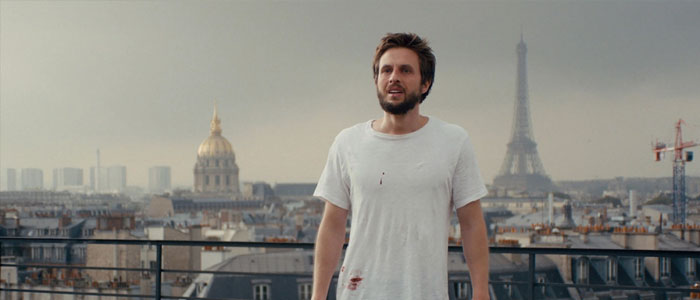
by Walter Chaw A spiritual companion piece to “The Twilight Zone”‘s “Time Enough at Last,” in which a bookish, harried loner survives a nuclear holocaust (to his delight), gathers all the books he wants to read, and then accidentally breaks his glasses, Dominique Rocher’s The Night Eats the World has angry, awkward loner Sam (Anders Danielsen Lie, who broke my heart in Oslo, August 31) find a little safe space only to discover that the zombie apocalypse has happened. It opens at a party thrown by his ex-girlfriend Fanny (Sigrid Bouaziz), where he’s come to collect a box of tapes she’s accidentally taken with her upon her departure. He’s irritated that her attention’s divided and that she’s invited him to get his stuff during a party. Her public displays of affection with a new, aggressive boyfriend (David Kammenos) seem calculated, too, to make him uncomfortable, small. The first ten minutes of the film see Sam floating through the party, nursing his drink, trying to get Fanny’s attention. Hours pass with Sam on the periphery of every interaction. In a very real, visceral way, The Night Eats the World is a character study of introversion and depression. Fanny, frustrated instantly, asks Sam why he can’t just mingle, meet some new people, “try for a change.” It’s clear why they’ve broken up. She doesn’t understand what it’s like to be depressed. He doesn’t understand what it’s like not to be. She tells Sam to go in a back bedroom for his things and stay there because it’s quiet. They’ll talk later. She does understand at least that Sam might have some audio processing issues related to his overlapping conditions. Yeah, don’t we all.
FrightFest ’18: Ghost Stories
FrightFest ’18: The Man Who Killed Hitler and Then the Bigfoot
FrightFest ’18: Rock Steady Row
Support the Girls (2018)
***/****
starring Regina Hall, Haley Lu Richardson, James Le Gros, Shayna McHale
written and directed by Andrew Bujalski
by Angelo Muredda A relaxed, low-stakes counterpart of sorts to Boots Riley's more amped-up Sorry To Bother You, Andrew Bujalski's Support the Girls is about as good as movies about labour, power, and empathy for one's fellow worker get. The marketing materials have emphasized the ostensible hijinks wrought by the film's Hooters knockoff setting, pitching Support the Girls as a more conventionally satisfying ensemble comedy than the rambling micro-budget indies with which Bujalski made his mark–a natural next step, after Results, in his post-Computer Chess evolution into the mid-budget range. Its uncharacteristically glossier colour palette and hooky premise aside, though, Support the Girls is a refreshingly rumpled affair that's squarely in the Bujalski tradition, more than earning its cathartic closing moments of a trio of exploited bar workers' collective rooftop scream into the abyss by taking every opportunity available to be the anti-Garden State: a film that prizes character over manufactured quirk and genuine workaday ennui over dopey existentialism.
FrightFest ’18: Summer of ’84
Summer of 84
**½/****
starring Graham Verchere, Judah Lewis, Caleb Emery, Rich Sommer
written by Matt Leslie & Stephen J. Smith
directed by Francois Simard, Anouk Whissell & Yoann-Karl Whissell
by Walter Chaw From the first strains of Le Matos' Tangerine Dream-influenced score (borrowed most heavily from Risky Business, for some reason), even before the Class of 1984 title font tells it to you raw, you know that Summer of '84, from Turbo Kid helmers Francois Simard, Anouk Whissell, and Yoann-Karl Whissell (collectively known as RKSS), is going to be another '80s throwback flick. That's not bad in and of itself, but it comes with some built-in pitfalls. "Stranger Things", for instance, the setting is all it has going for it and it doesn't even get the vernacular right, whereas something like It well and truly knows the notes and hears the music, too. Summer of '84 falls somewhere between these two contemporary touchstones. It spends most of its time as a high-concept movie that rumbles along with cozy familiarity and an exceptional cast, and then in its last five minutes, it discovers its purpose and nails the landing. Pity that it didn't find its feet sooner. A greater pity, perhaps, that it didn't get another pass through the typewriter.
FrightFest ’18: Bad Samaritan
First Reformed (2018) – Blu-ray + Digital
****/**** Image A+ Sound A+ Extras B
starring Ethan Hawke, Amanda Seyfried, Cedric Kyles, Victoria Hill
written and directed by Paul Schrader
by Walter Chaw The title character of Robert Bresson’s Diary of a Country Priest is consumed by his inconsequence. Determined to make a difference, he can’t even make an impression on the vile inhabitants of the little town that is his parish. It consumes him. It kills him. No one notices. There’s nothing to notice. Bresson doesn’t even bother to show it. The priest’s voiceovers become more urgent, though his faith never flags. He develops terrible stomach pains he seeks to soothe with an austere diet of bread soaked in wine: the Host, I guess, that nourishes communion with the holy spirit, but also the cancer in his gut that consumes him. His last words? “All is grace.” Paul Schrader, raised in the Dutch Calvinist Christian Reformed Church, which basically believes that Christians don’t earn their salvation but rather receive it as a gift they don’t deserve, has made it his life’s work to react against his faith–and to live it, too, when reaction fails. Towards the end of his new film, First Reformed, the priest, Toller (Ethan Hawke), writes on his church’s whiteboard “Will God Forgive Us?,” which is less Calvinist–God already has forgiven us–than a sign of a faith in severe crisis. Schrader’s riffed on Bresson’s film before with his script for Taxi Driver, still his best-known work despite a career littered with masterpieces of individual fears, men in isolation from God, and spiritual self-loathing. In Taxi Driver, the Priest is a sociopath driving through a Times Square hellscape, praying for the apocalypse to come as a purifying, obliterating rain. He tries to kill himself, but becomes a hero instead. First Reformed is either less cynical or more cynical than that. It’s complicated.
BlacKkKlansman (2018)
****/****
starring John David Washington, Adam Driver, Laura Harrier, Topher Grace
written by Charlie Wachtel & David Rabinowitz and Kevin Willmott & Spike Lee, based on the book by Ron Stallworth
directed by Spike Lee
by Walter Chaw Colorado Springs is a big, modern, beautiful city. It's home to natural wonders like the Tolkien-sounding Garden of the Gods and the Cave of the Winds. Its zoo, perched on the slopes of Cheyenne Mountain, is world class. Spencer Penrose built a shrine to his friend Will Rogers on that same mountain when Rogers died in a plane crash. Cheyenne Mountain is also where NORAD is housed, and Colorado Springs is also host to the United States Air Force Academy and, once upon a time, Focus on the Family. It's an ultra-conservative city just south of blue Denver, which is itself south of the trust-fund hippie commune of Boulder. And for a few years starting around 1925, there was no greater stronghold for the Klan in the United States than in Denver. In 1978, Ron Stallworth became the first African-American police officer hired by the Colorado Springs Police Department, and then the first detective when he went undercover to infiltrate a Kwame Ture speech at a black nightclub. In 1979, he answered an ad hoping to establish a chapter of the KKK in the Springs, posing over the telephone as a man who hated every non-white race, but especially "those blacks." A white counterpart attended meetings while Stallworth eventually gained the trust of then-Grand Wizard David Duke. Duke reached out to Stallworth recently because he was concerned he was going to be portrayed as a buffoon in Spike Lee's adaptation of Stallworth's memoir, BlacKkKlansman. I mean, if the hood fits… If there is one indicator of involvement with cults like this, it's deep-seated insecurity. It bears mentioning that Denver's old airport, Stapleton International Airport, is the namesake of five-time Denver Mayor Ben Stapleton, who was a high-ranking member and, until the end of his reign, vocal supporter of the Klan. The airport is gone, but the neighbourhood that replaced it still carries his name.
Night Comes On (2018)
***/****
starring Dominique Fishback, John Jelks, Max Casella, Tatum Marilyn Hill
written by Jordana Spiro and Angelica Nwandu
directed by Jordana Spiro
by Alice Stoehr Social workers reel off exposition: this cagey black girl in their midst is Angel (Dominique Fishback), nearly 18. She has a 10-year-old sister, Abigail, but hasn’t seen her in a couple of years. Since their mother’s death (at their father’s hands), Angel’s been in foster homes and juvenile detention. Now she’s on parole and plans to stay with her girlfriend. These government employees briskly summarize her life while the camera holds her in close-up. It’s efficient filmmaking that establishes both the heroine’s circumstances and the system that’s confined her. Moments later, she’s out on the street, looking for someplace to charge her phone. So begins Night Comes On, the debut feature from white actress-turned-director Jordana Spiro, who also co-wrote the screenplay with Angelica Nwandu. Its 80 minutes will chart Angel’s next 48 hours as she pursues an objective of which her caseworkers are unaware: to acquire both a handgun and her father’s new address. The film extends outwards from this premise in a straight line. First, she meets with the father of her former cellmate, a scumbag dealing in black-market firearms. (Max Casella plays him the same way Harvey Keitel might’ve a few decades earlier.) A phone call interrupts their negotiations, which have involved him groping her; to buy time, he has his wife stop at the store for milk. On Angel’s way out, he hands her a half-gallon jug from the fridge. “Do me a favour,” he says. “Throw this out.” A beat later, she’s outside tossing the jug against a wall with casual disdain.
