TIFF ’21: Wrap-up

One_second_still_01

by Bill Chambers I’ve been covering TIFF for, gulp, 25 years now. If I didn’t expect to mark this silver anniversary in the confines of my living room, I have no complaints. Some of the show ponies were geoblocked for Canadian press or offline altogether, but although I’m fully vaccinated, I wasn’t about to risk transmission or stew for hours in a mask to see the May-December romance Dear Evan Hansen, or another remake of Dune, or a Secret Steven Soderbergh Screening that turned out to be, lol, Kafka, which is almost as good a prank as moving Best Actor to the end of the Academy Awards ceremony. I did at least get to stream my white whale, Jane Campion’s The Power of the Dog, so no regrets. No regrets, no complaints.

Dear Evan Hansen (2021)

Dearevanhansen

ZERO STARS/****
starring Ben Platt, Julianne Moore, Kaitlyn Dever, Amy Adams
screenplay by Steven Levenson, based on his stage play with songs by Benj Pasek and Justin Paul
directed by Stephen Chbosky

by Walter Chaw Dear Evan Hansen is the Canadian-girlfriend grift, emerging from insecurity and good intentions–that mythological girl from a place far enough away for high-school kids that it might as well be Narnia or Middle-Earth, whose phantom existence affirms you are not as pathetic and alone as you really are. And when your Canadian girlfriend dies by house-fire or moose misadventure, perhaps there’s a vein of pathos to be mined there for whatever profit grief allows. It’s the illusion of depth for an immature, troubled, frightened kid, common enough that the “Canadian girlfriend” has entered the pantheon of urban fairytales. How ’bout if Dear Evan Hansen had been about the social pressures that harangue Evan Hansen (Ben Platt) into exploiting the death of a deeply unbalanced and complete stranger instead of how Evan Hansen’s own terminal thoughts and attempted suicide forgive his sociopathic manipulation of a grieving family and school community? Aye, there’s a movie for you–the one where Evan Hansen is a victim and not the hero, and the bad guy is not the truth of his unforgivable deception being discovered, but the overwhelming stricture to conform that weighs especially heavy on adolescents. The sneakiest thing about Dear Even Hansen is that at the end of it all, it’s not actually okay that Evan is an outcast. The premise itself is the bully.

TIFF ’21: The Good House

Tiff21goodhouse

*/****
starring Sigourney Weaver, Kevin Kline, Morena Baccarin, Rob Delaney
screenplay by Thomas Bezucha and Maya Forbes & Wally Wolodarsky, based on the novel by Ann Leary
directed by Maya Forbes and Wally Wolodarsky

by Bill Chambers Earlier this year, I revisited 1995's Copycat, in which Sigourney Weaver plays an agoraphobic criminologist assisting the police in their hunt for a serial killer who arranges tableaux in tribute to famous murderers of the past. It's the sort of B-movie in A dress they don't make anymore, an exuberantly tasteless piece of crackerjack filmmaking that made me wistful for medium-budget, middle-class movie-movies that exist for their own sake. But, perhaps because her most iconic roles are so heroic (this is a woman neither gorillas, nor xenomorphs, nor Bill Murray himself could cow), Weaver's brand doesn't bend towards powerlessness without showing the strain. I thought then and still think that Weaver was miscast as a woman who hyperventilates into paper bags in Copycat. Similarly, her character's reluctance to admit she has a problem with alcohol in The Good House seems as much informed by pride and social stigmas as it does by certain firewalls in Weaver's persona. Hildy Good (Weaver) is a real-estate agent in Wendover, Massachusetts (actually Nova Scotia). It's a small coastal town and she worries what her neighbours think of her, especially considering word-of-mouth affects her livelihood. Maybe that's why she's had her struggles with booze, because of the pressure of maintaining a reputation. Booze, of course, never helped anybody's reputation.

Telluride ’21: The French Dispatch

Tell21frenchdispatch

The French Dispatch of the Liberty, Kansas Evening Sun
**/****
starring Bill Murray, Tilda Swinton, Frances McDormand, Jeffrey Wright
screenplay by Wes Anderson
directed by Wes Anderson

by Walter Chaw Out of three sections, not including a framing story, there is one that gets what it’s after with the soul of wit and a tug of the heart along the way. It’s the middle section, the one concerning a brilliant modern artist incarcerated in a French prison for dismembering two bartenders who falls in love with one of his jailers. He is Moses Rosenthaler (Benicio Del Toro) and his eternal Beatrice, his jack-booted muse, is Simone (Léa Seydoux), and the pas de deux they perform together encapsulates a range of lovely nuance that crystallizes what it is that Wes Anderson does very well, if only occasionally these days, in brief flashes glimpsed between the metric ton of artifice and affectation. For many, the chantilly is the point of Anderson–those gaudy elements that make him one of the most satirized filmmakers of his generation. For me, and up through The Darjeeling Limited, what I liked best about Wes Anderson was his sometimes shockingly effective grappling with absent fathers and broken families. His twee quirk used to be a delivery system for emotional squalls. Now, if those crescendos are there, they’re gasping for air.

Almost Famous (2000) – 4K Ultra HD + Digital

00351.m2ts_snapshot_00.13.11_[2021.08.16_23.39.33]Note: all framegrabs were sourced from the 4K UHD disc. Click any image to enlarge.

Almost Famous **½/****
Untitled ***/****
Image A- Sound A- Extras A-

starring Patrick Fugit, Billy Crudup, Frances McDormand, Kate Hudson
written and directed by Cameron Crowe

by Bryant Frazer Almost Famous, Cameron Crowe’s fondly remembered period piece about a bygone era of rock stars and the various satellites in their orbit, is a bit of a relic these days. Even on its release in 2000, when it was almost 30 years removed from its subject matter, Almost Famous was a notably uncritical celebration of a moment in 20th-century music history. Another 20 years on, having centred the phallic sexual and creative powers of a white guy with a guitar, Almost Famous is increasingly disconnected from the prevailing pop and hip-hop zeitgeist, and the film feels even more like cultural hagiography. On the other hand, it is a hell of a story. The fundamentals are autobiographical: Cameron Crowe really was a 15-year-old whiz kid who earned early graduation from high school; he really did seek career advice from legendary rock-and-roll critic Lester Bangs; and he really landed a ROLLING STONE assignment to hit the road with a group of next-big-thing cock-rockers. The story, as Crowe retells it here, has intrepid young journo William Miller (a fresh-faced Patrick Fugit) on assignment with the fictional rock group Stillwater–dealing with celebrity egos, yearning for the teenaged groupies who sprinkle their figurative fairy dust around a series of interchangeable ballrooms, basketball arenas, and hotel suites, and checking in with a protective mother (Frances McDormand) who can only peer helplessly into her son’s wonderland from her world outside the circus tent. Finally, William meets with his editors back at HQ to bang out a chunk of blistering reportage that will lay bare the raw emotional state of a band on tour and cement his status as a rock journalist. What could go wrong?

Fantasia Festival ’21: Beyond the Infinite Two Minutes

Fantasia21beyondtheinfinite

Droste no hate de bokura
****/****
starring Kazunari Tosa, Riko Fujitani, Gôta Ishida, Aki Asakura
screenplay by Makota Ueda
directed by Junta Yamaguchi

by Walter Chaw Junta Yamaguchi’s directorial debut Beyond the Infinite Two Minutes is zero-budget high-concept done right, a fastball-down-the-middle of a time-travel movie landing right when the concept seemed to have been wrung dry. Logging in at a lean 70 minutes, it doesn’t have a trace of fat on it. More, it manages in that brief span to paint fully-fleshed characters, conjure and pay off a romantic-comedy subplot, and juggle a couple of sharp tonal shifts. It’s so good because it’s so…simple. A strange thing to say about a premise that’s kind of mind-breaking as a pair of connected, closed-circuit monitors accidentally creates a temporal wormhole across the span of two minutes, but there you have it. This little masterpiece proves the truism that whatever the plot might be, as long as the characters and their motivations remain legible and relatable, baby, you got a movie. Simple.

Fantasia Festival ’21: Hotel Poseidon

Fantasia21hotelposeidon

****/****
starring Ruth Becquart, Steve Geerts, Anneke Sluiters, Tine Van den Wyngaert
written and directed by Stef Lernous

by Walter Chaw An art director’s fever dream, Stef Lernous’s Hotel Poseidon is a sequel in spirit to Jean-Pierre Jeunet and Marc Caro’s Delicatessen and a film that would comfortably complete a trilogy with Jeunet & Caro’s City of Lost Children. Here, Lernous says that we’re all the product of our shadows, those unexamined parts of us shoved into the crannies of our unconscious, and he packs every frame with florid, fulsome, grotesque manifestations of this idea, which is matched by a genuinely exciting dedication to going for it. It’s not unlike a David Lynch film in that way, and like Lynch’s work, its unpredictability and willingness to do anything make it both very funny and occasionally existentially horrifying. Sometimes in the same moment. Hotel Poseidon is set in a single building bathed in a sickly sepia palette and suffused with themes of submersion. It follows a vignette structure of sorts that finds a different psychodrama, a different element of the subconscious, played out in each room of a decaying apartment hotel. The film is a tour through the unconscious–a Being John Malkovich or Eternal Sunshine of the Spotless Mind in which each new horror plumbs personal depths of grief, guilt, and shame most of all. (Its closest analogue may actually be Barton Fink.) Hotel Poseidon, in other words, is difficult to describe.

The Suicide Squad (2021)

The Suicide Squad (2021)

***½/****
starring Margot Robbie, Idris Elba, John Cena, Viola Davis
written and directed by James Gunn

by Walter Chaw James Gunn’s The Suicide Squad is weird. It’s explosively, hilariously gory, profane, ridiculous, and, best of all, lawless. As much as I love Christopher Nolan’s Dark Knight trilogy, the darkness–the grittiness–he brought to the DC Universe has proven difficult to shake due to its commercial success. In contrast, The Suicide Squad looks and acts a lot like the Adam West “Batman” TV series, a piece fully embracing the elasticity of both its mediums and, though it seems silly to say, one bracingly unafraid of literal colour. I also felt this way about Gunn’s still-dour-but-colorful-by-MCU-standards Guardians of the Galaxybut this film feels very much like something, from character and production design down to the choice of members for the titular squad, allowed to be whatever it was going to be, damn the torpedoes. Have I mentioned that it’s weird? It’s exquisitely strange, and not just because of the obvious ways in which things are strange, but because it says the bad guys are the colonial-/meddling-minded United States, the military-industrial complex is reliant on the enslavement of the carceral state, and the best test of manhood is not facility with firearms and sociopathy. A billion-dollar IP that isn’t trying to skate the middle line of absolute, frictionless equivocation? Weird, right?

Howard the Duck (1986) – 4K Ultra HD + Blu-ray + Digital Code

Howard the Duck (1986) – 4K Ultra HD + Blu-ray + Digital Code

**½/**** Image B- Sound A- Extras B
starring Lea Thompson, Jeffrey Jones, Tim Robbins, Ed Gale
written by Willard Huyck & Gloria Katz, based on the Marvel Comics character created by Steve Gerber
directed by Willard Huyck

by Bill Chambers If you’ll indulge me, as I recall it was at my local Sunrise Records that I first laid eyes on the egg with the hatched beak chomping on a cigar, which became as emblematic of Howard the Duck, albeit not as iconic or enduring, as the gleaming bat symbol would become of Batman three summers later. It was on the cover of a 12″ EP of the movie’s title track, performed by Dolby’s Cube featuring Cherry Bomb, a fictitious band consisting of actresses Lea Thompson, Liz Sagal, Holly Robinson, and Dominique Davalos, who did all their own singing. (Thomas “She Blinded Me with Science” Dolby wrote and produced their songs.) When I flipped the jacket, I encountered a photo spread of Thompson in rock-‘n’-roll leathers and big, crimped hair, and I reacted how any 11-year-old boy hot for Marty McFly’s mom would: I begged my dad to buy it for me.

Jungle Cruise (2021)

Junglecruise

**/****
starring Dwayne Johnson, Emily Blunt, Edgar Ramirez, Paul Giamatti
screenplay by Michael Green and Glenn Ficarra & John Requa
directed by Jaume Collet-Serra

by Walter Chaw For a film based on a theme-park attraction without a point of view or anything to say, Jungle Cruise is as good as it could possibly be, i.e.: fine. It reaps whatever benefits one could from the star power of Dwayne Johnson and Emily Blunt without giving them something to do, and it seems to belong to the Aguirre, The Wrath of God cinematic universe, which is, you know, unexpected. There’s a moment somewhere in the middle of it where Blunt’s character, Lily, asks Johnson’s Frank a personal question and then listens. She’s an actor of tremendous empathy and clarity, and although, in these moments after finishing the movie, I can’t for the life of me remember what they were talking about, I do recall thinking how nice it would be if Blunt got more roles in which she might play a human being. For now, she’s a plucky scientist two years into WWI who is denied admission into stuffy scientific societies because she’s not only a woman but a woman who wears pants. What Lily wants to do most is find a mythical tree blossom in the Amazon that bestows eternal life, making Jungle Cruise a part of The Fountain‘s cinematic universe, too, which is likewise unexpected. The person she hires to help her is Frank, of course, and the bad guy who wants the blossom but for nefarious reasons is German Prince Joachim (Jesse Plemons). Oh, the other bad guy who wants the blossom is Aguirre (Edgar Ramirez), a centuries-old conquistador doomed to jungle purgatory. It doesn’t matter.

Riders of Justice (2020)

Ridersofjustice

Retfærdighedens ryttere
***/****

starring Mads Mikkelsen, Nikolaj Lie Kaas, Andrea Heick Gadeberg, Roland Møller
written and directed by Anders Thomas Jensen

by Walter Chaw Dogma 95 vet Anders Thomas Jensen has a particular interest in oddness. Characters, especially, in Jensen’s films as writer and director are given to sometimes-extravagant eccentricity, fueled by traumas Jensen declines to sanitize that are often exacerbated by intelligence worn as an unwelcome birth defect. Consider the menagerie at the centre of Jensen’s Men & Chicken, an updating in a way of The Island of Dr. Moreau reconfigured as a “light” family drama in the Danish countryside. Mads Mikkelson stars in that one, too, playing a chronic masturbator who finds out that his father has been splicing his own sperm with animal sperm in an attempt to… Well, look, it’s an interesting piece about social norms and how an inability to assimilate culturally leads to these islands of misfit boys. Jensen is interested, specifically and obsessively, in what happens when physical and mental mutations stunt emotional and social development. Though no one would want the crown, he is the poet laureate of the incel state.

Luca (2021)

Luca

**½/****
screenplay by Jesse Andrews, Mike Jones
directed by Enrico Casarosa

by Walter Chaw Enrico Casarosa’s Luca is a gentle love letter to the Miyazaki-verse set in a small, coastal Italian town called “Porto Rosso” in an obvious nod to Porco Rosso. The body of it, meanwhile, is parts of Ponyo, parts of Kiki’s Delivery Service, bits and pieces of shots and sequences from Spirited Away, and even the scavenging scenes from Nausicaä of the Valley of the Wind. Luca‘s message of acceptance is general and loose enough to allow for a couple of innocuous interpretations, the obvious one being the Depeche Mode-ism of how people are people and shouldn’t, therefore, get along so awfully, the more potentially impactful one a coming-out tale in which the residents of a cloistered community realize their friends and neighbours harbour secrets about their identities that they’re afraid to reveal, lest they be ostracized, even murdered. It’s tempting to go here, not just because the central drama revolves around the friendship between little Luca (voiced by Jacob Tremblay) and his buddy Alberto (Jack Dylan Grazer), but also because of the late-film reveal that a pair of elderly spinsters in town are identically coupled. There are also moments where it’s clear that Alberto, without being interested in her, is jealous of the relationship blooming between Luca and Giulia (Emma Berman), the little girl who takes them in when they find themselves needing a place to stay. It’s there if you want it.

Cruella (2021)

Cruella

***/****
starring Emma Stone, Emma Thompson, Joel Fry, Mark Strong
screenplay by Dana Fox and Tony McNamara
directed by Craig Gillespie

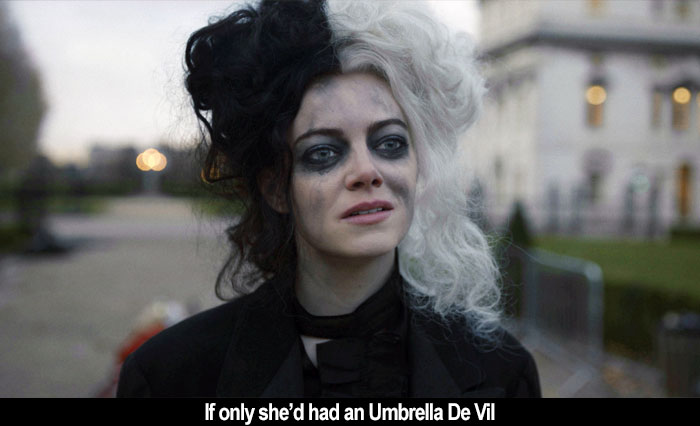
by Walter Chaw It’s better to think of Craig Gillespie’s Cruella as a riff than as a prequel–a variation on a theme rather than the puzzle-box predecessor to a beloved intellectual property. In fact, one’s ability to do so informs the extent to which this film is not merely enjoyable but indeed good. Cruella is a mindfuck of a construct, a postmodern exercise in which nothing of it could cohere without knowledge of, and experience with, other cultural artifacts–but even there, it occupies two spaces simultaneously: the Disney side, where the references are all to 101 Dalmatians, against the Gillespie side, where the references are to pop-cultural movements in music, fashion, even literature. Early on, a young Cruella (Tipper Seifert-Cleveland), born “Estella,” is urged by her saintly mother Catherine (Emily Beecham) to contain Estella’s exuberant, sometimes-violent and “evil” side by dubbing her “Cruella” and, in so naming it, caging it. The suggestion, then, is that “Estella” is the polite-if-constricting requirement that Cruella be a prequel to a Disney “vault” classic, while “Cruella” is the Something Wild barely contained that, like Michelle Pfeiffer’s resurrected Catwoman in Batman Returns, is a creature born of violence returned as the avatar for perversity and chaos. Imagine how great this good film would have been were it just the one with none of the other.

Some Kind of Wonderful (1987) [John Hughes: 5-Movie Collection] – Blu-ray Disc

Some Kind of Wonderful (1987) [John Hughes: 5-Movie Collection] – Blu-ray Disc

***½/**** Image A- Sound B+ Extras A-
starring Eric Stoltz, Mary Stuart Masterson, Craig Sheffer, Lea Thompson
written by John Hughes
directed by Howard Deutch

by Bill Chambers “Cinema is the most beautiful fraud in the world. In order to criticize a movie, you have to make another movie.” John Hughes may have had this famous Jean-Luc Godard quote in mind when he embarked on the screenplay for Some Kind of Wonderful, a gender-swapped version of his heavily-compromised Pretty in Pink that came out less than a year later. But Some Kind of Wonderful did not start out like it ended up: The script that director Howard Deutch originally signed on to direct was about a citywide first date between a social pariah and the prettiest girl in school that notoriously called for the Blue Angels flight demonstration squadron to put on a private show for the couple. A broad comedy, it opened with its hero masturbating into a pillow. If you’ve seen Some Kind of Wonderful, this will all sound pretty incongruous.

Me You Madness (2021)

Meyoumadness

**½/****
starring Ed Westwick, Louise Linton
written and directed by Louise Linton

by Walter Chaw Louise Linton’s Me You Madness is a particularly fraught and grim fandango seeking to walk the line between self-parody and self-aggrandizement. It dances along the edge of a blade, this one, with the kind of extraordinary privilege afforded the fabulously wealthy, powerful, and beautiful. On the one hand, you’re making fun of your ridiculous luck; on the other hand, or maybe the same hand, you’re rubbing everyone’s face in it. False modesty is dangerous–and unsuccessful self-satire is the most deluded manifestation of it. Shit, successful self-satire isn’t that great, either, because it suggests that one’s station is so elevated it can be a target of satire. So is Me You Madness terrible? It’s fabulously terrible, calamitously terrible. It’s also genuinely fascinating as both symptom and diagnosis of exactly what’s wrong with the particular strain of capitalistic excess embodied by Linton and her vile husband, Steve Mnuchin. These are the architects of the end of the world, and this is evidence that they’re aware of it but don’t quite know what it is that they know.

She’s Having a Baby (1988) [John Hughes: 5-Movie Collection] – Blu-ray Disc

Vlcsnap-2021-02-19-17h12m29s562

*½/**** Image C Sound A Extras B-
starring Kevin Bacon, Elizabeth McGovern, Alec Baldwin, James Ray
written and directed by John Hughes

by Bill Chambers I rented She’s Having a Baby the moment it hit video out of brand loyalty to John Hughes, whose teen movies had had an epic and indoctrinating influence on my peers and me. And I was largely indifferent to it up until the closing-credits montage of celebrities tossing out names for the titular baby, at which point my lack of enthusiasm gave way to dismay.* At the time, I assumed the film’s subject matter was too adult for 13-year-old me (and it was), but 18 years later I didn’t like it any better, and after revisiting it with another 15 years’ distance–which brings us to 2021–I’ve decided that when it comes to She’s Having a Baby, “it’s not me, it’s you” suffices. Even though the travails of one Jefferson “Jake” Briggs remain as hypothetical to me as they were when I was a kid, movies, as Roger Ebert was fond of saying, are empathy machines; the cinema would never have flourished if films demanded a 1:1 relationship with the viewer’s experiences. (Granted, this is also how they’ve gotten away with being so lily-white for so long.) Definitive proof of She’s Having a Baby‘s mediocrity came for me when I saw Tamara Jenkins’s Private Life, in which a cultured New York couple struggles with infertility as their biological clocks wind down. It was, next to First Reformed, my favourite film of 2018. I’ve never been on that side of the family equation and I’m not a churchgoer, either.

Tom and Jerry (2021)

Tomandjerry

½*/****
starring Chloë Grace Moretz, Michael Peña, Colin Jost, Ken Jeong
written by Kevin Costello
directed by Tim Story

by Walter Chaw I want to say right off the bat that Hanna-Barbera’s “Tom & Jerry” cartoons were in constant syndication when I was a kid. I watched them every day after school, like all my friends did, and we agreed that we liked it best when Tom and Jerry were friends. We weren’t peaceniks; honestly, I think all the unleavened brutality of the cartoons got tedious after a short while and we were starved for something that suggested creativity beyond how best to murder a cat. Thinking back, I wonder if these cartoons had anything to do with how cat abuse is still played for comedy in movies–I mean, you can’t hurt them, right? The thing that’s tempting about reviewing the new Tom and Jerry is to not take it very seriously. There’s enough to skewer, after all, without bothering to engage it. Yet real people worked on this, an entire animation company’s creative capital was spent on doing everything they could to honour the questionable source material (and they do a really good job), and now here it is, the second attempt at a feature-length Tom and Jerry movie in almost 30 years, ostensibly landing as some sort of family entertainment designed to make your kids docile and pacific for 100 minutes. Honestly, I don’t think it’s worth the damage it potentially does. I mean, you can feed your children paint chips, too. And it’ll fill ’em up! But the cancer is something to consider.

Coming 2 America (2021)

Coming2america

*/****
starring Eddie Murphy, Arsenio Hall, Jermaine Fowler, Wesley Snipes
screenplay by Kenya Barris and Barry W. Blaustein & David Sheffield
directed by Craig Brewer

by Walter Chaw I don’t understand Craig Brewer’s Coming 2 America, probably because I don’t understand John Landis’s Coming to America, either. For me, they are both artifacts of an alien culture where the references are obscure and the humour is arcane. I spent most of my life thinking the first film was making fun of Africans, only to learn that for a generation of Black creatives, the film was a rare example of positive, even admiring, representation of Africans in the American popular culture. I think that’s true; I also know the fish-out-of-water machinations of Coming to America‘s plot–the cheap sex jokes, the gay terror, the burlesque of it–rubbed me the wrong way then and still do. But there’s a sweetness to Akeem (Eddie Murphy), isn’t there? These films are decidedly not for me. I do trust people with vital voices like Ryan Coogler, who apparently loved the first film and had his own ideas about a sequel–and I would say the analogue I can find while I’m grasping for one is the reception of Short Round in Temple of Doom, which I initially rejected with horror but now embrace as one of the few positive Asian representations in that same American popular culture. Strange bedfellows, Shorty and Prince Akeem, but there you have it.

Raya and the Last Dragon (2021)

Rayaandthelastdragon

****/****
screenplay by Qui Nguyen & Adele Lim
directed by Don Hall and Carlos López Estrada

by Walter Chaw I’ve thought a lot lately about quitting, and seriously, this thing I’ve done over the last twenty-some years–this thing that started, ultimately, because I was a kid who couldn’t speak the language and wanted desperately to belong to something that would never have me on my terms. I’ve thought about quitting, and it’s a dangerous thing for someone like me to think that way. Movies were a thing I loved that never betrayed me, never abandoned me, whenever there was pain or confusion, or something I needed to work through; this was the art form that was primary for me as a catalyst for introspection. There’s literature and music and poetry, of course, yet film could encompass all of those things. It’s saved my life a time or two. I thought I had a place among others who loved it like me, but no one loves it like me–people love it like they love it. Or they just use it because they’ve failed at everything else and don’t have the introspection to feel despair. When you give yourself over to an idea of affiliation through the appreciation of objects, you’re doomed to disappointment and loneliness. When a person like me thinks about quitting, he’s thinking about cutting the line that connects him to his life. I’ve been thinking about quitting, because what’s the point of any of it when your rope is tied to a quintessence of dust? I don’t trust this anymore.

Sundance ’21: Strawberry Mansion

Sundance21strawberrymansion

****/****
starring Penny Fuller, Kentucker Audley, Grace Glowicki, Reed Birney
written and directed by Albert Birney & Kentucker Audley

by Walter Chaw Strawberry Mansion is very much like a live-action “Adventure Time”, perhaps doomed, like Pendleton Ward’s existentialist/surrealist masterpiece, to a long road to appreciation as something emotionally incisive rather than something especially but merely unconventional. Of all the antecedents it boasts (add eXistenZ, Alphaville, Tom Schiller’s Nothing Lasts Forever, Eternal Sunshine of the Spotless Mind, Douglas Adams’s work, and, um, Laura to the mix), however, Strawberry Mansion finally reminds me most of the Oliver Stone-produced miniseries “Wild Palms” in both its literal execution and the low thrum of underlying paranoia about the commodification of dream sleep. The danger is great that a stew as heady as this will be ponderous at best, indecipherable at worst, but it’s delivered with a confident, even light touch by co-writers/co-directors Kentucker Audley and Albert Birney. As odd as it seems on the surface, the picture, again like “Adventure Time”, has easy-to-argue themes and is guided by what feels like real, cathartic pathos. Strawberry Mansion‘s aggressive artifice actually enhances its emotional authenticity. I love this film.