Editor’s Choice: The Year in Blu-ray (2019)

Top10discs2019

by Bill Chambers I learned to appreciate the benefits of streaming this past October when I became so fatigued from illness that getting up to load a disc may as well have been trekking across the Sahara. (It really put the “physical” in physical media.) Then Disney+ launched, and “Maclunkey” happened–a startling reminder that streaming content can change at the drop of a hat depending on corporate or creator whim. It remains a struggle to fight complacency, though, given that a) the screener pool is drying up and b) even the cheapest disc will probably set you back as much as a month’s subscription to a streaming service. In short, I wouldn’t call this a definitive or comprehensive list of the year’s best discs by any stretch, merely the best among those I had an opportunity to audit. But FILM FREAK CENTRAL will never stop championing physical media, for a variety of “because”s:

Polyester (1981) [The Criterion Collection] – Blu-ray Disc

Vlcsnap-2019-12-11-17h59m37s278

***/**** Image A- Sound A Extras A-
starring Divine, Tab Hunter, Edith Massey, Stiv Bators
written and directed by John Waters

by Bryant Frazer For anyone who kept up with John Waters’s gleeful forays into poor taste during the 1970s, Polyester, released at the dawn of the Reagan era, must have seemed like a change-up. It was hardly a big-budget affair, but it felt posher than the earlier, low-budget features that earned him his (dis)reputation. Those movies were filmed on grungier 16mm in the belly of Waters’s Baltimore hometown, but Polyester was shot on 35mm and set in the suburbs. Famed actor-in-drag Divine was once again in front of the camera, but instead of the usual outsider role, he was playing squarely against type as neglected housewife Francine Fishpaw–and sharing star billing with 1950s/’60s heartthrob Tab Hunter. Waters introduces Francine by having his camera glide into the Fishpaws’ home and up the stairs (the director’s first-ever Steadicam shot) to find her dressed only in bra and girdle, bathed in a golden-hour glow, as Hunter croons lines from the title tune (lyrics by Debbie Harry): “You know about abundant women/Well, this girl only aims to please/Outside there’s a load of noisy neighbours/Upstairs there’s a Polyester squeeze.”

Universal Soldier (1992) – 4K Ultra HD + Blu-ray + Digital

00007.m2ts_snapshot_01.10.23_[2019.11.23_12.06.31]Note: all framegrabs were sourced from the 4K UHD disc

**½/**** Image A- Sound B+ Extras B
starring Jean-Claude Van Damme, Dolph Lundgren, Ally Walker, Jerry Orbach
screenplay by Richard Rothstein & Christopher Leitch and Dean Devlin
directed by Roland Emmerich

by Bryant Frazer You might expect an early-1990s T2 knock-off starring Jean-Claude Van Damme and Dolph Lundgren to be a bit of a romp, but Universal Soldier is pretty dark from the get-go. It opens with a cut-rate Vietnam War-movie pastiche that has Sergeant Andrew Scott (Lundgren) going on a My Lai-style rampage, stitching human ears into a necklace, executing innocent civilians, and decrying the horrified American soldiers around him as traitors before shooting them, too. Private Luc Devreux (Van Damme) manages to jam his bayonet into Scott’s gut, ending his murderous spree but earning a lethal volley of return fire in the bargain. Both men end up bleeding out in the mud before the U.S. military spirits their bodies away and declares them AWOL. Fast-forward 20 years or so, and the government has figured out a way to revive and power up dead soldiers and repurpose them as an unbeatable tactical force. We see these so-called “universal soldiers,” including Scott and Deveraux, working as a unit to take out a group of terrorists in an action set-piece that was, impressively, shot at the Hoover Dam. All goes well for a while, until both Scott and Deveraux start recalling their former lives–and remembering they don’t like each other very much.

Red Heat (1988) – 4K Ultra HD + Blu-ray + Digital

00007.m2ts_snapshot_00.04.09_[2019.11.06_14.07.15]Note: all framegrabs were sourced from the 4K UHD disc

***/**** Image B+ Sound B+ Extras B
starring Arnold Schwarzenegger, James Belushi, Peter Boyle, Ed O'Ross
screenplay by Harry Kleiner & Walter Hill and Troy Kennedy Martin
directed by Walter Hill

by Bryant Frazer The first, pre-credits scene of Red Heat takes place in a Russian banya, a steam bath where hulking, Vulcanian workers in grimy T-shirts labour to shovel wood and coal into massive stoves that keep the water hot and the room steamy. The camera follows a blue-eyed man as he steps into the room, assuming his POV as he surveys the tableau. A whole section of the space is dedicated to barely-clad muscled men pumping iron, and the camera lingers on them. It pans slowly across the room before finding a group of nymphs bathing au naturel, zooming in and reframing, finally deciding it's not interested in them. The blue-eyed man turns his head, catching sight of a figure across the room. It's Schwarzenegger, about one square foot of fabric shy of nudity, striding confidently past the bathing beauties before stepping up into a side chamber and disappearing again into the haze. The next shot catches Arnold in medium close-up, tilting lazily from his calves all the way up his chiselled torso, until it frames him in flattering low-angle portraiture. He is squinting, and he is scowling, and he has an Ivan Drago flat-top. This is peak Arnold. The reverse shot lands, almost hilariously, on a group of a half-dozen nude and nearly-nude bathers, all pink and vulnerable in their skin, gazing back at him, excited or terrified or maybe both. It's as if a god stands before them.

House of Games (1987) [The Criterion Collection] – Blu-ray Disc

Vlcsnap-2019-09-14-14h35m14s811

***½/**** Image A- Sound B+ Extras B+
starring Lindsay Crouse, Joe Mantegna, Mike Nussbaum, J.T. Walsh
screenplay by David Mamet
directed by David Mamet

by Bryant Frazer House of Games pivots on a hand of poker that spirals out of control and reveals itself as more than a mere card game. It’s a moral hazard. On one side of the table, holding three of a kind, is Mike (Joe Mantegna), a small-time hood with a big mouth who runs a card room out of the back of House of Games, a pool hall that sits upstairs from a paperback bookstore in downtown Seattle. Across from him, George (the late, great sleight-of-hand artist Ricky Jay, in his first film role), who may or may not have drawn to a trips-beating straight or a flush. Spectating from Mike’s side is Margaret (Lindsay Crouse), a psychiatrist (and best-selling author) who stumbled upon the tableau in an effort to negotiate down the debt of a troubled patient (Steve Goldstein), a gambling addict. Impressed by Margaret’s apparent fearlessness–when he makes an oblique threat to kill her, she calls him a bully–Mike enlists her help in a scheme that isn’t cheating, per se, but does rely on duplicity. Simply put, Mike contrives to leave the room for a few minutes; in his absence, Margaret watches for an indication that George is bluffing and signals Mike, quietly, to call.

The Doors (1991) [The Final Cut] – 4K Ultra HD + Blu-ray + Digital HD

The Doors (1991) [The Final Cut] – 4K Ultra HD + Blu-ray + Digital HD

**/**** Image A- Sound A Extras C+
starring Val Kilmer, Meg Ryan, Kevin Dillon, Kathleen Quinlan
written by J. Randal Johnson and Oliver Stone
directed by Oliver Stone

by Bryant Frazer Oliver Stone’s lofty take on California psychedelic rock band The Doors begins near the end, with a thickly bearded Jim Morrison–Val Kilmer, delivering a well-practiced but largely soulless imitation of the ’60s cultural icon–slouched in a dark Los Angeles studio recording lines of spoken-word poetry. “Did you have a good world when you died?” he demands. “Enough to base a movie on?” The setting is December, 1970, a few months before Morrison voluntarily exiled himself in France–perhaps to dodge a potential prison sentence after his arrest for lewdness on stage–and a little more than six months before his death in Paris. Stone fills all of that in later, but he starts here, not just because the poem Morrison is reading, “The Movie,” is too apropos for a filmmaker as literal-minded as Stone to resist, but also because Morrison’s demonstrated preoccupation with death and storytelling dovetails so nicely with the film’s manifestation of same. Stone includes a formative event from Morrison’s early life: His family is driving through the desert when they pass the aftermath of a car accident where an elderly Navajo man is bleeding to death at the side of the road. Young Jim, rubbernecking, locks eyes for an instant with the Native American and, just like that, picks up a fellow traveller. Stone digs the idea. Throughout the film, he has Morrison seeing Native spirits at key moments, dancing at Doors performances, or lurking in the corners of parties. He also gives Morrison a stalker: a mysterious man (an uncredited Richard Rutowski, who later collaborated on the screenplay for Stone’s Natural Born Killers), well-built and sometimes nude, who represents death and occasionally materializes at the periphery of the action, not unlike the reaper from Bergman’s The Seventh Seal.

Bumblebee (2019) – Blu-ray + DVD + Digital

Img028

***½/**** Image A+ Sound A Extras C
starring Hailee Steinfeld, John Cena, Jorge Lendeborg Jr., John Ortiz
written by Christina Hodson
directed by Travis Knight

by Walter Chaw Travis Knight’s Bumblebee is a tone-perfect amalgamation of The Love Bug and The Iron Giant. It is, in other words, both a throwback summer programmer (perhaps mistakenly released during the Christmas season) and a sophisticated parable about coming of age in a divided America. It casts Hailee Steinfeld as Charlie, a gearhead who loves her car more than she’s interested in fielding the advances of the awkward neighbour kid pining after her. And then it has her dealing with the loss of a parent as she finds her way through an already-difficult period in a young person’s development. It wisely hires Knight, who at Laika Studios produced the unexpectedly sensitive and introspective ParaNorman and Kubo and the Two Strings (the latter of which he directed), and screenwriter Christina Hodson (the woman entrusted with upcoming films about Harley Quinn and Batgirl), with uncredited contributions from Kelly Fremon Craig, writer-director of the sensitive The Edge of Seventeen, which also starred Steinfeld. In placing gifted, effortlessly diverse people before and behind the camera and then watching as the lingering hostility around the misogynistic, racist, xenophobic Michael Bay cock operas that have made the Transformers franchise to this point disgusting and toxic just melt away, Bumblebee becomes a prototype for the modern reboot. It’s amazing how the right choices among topline talent make all the work of not only avoiding offense, but also providing uplift, seem a magical side-effect rather than some laborious and arcane undertaking. (It’s the difference, for instance, between Wonder Woman and Captain Marvel.) Knight’s Bumblebee is the Transformers franchise as it should have been from the start: on the one hand a nostalgic, sometimes exciting, often hilarious story about the coming to earth of sentient machines engaged in perpetual war who can camouflage themselves as terrestrial vehicles and appliances–and on the other, a clever parable about how the toys (and cars) we grow up with sometimes provide the guardrails for how we view accountability as we get older. By the end of Bumblebee, the girl and her ‘bot arrive at the mature–and, more importantly, healthy–decision to move on from each other. Another franchise after The Last Jedi making the daring suggestion that living in the past is death.

Us (2019) – Blu-ray + DVD + Digital

Us1

*½/**** Image A Sound A Extras B
starring Lupita Nyong’o, Winston Duke, Elisabeth Moss, Tim Heidecker
written and directed by Jordan Peele

by Walter Chaw SPOILER WARNING IN EFFECT. Get Out was an instant classic that appeared at the spearhead of a new blaxploitation movement. It introduced terms and concepts into the lexicon (“Now you’re in the sunken place”). It attacked race relations with intelligence and, save one tonal slip at the end, maintained an almost unbearable tension throughout. Its signature image of a black face, frozen in terror, the path of a single tear tracing its way down one cheek–you see it three times, on three different characters in the film–encapsulates the black experience: outrage held forever in abeyance, voices stolen by the ruling culture, along with lives and potential lives. Get Out won its writer-director Jordan Peele accolades and the type of laurels (the next Spielberg!, the next Hitchcock!) that, the last time they were handed out (to one M. Night Shyamalan), did the recipient no real favours. And where Get Out asked the question of what Peele’s limits were, Us answers it immediately–and decisively enough that it feels almost cruel. Us has a couple of vaguely interesting ideas it fails to develop, a few set-pieces it fails to pay off, and a central metaphor–literal upper and lower classes being tethered together along some socially-engineered psychic conduit–that it has no real idea what to do with. The two choices for any conversation about Us, then, are to continue treating Peele like a holy, anointed savant/prophet until he makes The Happening (to the extent that Us is not already The Happening, let’s face it), or to say that Us is at best disappointing and at worst just plain bad.

Detour (1945) [The Criterion Collection] – Blu-ray Disc

Detour1

****/**** Image A- Sound A- Extras B
starring Tom Neal, Ann Savage, Claudia Drake, Edmund MacDonald
screenplay by Martin Goldsmith, based on his novel
directed by Edgar G. Ulmer

by Bryant Frazer Among legitimate Hollywood classics, Detour is about as threadbare as they come: a small film, shot on a shoestring over a handful of days (between six and 14, depending on whose accounting you believe) at a Poverty Row film studio. And yet, the finished product is uniquely compelling. As a crime thriller, it’s notable for the absence of gunfights, chase scenes, double-crosses, and back-stabbings. What it’s lacking in film noir‘s usual narrative detail or expressionistic flourishes is compensated for by its overarching preoccupation with determinism and a healthy contempt for fate. Amplifying and accompanying the slow-building sense of despair and helplessness is an internal-monologue-in-voiceover that’s unrelentingly dreary and self-pitying, even for noir. Detour isn’t remotely sexy or exciting, though it is amply dour and uncomfortably personal–disturbing, even, in its spare vision.

Howard the Duck (1986) [Limited Edition] – Blu-ray Disc

Howardtheduck1

**½/**** Image A- Sound A Extras B
starring Lea Thompson, Jeffrey Jones, Tim Robbins, Ed Gale
written by Willard Huyck & Gloria Katz, based on the Marvel Comics character created by Steve Gerber
directed by Willard Huyck

by Bill Chambers If you’ll indulge me, as I recall it was at my local Sunrise Records that I first laid eyes on the egg with the hatched beak chomping on a cigar, which became as emblematic of Howard the Duck, albeit not as iconic or enduring, as the gleaming bat symbol would become of Batman three summers later. It was on the cover of a 12″ EP of the movie’s title track, performed by Dolby’s Cube featuring Cherry Bomb, a fictitious band consisting of actresses Lea Thompson, Liz Sagal, Holly Robinson, and Dominique Davalos, who did all their own singing. (Thomas “She Blinded Me with Science” Dolby wrote and produced their songs.) When I flipped the jacket, I encountered a photo spread of Thompson in rock-‘n’-roll leathers and big, crimped hair, and I reacted how any 11-year-old boy hot for Marty McFly’s mom would: I begged my dad to buy it for me.

Crank (2006) – 4K Ultra HD + Blu-ray + Digital

Crank (2006) – 4K Ultra HD + Blu-ray + Digital

**½/**** Image B- Sound A- Extras B-
starring Jason Statham, Amy Smart, Jose Pablo Cantillo, Dwight Yoakam
written and directed by Neveldine/Taylor

by Bryant Frazer A mere 13 years have passed since Crank tumbled roughly onto multiplex screens, but the film has not aged particularly well. In 2006, its down-and-dirty action aesthetic seemed almost futuristic, thanks to filmmakers Mark Neveldine and Brian Taylor and their embrace of portable HiDef cameras, death-defying handheld camerawork, and aggressive, boundary-pushing visual style. But cinematic techniques have moved on, with ever-more-agile digital cameras making it easier than ever for action mavens to get tack-sharp images from impossible angles. Crank‘s stuntwork, much of it performed by the stars themselves, remains impressive, but it’s pretty small beer compared to the latest instalments in state-of-the-art action franchises like Mission: Impossible and John Wick, which share Crank‘s daredevil aesthetic but eschew its rude, HDCAM-level physicality in favour of spectacular digital cinematography fit for enormous IMAX screens.

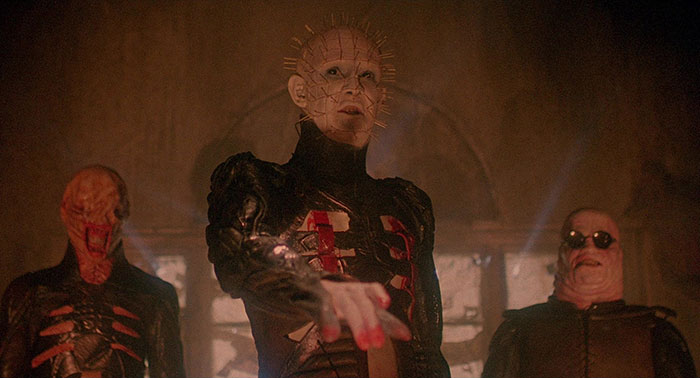
Hellraiser I II III: The Scarlet Box – Blu-ray Disc

Hellraiser1

Clive Barker’s Hellraiser (a.k.a. Hellraiser) (1987)
**/**** Image A Sound B+ Extras A
starring Andrew Robinson, Clare Higgins, Sean Chapman, Ashley Laurence
written and directed by Clive Barker

Hellbound: Hellraiser II (1988)
***/**** Image A- Sound A Extras A
starring Clare Higgins, Ashley Laurence, Kenneth Cranham, Imogen Boorman
screenplay by Peter Atkins
directed by Tony Randel

Hellraiser III: Hell on Earth (1992)
*/**** Image B Sound B Extras B
starring Terry Farrell, Doug Bradley, Paula Marshall, Ashley Laurence
written by Peter Atkins
directed by Anthony Hickox

by Walter Chaw Pinhead (Doug Bradley) looks menacing, but he’s actually just a leather-daddy who seems reluctant, most of the time, to do what other people think is in his job description. There’s a scene at the end of the first Hellraiser, the only one written and directed by creator Clive Barker, where Pinhead and his good-time boys and girls (“Cenobites,” if you must, an appropriation of another term for “monk”) are about to tear heroic Kirsty (Ashley Laurence) apart when she asks for a chance to explain something. Pinhead patiently hears her out. In the sequel, as she’s running away, rather than hooking her in place with their literal hooks on chains, Pinhead and his Cenobites send the chain to block her way, instead. They’re terrible villains, Cenobites. They’re fun to look at–Hellraiser‘s creature design is, of course, legendary, with Pinhead occupying a privileged place on the Mt. Rushmore of horror bogeys–but more mildly-disapproving Greek Chorus than Iron Maiden. Reason in part, I think, for why they were disastrously made into stock slasher villains in the third film: part wise-cracking Freddy Krueger, part Jason Vorhees rampaging psychopaths. The failure of that metamorphosis and the ensuing wrestling with what role Cenobites should ultimately occupy comprise the minor ups and horrific downs of the seven films (and counting) to follow. Maybe it’s in the name. Maybe the idea never was for the Cenobites, these dour, British, monastic, S&M losers, to be avenging angels, but rather for them to be precisely what they are: these drippy scolds who appear at the exact moment you go searching for more outré porn on an unprotected browser. One of a couple of Pinhead’s catchphrases doubles as a carnival barker’s patter: “We have such sights to show you.” His buddies represent that banner of geeks and sideshow freaks. But they’re not going to force it on you. In the pantheon of bad guys, they’re maybe the only ones who not only need but would like your consent, if you don’t mind, please and thanks ever so.

The Witch (2016) – 4K Ultra HD + Blu-ray + Digital

Witch3Please note that all framegrabs are from the 1080p version

The VVitch
****/**** Image A- Sound A- Extras B

starring Anya Taylor-Joy, Ralph Nelson, Kate Dickie, Harvey Scrimshaw
written and directed by Robert Eggers

by Walter Chaw Robert Eggers’s The Witch details a young woman’s coming-of-age as a thing of wonder and, to her Puritanical community, an incalculable and infernal threat. It has analogs in any number of films dealing with female sexuality, unlocking avenues for critical dissection. It parallels Osgood Perkins’s extraordinary February (a.k.a. The Blackcoat’s Daughter), rhyming it in not just tone but denouement, too, as young girls dance with the devil literally and metaphorically, and find it good. It parallels Jaromil Jireš’s Valerie and Her Week of Wonders in its tale of budding sex and the surreal phantasmagoria that explodes in the imagination around such a thing. It parallels Park Chan-wook’s Stoker, which shares a scene of illicit bliss and similarly decodes the incestuous loathing coiled in the belly of Hitchcock’s Shadow of a Doubt. Speaking of Hitchcock, The Witch parallels The Birds, where the intrusion of a woman’s heat makes things odd. There’s a moment in The Birds where heroine Melanie Daniels is confronted by a group of women who accuse her of causing Nature to go weird, while in The Witch, a family alone in the American pre-colonial wilderness blames eldest daughter Tomasin (Anya Taylor-Joy) for the same thing. In both cases, they’re right. The misfortune generally begins with menstruation or codes for the same–a blot of red on white cloth, a mention in The Witch that Tomasin has begun her period and thus should probably be sent to live with a different family as a servant in order to protect…well, not herself, anyway.

Pet Sematary (1989) – 4K Ultra HD + Blu-ray + Digital

Please note that all framegrabs are from the 1080p version

**½/**** Image A Sound A- Extras B
starring Dale Midkiff, Fred Gwynne, Denise Crosby, Brad Greenquist
screenplay by Stephen King, based on his novel
directed by Mary Lambert

“Machado would have traded every word, every poem, every verse he ever wrote for one more hour with his beloved. And that is because when it comes to grief, the normal rules of exchange do not apply, because grief transcends value. A man would give entire nations to lift grief off his heart, and yet you cannot buy anything with grief. Because grief is worthless.”
-Jefe (Rubén Blades), The Counselor

by Bill Chambers A VICE UK review of the recent Happy Death Day 2U came in for a shellacking on social media because of a click-baity tweet suggesting it was the “first” slasher movie about grief, a claim that only demonstrated a lack of expertise while making a sacrificial lamb of Happy Death Day 2U (which scarcely benefited from the bad-faith attention). Neither the headline nor the subheader of the review itself is as boldly specious, but there in the body of the piece is this: “Christopher Landon’s latest, Happy Death Day 2U[,] might be the first slasher that actually centers on dealing with grief.” (The headline–“‘Happy Death Day 2U’ Is More About Grief Than Horror”–nevertheless bothers me, too, incidentally: grief is horror.) So often accused of cynicism because they’re formulated to maximize a body count, slashers are engineered to comment on the capricious nature of existence, and the best ones seize on this to acknowledge the toll of loss on the survivors (Black Christmas (1974), Rob Zombie’s Halloween II)–while even the most mediocre ones tend to have a killer motivated by a deep and incurable sorrow (see: The Toolbox Murders (1978), the first Friday the 13th).

The Neverending Story (1984) – Blu-ray Disc

Neverendingstory2

The NeverEnding Story
**½/**** Image C+ Sound B
starring Noah Hathaway, Barret Oliver, Tami Stronach, Moses Gunn
screenplay by Wolfgang Petersen, Herman Weigel
directed by Wolfgang Petersen

by Walter Chaw SPOILER WARNING IN EFFECT. About two-thirds of the way through Wolfgang Petersen’s The NeverEnding Story, the warrior/child Atreyu (Noah Hathaway) encounters a mirror that reveals a person’s true self, and he discovers his reflection is that of Bastian (Barret Oliver, once synonymous with ’80s genre fare as the child star of Cocoon, D.A.R.Y.L., and the original Frankenweenie), the reader of Atreyu’s story. It’s a fascinating, Oedipal (read: Lacanian) moment where the hero, enlisted to save his world from an inexorable plague called “The Nothing,” realizes that his quest has led to himself and, more particularly, this self’s ability to bestow a name upon his kingdom’s stricken mistress (Tami Stronach). Atreyu encounters the mirror after he’s survived a pair of gatekeepers who test his perception of himself. He makes it, but barely–suggesting, maybe, that he knows he has an author, but hasn’t quite put together that he and his world are a boundless “piece of the hopes and dreams of mankind.”

Spider-Man: Into the Spider-Verse (2018) – 4K Ultra HD + Blu-ray + Digital

Spideyverse3Please note that all framegrabs are from the 1080p version

****/**** Image A Sound A Extras A-
screeplay by Phil Lord & Rodney Rothman
directed by Bob Persichetti, Peter Ramsey, Rodney Rothman

by Walter Chaw SPOILER WARNING IN EFFECT. Bob Persichetti, Peter Ramsey, and Rodney Rothman’s Spider-Man: Into the Spider-Verse, hereafter Spider-Verse, is a game-changer. It’s American anime, essentially, an Akira moment for our film art that will sooner or later be identified as the definitive event where everything tilted forward. I hope sooner. More than beautiful, it’s breathtaking. More than kinetic, it’s alive. And more than just alive, it’s seething with possibilities, self-awareness, a real vision of a future in which every decision in Hugh Everett’s quantum tree produces an infinite series of branches. It’s a manifestation of optimism. There’s hope in Spider-Verse, along with a reminder that more people in these United States believe in progressive values than don’t, no matter who the President is. Empathy and compassion hold the majority; there’s a recognition we are essentially the same–the same desires, the same disappointments. When a father tells his son he’s proud of him, it makes us cry because we identify with the entire spectrum of complexity such a conversation entails. When it happens in Spider-Verse, the son is unable to respond and the father is unable to see why, and the visual representation of the distance that can grow between fathers and sons is astonishingly pure. Turgenev never conceived a more graceful image on the subject. It’s perfect.

Venom (2018) – 4K Ultra HD + Blu-ray + Digital

00001.m2ts_snapshot_01.06.07_[2019.03.11_20.22.55]Note: all framegrabs were sourced from the 4K UHD disc

**/**** Image A- Sound A- Extras C+
starring Tom Hardy, Michelle Williams, Riz Ahmed, Scott Haze
written by Jeff Pinkner & Scott Rosenberg and Kelly Marcel
directed by Ruben Fleischer

by Bryant Frazer The history of Venom, a rippled black mass of sentient alien muscle with a ‘roided-out appearance and a gnarly personality to match, is complicated even for a comic-book origin story. It goes sorta like this: Way back in the 1980s, the Marvel Comics powers-that-be were looking to juice interest in Spider-Man. As a solution, they gave him a sleek black-and-white costume to replace the familiar red-and-blue outfit. Long story short, that suit turned out to be an alien symbiote with a mind of its own; it insinuates itself into human bodies and coexists with them in an ostensibly mutually beneficial relationship. It didn’t take long for Spidey to get wise and ditch the organism, but Marvel brought Spidey’s black-and-white look back later by having Black Cat sew him a non-sentient version of the costume. By then, Marvel was wooing artist Todd McFarlane to the book. Sure, McFarlane said, he was interested in Spider-Man–old-school, red-and-blue Spider-Man. So Marvel scrambled to once again get rid of the black outfit.

Ocean’s 8 (2018) – Blu-ray + DVD + Digital

Oceans81

Ocean’s Eight
*/**** Image A Sound B Extras D

starring Sandra Bullock, Cate Blanchett, Anne Hathaway, Helena Bonham Carter
screenplay by Gary Ross & Olivia Milch
directed by Gary Ross

by Walter Chaw Gary Ross’s Ocean’s Eight is the perfect nightmare: something you’re rooting for sociologically that’s artistically bad. It’s a film with an all-female cast that tries very hard to be racially diverse as well–unlike Paul Feig’s Ghostbusters, for example, which declines to show any Chinese people in its New York City, even though it’s set largely above a Chinese restaurant. Similarly, the kindest thing that could be said about Ocean’s Eight is that it’s strangely listless, aggressively mediocre, doggedly unmemorable, while the most accurate thing that could be said about it is that it could have benefited from people of colour in some kind of meaningful role behind the camera. The time is coming, hopefully soon, where movies that just take intellectual properties and recast them with women will also be written and directed by women–who, you know, probably have something to say about women. Although Olivia Milch, hyphenate behind the decent Dude (and probably the only reason Awkwafina got a shot at Ocean’s Eight, pre-Crazy Rich Asians), co-wrote this one with Ross, Ocean’s Eight has “glad-handing equivocation” written all over it. I don’t want to say it’s terrible, but…but, I really don’t. Best to say that Ocean’s Eight won’t ruin any careers because the women are already established stars and Gary Ross, as a white guy in the business, is essentially bulletproof and fire retardant, too. True equality, after all, is when women are allowed to make movies this awful and, like their male counterparts, don’t spend any time in movie jail for the offense, either.

12 Monkeys (1995) – Blu-ray Disc

12monkeys3

Twelve Monkeys
***½/**** Image A Sound A- Extras B
starring Bruce Willis, Madeleine Stowe, Brad Pitt, Christopher Plummer
screenplay by David Webb Peoples & Janet Peoples, inspired by the film La Jetée written by Chris Marker
directed by Terry Gilliam

by Bryant Frazer Twelve Monkeys is a movie about a moment. Yes, sure, it’s a decades-spanning science-fiction tale about time travel, the illusion of free will, and a romance at the end of the world. Yet its defining facet is its repeated, soulful depiction of a few terrible minutes in the life of a young boy who witnesses an event that’s tragic in ways he can’t comprehend. That’s how the story starts and how it ends, the first thing we see and also the last–a child’s eyes, open wide, as he is exposed to the spectacle of death, probably for the first time. Although Twelve Monkeys deals with the destruction of human civilization by a lethal contagion, and the plague’s aftermath, less of the action centres on the plague itself than on this little boy. Mostly, it’s concerned with a man named James Cole (Bruce Willis), who believes he’s a time-travelling agent sent back from the 2030s, after a small number of survivors retreat to the safety of underground caves. Liberated from a prison cell for the mission to contemporary Philadelphia (ground zero for the virus release), Cole is trying to discover information about its origins that can be used, decades hence, to help make the earth’s ruined surface safe for human habitation. Success means redemption, since Cole would return to his future world a hero. But in an ironic twist, Cole is almost immediately institutionalized; only psychiatrist Kathryn Railly (Madeleine Stowe), a specialist in “madness and apocalyptic visions,” and fellow patient Jeffrey Goines (Brad Pitt), who may be a nascent environmental terrorist, suspect Cole’s references to upcoming cataclysmic events may be more than just delusional.

Burning (2018) – Blu-ray + DVD

Burning1

****/**** Image A Sound A Extras D
starring Ah-in Yoo, Steven Yeun, Jong-seo Jun
screenplay by Oh Jung-mi & Lee Chang-dong, based on the short story “Barn Burning” by Haruki Murakami
directed by Lee Chang-dong

by Walter Chaw When she was seven, she fell into a dry well and spent a day there, crying up into the round sky until he found her. She’s Haemi (Jong-seo Jun), maybe 20 now, working as a live model with a bare midriff, standing on a busy street, dancing next to a prize-wheel and giving out “tacky” things to, predominantly, men buying raffle tickets from the pretty girl. He is Jongsu (Ah-in Yoo), of the perpetually slack expression. He doesn’t remember the well, nor rescuing her from it, nor the day he stopped her in the street on the way home from junior high to tell her she was ugly. “It’s the only thing you ever said to me,” she remembers. “I had plastic surgery. Pretty, right?” she asks him, but it’s rhetorical. They fuck in an awkward, desultory way, with him looking at how the sunlight bounces off a tower in downtown Seoul, into her tiny apartment. (She’s told him he’d be lucky to see it.) He goes back there to feed her cat while she’s in Africa, and masturbates absently to the afterimage of her picture as he stares out the window. When she returns from her trip, it’s on the arm of sexy, urbane Ben (Stephen Yeun). Ben likes Haemi because she cries–he doesn’t–and can fall asleep whenever and wherever. He enjoys her guilelessness. “What’s a metaphor?” Haemi asks Ben. Ben smiles in his empty way and tells her to ask Jongsu. Jongsu is, after all, an aspiring writer. “[Ben]’s the Great Gatsby,” Jongsu tells Haemi–young, wealthy, and mysterious. Jay Gatsby is a metaphor. Jongsu says that Korea is full of Gatsbys.