Annihilation (2018)

Annihilation

***½/****
starring Natalie Portman, Jennifer Jason Leigh, Gina Rodriguez, Oscar Isaac
written by Alex Garland, based on the novel by Jeff VanderMeer
directed by Alex Garland

by Walter Chaw

‘But when we sit together, close,’ said Bernard, ‘we melt into each other with phrases. We are edged with mist. We make an unsubstantial territory.’
–Virginia Woolf, The Waves

This is what I said. I said, “If you survive, you are this rare thing. We are members of an endangered species, you and I, born with this romance for self-destruction. Most of us don’t survive, or survive as something else. But if you do survive, in thirty years, maybe you find yourself across from someone your age now, telling them that there’s more to their story if they choose to read on. And it’s the most wonderful thing and it’s worth the pain of getting there.”

Black Panther (2018)

Blackpanther18

**½/****
starring Chadwick Boseman, Michael B. Jordan, Lupita Nyong’o, Andy Serkis
written by Ryan Coogler & Joe Robert Cole
directed by Ryan Coogler

by Walter Chaw There are issues Black Panther raises that I’m not equipped to discuss. I don’t understand them. I do understand that its closest analogues are Wonder Woman and Rogue One, in that these are deeply flawed films that, for particular audiences, hold a near-totemic value as representative artifacts. I can’t possibly express the joy and immense satisfaction I felt seeing Asian faces in a Star Wars film. I can’t possibly share in the same joy and sense of satisfaction that women got from Wonder Woman and that African-Americans will likely experience with Black Panther. They are all three films that you only really dislike from a position of privilege, and such is the conundrum of our current discourse. I will say that there are a handful of scenes in Black Panther that are as powerful statements of racial outrage as anything I’ve ever seen in mainstream cinema–that is, in a film that is not otherwise directly about slavery and the African-American experience. During its prologue/creation myth, I gasped at a scene of slaves, chained together, being led onto a slaver’s galley. There are moments so bold (if not reductive) that they’re genuinely breathtaking in their audacious impoliteness. Bold enough that some of my more conservative peers left the screening soon after a particular pronouncement about the legacy of slavery poisoning race relations into the modern day. At the end of it, a character proclaims they’d rather die than live in chains. It couldn’t get balder than that, nor more revolutionary. Yeah, man.

Jabberwocky (1977) [The Criterion Collection] – Blu-ray Disc

Jabberwocky2

**½/**** Image A- Sound B+ Extras B+
starring Michael Palin, Max Wall, Harry H. Corbett, John Le Mesurier
screenplay by Charles Alverson and Terry Gilliam, from the Lewis Carroll poem
directed by Terry Gilliam

by Bryant Frazer The pre-credits sequence of Jabberwocky features director Terry Gilliam’s ex-Python troupemate Terry Jones portraying a hunter collecting trapped wild animals from a pastoral forest as shafts of sunlight stab through tree branches and featherlight moths flit among the leaves. The natural beauty is subverted, ominously, by point-of-view shots taken from far overhead, accompanied by boomy, creature-feature sound design (think Jaws, released a couple of years previous), suggesting the hunter is also the hunted. Jones glances around quizzically, a dopey, open-mouthed expression plastered across his face. With a jump cut, he turns suddenly towards the camera, wide-eyed and screaming in extreme close-up. The camera pulls back from the ground and carries Jones with it, still yelling and beating his arms frantically in the air. He jerks his head this way and that, his tongue lolling about in and around his mouth, delivering a death scene of such unexpected intensity that it’s hard for an audience to know how to respond. Is it scary, or hilarious? Or just…goofy?

Geostorm (2017) – Blu-ray + DVD + Digital

Geostorm3

½*/**** Image A- Sound A Extras C+
starring Gerard Butler, Jim Sturgess, Abbie Cornish, Andy Garcia
screenplay by Dean Devlin & Paul Guyot
directed by Dean Devlin

by Bill Chambers SPOILER WARNING IN EFFECT. It’s the near future. Not much has changed, except the President isn’t totally repulsive, “HoloFrames” have supplanted cell phones, and climate change is no longer an immediate threat, thanks to the creation of a global weather-management system called Dutch Boy, after the story of the little Dutch boy who plugs a leak in a dike with his finger. (Like all those movie scientists who’ve named their game-changer “Icarus,” the christeners of Dutch Boy should’ve read to the end of the story.) Gerard Butler’s Jake Lawson scienced Dutch Boy together but got kicked off the project when he switched it on ahead of schedule. Now, with the damn thing turning miles of Afghanistan desert into frozen tundra, White House lackey Max (Jim Sturgess with inexplicable hair) knows there is only one man who can get to the bottom of this glitch: his estranged brother Jake, who reticently returns to the International Climate Space Station (ICSS), leaving young daughter Hannah (Talitha Bateman) to fret for his safety and narrate the film for that soupçon of folksiness. More incidents accumulate both on the ground and miles above the earth, including a terrifying ordeal for a lady in a bikini who’s cornered by a flash-freeze wave, leading Jake and Max to believe that President Palma (Andy Garcia) might be plotting a planet-wide attack of hellish weather–a “geostorm,” if you will–in order to impede Dutch Boy’s upcoming transfer of ownership from America to “the world.”

Jumanji: Welcome to the Jungle (2017)

Jumanji2

*½/****
starring Dwayne Johnson, Jack Black, Kevin Hart, Karen Gillan
screenplay by Chris McKenna & Erik Sommers and Scott Rosenberg & Jeff Pinker, based on the book Jumanji by Chris Van Allsburg
directed by Jake Kasdan

by Walter Chaw Inexplicably named after a Guns N' Roses song, Jumanji: Welcome to the Jungle (henceforth Jumanji 2) is a deeply problematic film that castrates its smartest ideas in order to please the broadest possible audience on opening weekend before dragging itself off somewhere to show up in a Redbox in a few months' time. Start with Kevin Hart–reunited with his Central Intelligence co-star, Dwayne Johnson–playing a porter, essentially, in a jungle adventure. Which, you know…what the actual fuck? I'm sure it means well, and Hart's threadbare shtick of being short and put-upon certainly fits the situation, but there's opportunity here, should director Jake Kasdan have chosen to take it, for Hart to comment on how degrading it is for a star of his stature to be appearing in a movie as Bagger Vance. He doesn't seem to notice there's baggage related to his playing a character who essentially carries a bag and hands weapons to the hero. He complains about it, though mostly he complains about not being able to run very fast and having one of his avatar's weaknesses be pound cake.

Star Wars: The Last Jedi (2017)

Lastjedi

Star Wars: Episode VIII – The Last Jedi
***/****
starring Mark Hamill, Carrie Fisher, Adam Driver, Benicio Del Toro
written and directed by Rian Johnson

by Walter Chaw I wrestled for a long time with this review. Not what I would write but whether I should write it at all. I consider director Rian Johnson to be a friend. He’s kind, smart, true, and unaffected despite having been handed the reins to the most revered American mythology–save for becoming somehow more humble during the course of it. In the middle of a period in which everyone in the business, it seems, is being outed as a cad, Rian is something like hope that there are good and decent men left. Star Wars: Episode VIII – The Last Jedi (hereafter The Last Jedi) is every inch his movie. It’s about hope, see, and hope is the word that’s repeated most often in his script. By the end of it, he suggests that hope can even grow from salted earth. It’s a beautifully-rendered image as open, guileless-unto-corny, and genuine as Rian is. I don’t love everything in the film, but I do love Rian and The Last Jedi as a whole. In a franchise this venerated and valuable, it’s ballsy as fuck that he decided to do his own thing and that Disney let him. Now they’ve decided to invest another $600M or so in letting him do his own thing some more.

Justice League (2017)

Justiceleague

*/****
starring Ben Affleck, Henry Cavill, Gal Gadot, Amy Adams
screenplay by Chris Terrio and Joss Whedon
directed by Zack Snyder

by Walter Chaw Marrying the worst parts of Zack Snyder with the worst parts of Joss Whedon (who stepped in to complete the film after Snyder had a family tragedy), DC’s superhero team-up dirge Justice League shambles into unnatural half-life with a message of apocalyptic doomsaying presented now without puke filters, so that it looks like a movie my mom watches on her television with the motion-smoothing turned on. The same trick has been attempted with a script burdened by Whedon’s patented hipster-ese, which went stale about halfway through “Buffy”‘s run, let’s face it. The Flash’s non sequiturs (Whedon’s suggesting he’s autistic (which isn’t funny)), Aquaman’s hearty, get-a-haircut bro-clamations (“I dig it!” and “Whoa!” and so on)–all of it is so poorly timed that it’s possible to become clinical about what happens when a punchline is grafted onto a piece at the eleventh hour, and it doesn’t help that no one in this cast is known for being even remotely funny or glib. Jason Momoa is a lot of things; Noël Coward ain’t one of them. When Wonder Woman (Gal Gadot) shakes her head bemusedly (I think) and says warmly (I guess), “Children. I work with children,” you get that sick, embarrassed feeling that happens when you’re watching a person you want to like succumb to flop sweat and overrehearsal.

Thor: Ragnarok (2017)

Thorragnarok

**½/****
starring Chris Hemsworth, Tom Hiddleston, Cate Blanchett, Anthony Hopkins
written by Eric Pearson and Craig Kyle & Christopher L. Yost
directed by Taika Waititi

by Walter Chaw I’ve reached a limit with facility, I think–a point at which things that are professionally executed and entirely meaningless just slide off into a kind of instant nothingness. I’m talking about machine-tooled product, a brand like Kleenex or Kellogg’s, where the only time there’s any awareness of consumption is when the experience of it is unexpected in some way. There’s a reason people see the Virgin Mary in potato chips sometimes. Variation in extruded products is so exceedingly rare that it’s akin to holy visitation: some accidental proof of the supernatural; a glitch in the Matrix. Marvel films are akin now to your daily lunch. You can remember the stray meal. Mostly, it’s something you do knowing you’ve had one yesterday and are likely to have one tomorrow. If you’re like most of us, you could probably eat better.

Telluride ’17: The Shape of Water

Tell17shapeofwater

***/****
starring Sally Hawkins, Doug Jones, Michael Shannon, Richard Jenkins
screenplay by Guillermo del Toro & Vanessa Taylor
directed by Guillermo del Toro

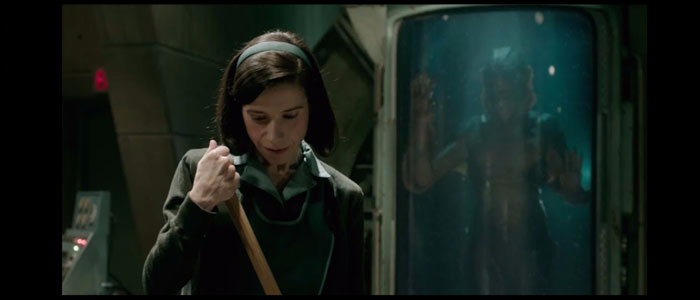
by Walter Chaw I watched Guillermo del Toro's The Shape of Water in a packed auditorium in Telluride, CO as a torrential rainstorm pounded the roof of what is, outside of the festival, an ice-skating rink, perched there with a park in front of it, the headwaters of the San Miguel to one side and the mountains to the other and all around. As the main character, cleaning lady Eliza (Sally Hawkins), turned on water for her bath, the cascading cacophony in the theatre joined in with a warm insularity I always equate with the Mandarin term for "cozy": two words that mean, or at least sound like they mean, "warm" and "noisy." The Shape of Water is like that, too, a gothic romance in the new del Toro style (after Crimson Peak, which, for me, was more noisy than warm, but mileage varies), which del Toro introduced as the evocation of a fantasy he had as a child upon watching Creature from the Black Lagoon in which the Creature falls in love with the girl and they live happily ever after. That's it, and were that truly it, The Shape of Water would be an instant classic rather than an acquired taste, perhaps–a future cult classic, certainly, that is forgiven for its odd digressions while justly-celebrated for its audacity. It's a triumph when it focuses in on the essential loneliness of misfits (the melancholic, Romanticist engine that drives del Toro's Hellboy movies), but in a subplot involving Russian spies, it becomes for long minutes time spent away from what works in favour of time spent with what doesn't. When del Toro has allowed intrusions like this in the past (see: his early masterpieces The Devil's Backbone and Pan's Labyrinth), it's been up to us to infer the connection between his dark fables and his political concerns. Here he brings the subtext into text at a cost to the "warm/noisy" coziness of his work. For del Toro, insularity is a strength.

The Dark Tower (2017)

Darktower

**/****
starring Idris Elba, Matthew McConaughey, Tom Taylor, Jackie Earle Haley
screenplay by Akiva Goldsman & Jeff Pinkner and Anders Thomas Jensen & Nikolaj Arcel
directed by Nikolaj Arcel

by Walter Chaw If I cared or knew one thing about Stephen King’s revered Dark Tower series, I’d probably really hate this movie in exactly the same way I initially hated Francis Lawrence’s Constantine. I was a devotee of the Vertigo sub-line of DC comics through the early-’90s–the one that produced titles like Neil Gaiman’s “The Sandman”, Jamie Delano’s “Animal Man”, Grant Morrison’s “Doom Patrol”, and Delano/Garth Ennis’s “Hellblazer”, which of course formed the basis for Lawrence’s picture. But I don’t. Care about The Dark Tower, that is. For all that King once meant to me as a kid, it and The Stand were two of his epics I could never get into. I missed the window on Tolkien, too. And in not caring and in my complete ignorance, I like Nikolaj Arcel’s The Dark Tower about as much as I like Constantine now, not needing the four or five years to come to terms with how it doesn’t jibe with images and rhythms I’d conjured in my jealous nerd-dom. (I maintain, however, that if they were going to make Constantine a Yank, they should’ve cast Denis Leary.) In The Dark Tower, the main hero is a kid named Jake (Tom Taylor) who, one day, discovers that all those crazy dreams he’s been having, which have led to all those creepy-kid drawings plastering his bedroom walls, are TRUE. Why won’t you listen to Jake, adults? Obviously modelled after the kid in Last Action Hero, Jake dreams of a dark tower that is not Idris Elba that is under attack by the evil Man in Black, who is not Johnny Cash but is named Walter and is played by Matthew McConaughey. My favourite moment in the film is when Walter shows up in Jake’s parents’ kitchen, frying something on the stove, explaining apologetically that where he’s from, there’s no chicken.

Valerian and the City of a Thousand Planets (2017)

Valerian

*½/****
starring Dane DeHaan, Cara Delevingne, Clive Owen, Rutger Hauer
written for the screen and directed by Luc Besson

by Walter Chaw Effortlessly, almost guilelessly sexist in the way that only a 12-year-old with lacklustre breeding can be, Luc Besson’s latest opus of antsy expressionism, Valerian and the City of a Thousand Planets (hereafter Valerian), is so relentlessly puerile, so unapologetically awful, that there’s absolutely no chance it won’t become a midnight masterpiece. Not one of the good ones, like Besson’s own The Fifth Element or The Professional (or The Messenger, curiously the most historically accurate Joan of Arc film), but one of the ones that are the feature-length equivalent of that repetitive noise your 9-year-old son makes when you’re driving him to a friend’s house. It’s an interminable adaptation of the Ruby Rhod sequence from The Fifth Element, an endurance test of unusual cruelty and imagination. If you’re sensing some grudging admiration for it, you’re not wrong. It’s like going to a torture museum and marvelling at the level of invention and craftsmanship dedicated to the methods to which humans go to discomfit one another. Some of that sadistic shit is worth millions–priceless, even.

War for the Planet of the Apes (2017)

Warfortheplanetoftheapes

**½/****
starring Andy Serkis, Woody Harrelson, Steve Zahn, Amiah Miller
written by Mark Bomback & Matt Reeves
directed by Matt Reeves

by Walter Chaw There are two problems that plague War for the Planet of the Apes. The first is that this far along into a franchise, it becomes a real burden to deal with the lore of eight (is it eight?) previous instalments; the second is that Rise… and Dawn of the Planet of the Apes, this sequel’s two immediate predecessors, are so subtle and intelligent that there’s a real danger now of being too “on the nose” in trying to keep up with them. That co-writer/director Matt Reeves is able to wrangle both tigers to the extent that he does speaks to his skill. That he’s not able to entirely avoid a mauling speaks to the near-impossibility of the task. What was before an elegant parable of race and tribalism, dehumanization and Turing empathy tests, is now well and truly a blockbuster franchise product. It’s good, don’t get me wrong, but it’s obvious, transitioning from a very fine, elegiac western like a late Ford or an any-time Anthony Mann into, by the end, first a broad and winking take on Apocalypse Now, then a carefully-narrated Moses allegory. Consider a moment where the ersatz Kurtz, The Colonel (Woody Harrelson), speaks to our chimp hero Caesar (a motion-captured Andy Serkis) about the cost of vengeance and the sacrifices made during war that allow him to paint himself as Abraham even as he transitions into Pharaoh. Everyone’s fantastic in the scene; the problem is that its expository payload is mainly meant to set up the Charlton Heston film that started it all. Too, it confuses the characters of its parables in such a way as to suggest, uncomfortably, a connection between Jews and their persecutors, and a concentration camp/Egyptian slave narrative involving the persecution of apes for cheap labour only adds to the confusion. Oh, also, they’re building a wall that Caesar calls “madness” that will solve nothing.

Spider-Man: Homecoming (2017)

Spidermanhomecoming

**½/****
starring Tom Holland, Michael Keaton, Jon Favreau, Robert Downey Jr.
screenplay by Jonathan Goldstein & John Francis Daley and Jon Watts & Christopher Ford and Chris McKenna & Eric Sommers
directed by Jon Watts

by Walter Chaw A painfully adequate entry in the ever-expanding MCU, Spider-Man: Homecoming has the benefit of a brilliant young lead in Tom Holland and a fantastically-layered villain turn by Michael Keaton, but it bears the burden of all the films that came before it and all those yet to come. There’s a lot of checking-off of boxes, in other words, with Homecoming reminding most of Ant-Man in that there seems to be a good standalone movie in here somewhere that keeps getting diverted into looking backwards and forwards. There was an episode of “St. Elsewhere” where a patient believed himself to be Mary Richards of “The Mary Tyler Moore Show”. Midway through, he spots Betty White, who had a recurring role on “St. Elsewhere”, and calls out “Sue Ann!,” the name of her character on “Mary Tyler Moore”. Both programs were produced by MTM, by the way, the company founded by Moore and ex-husband Grant Tinker. To enjoy that episode of the show completely would require knowledge of the “The Mary Tyler Moore Show” and its production company. It’s a living example of the concept of post-modernism: a product based on nothing but itself and reliant entirely on the insular knowledge of a small group of fetishists. Such is the fire in which fandom is born, and Spider-Man: Homecoming is the natural product of that: an origin story that doesn’t provide an origin because the previous incarnations of this story have provided it already; and film number 19 or 20 or something in a series that includes television shows and comic-book runs that, at this point, would require someone with absolutely nothing else to do to keep track of it. That’s another fire in which fandom is born.

Cars 3 (2017)

Cars3

**/****
screenplay by Kiel Murray and Bob Peterson and Mike Rich
directed by Brian Fee

by Walter Chaw I don’t understand very much about the Cars universe. I don’t understand its rules. Do the sentient cars feel pain? What part of them needs to “die” in order for them to die? The implication is that the voice actor needs to die, but even then the Paul Newman-voiced “Doc” is resurrected (along with Tom Magliozzi’s “Rusty”) in Cars 3 through the miracle of old voice outtakes and flashback sequences. It raises questions about sentience in a Blade Runner sort of way. It invites speculation that this is all a post-apocalyptic nightmare in which our “smart” cars have either outlasted, or outwitted, their primate creators. I wonder, too, about how they reproduce, as these films have always been clear that there are “children” in this universe. Or are they like child vampires: wizened monsters trapped in infant chassis? When I look at a sentient ambulance in this one’s central “Flesh Fair” demolition-derby sequence and how its patient bay is built for a human-sized customer and not a car, well…it raises questions. And let’s talk about the idea of a demolition derby in a film populated entirely by thinking, feeling cars. What would the human equivalent to this be? Thunderdome? It’s worth a conversation, though it’s not the conversation Cars 3 wants to have.

The Mummy (2017)

Themummy2017

*/****
starring Tom Cruise, Sofia Boutella, Annabelle Wallis, Russell Crowe
screenplay by David Koepp and Christopher McQuarrie and Dylan Kussman
directed by Alex Kurtzman

by Walter Chaw It took me a while but it finally clicked about an hour into Alex Kurtzman’s hilarible The Mummy that the whole thing wasn’t a really bad movie, but a really bad videogame in bad-movie form. It has the same alternating cadence of leaden exposition drop, interminable and hideously- animated/performed cut-scene, and standard FPS-strictured gameplay culminating in a boss fight. Envisioned as the launch for Universal’s “Dark Universe” franchise (in which the pantheon of classic Universal Monsters are given gritty action reboots, League of Extraordinary Gentlemen-style), it finally functions as a first-generation “Resident Evil” port in which the dialogue, for what it’s worth, was written in Japanese, translated into English, and performed by 64 pixels stacked on top of each other. Awkward doesn’t begin to describe the desperation with which all involved try to seductively reveal/hide their Dark Universe™ Easter eggs while hobbling from one big, button-geeking, CGI-hobbled moment to the next. Look, behind those dust zombies: it’s Dr. Frankenstein’s lab!

Wonder Woman (2017)

Wonderwoman

**½/****
starring Gal Gadot, Chris Pine, Robin Wright, Danny Huston
screenplay by Allan Heinberg
directed by Patty Jenkins

by Walter Chaw Patty Jenkins’s Wonder Woman gets it. I knew it the instant Wonder Woman (Gal Gadot), stationed in a trench on the Western Front sometime in the last days of the Great War, decides not to let people she could be saving die and climbs into the poignantly-named “No Man’s Land.” “No Man’s Land,” right? But maybe a woman’s. The fight choreography isn’t very good here, but the film is less about that than it is about why we fight. It asks that question a lot. At the moment of crisis, once Wonder Woman realizes who she is and defines herself as a hero, she declares that she fights for love. It’s more courageous to say something like that, baldly and unashamedly, in this, our age of sophisticated, sardonic, superior detachment. That’s why I cried when she climbs into battle in an unwinnable conflagration, because, you know, this is the DC movies harking back to the Christopher Reeve Superman to present us with a nostalgic view of superheroes, from when they cared a lot about us. When they fought for love and not Byronic self-actualization or to avenge some petty slight. When our heroes believed in us, more than we believe in ourselves. When they were, in fact, the best version of who we wanted to be.

Pirates of the Caribbean: Dead Men Tell No Tales (2017)

Pirates5

*/****
starring Johnny Depp, Javier Bardem, Brenton Thwaites, Geoffrey Rush
screenplay by Jeff Nathanson
directed by Joachim Ronning and Espen Sandberg

by Walter Chaw Pirates of the Caribbean: Dead Men Tell No Tales (hereafter Pirates 5) is stultifyingly boring, which is interesting because lots of stuff happens in it, constantly. It's guilty of a kind of antic, Brownian motion that suggests all of the repugnance inspired by a bivouac of army ants and none of the creepy sense of underlying order. It's like watching stirred tea: brown and insensible. Just like. Consider the first major set-piece, in which our jolly Roger, Captain Jack Sparrow (Johnny Depp, starting to look like those leather bags you find at Himalayan shops), conspires with his truncated crew to steal a giant iron safe and ends up stealing the entire bank. The entire bank, savvy? Compare it against the brilliance of the train sequence in 2013's The Lone Ranger to appreciate exactly how underestimated that film was, and exactly how estimated this one is. There's a team of horses, a little person, a building being dragged through an island town, shit flying everywhere, and Capt. Jack doing Buster Keaton if Buster Keaton weren't an artist and were, instead, an aging actor most of the audience is beginning to suspect is playing himself now. Later, there's a cameo by Paul McCartney and, you know, same, same. The posture is rock 'n' roll when really it's one of those "Top of the Charts" cover compilations gamely put together by the house band. It sucks. If it makes you feel cheated, well, you were.

King Arthur: Legend of the Sword (2017)

Kingarthur17

***/****
starring Charlie Hunnam, Astrid Bergès-Frisbey, Djimon Honsou, Eric Bana
screenplay by Jody Harold and Guy Ritchie & Lionel Wigram
directed by Guy Ritchie

by Walter Chaw This is the part where I confirm I've read my Malory and Pyle, my T.H. White, of course. That I've seen Excalibur and Monty Python and the Holy Grail and The Sword in the Stone and any number of First Knights, including even Unidentified Flying Oddball, which I loved when I was a kid easily-scarred by that weird android doppelgänger of Dennis Dugan's wayward astronaut. I was a big fan, too, of Choose Your Own Adventure #86: Knights of the Round Table. In other words, one of the most popular Western myths went pile-driving through the three decades of my relative cultural sentience. When I had a brief obsession with WWII, I brushed up on all the literature just to better understand why the British saw Churchill as the Once and Future King. Just last year, one of 2016's best films, Jackie, featured an extended sequence in which the titular widow wandered through the White House listening to the score from Camelot. Even my early Lego fantasies with the Castle playsets featured an adultery subplot where my French best friend made off with my Queen. I'm not a fan, then, so much as a victim of the mythology's ubiquity.

Guardians of the Galaxy Vol. 2 (2017)

Guardiansofthegalaxy2

**/****
starring Chris Pratt, Zoe Saldana, Dave Bautista, Kurt Russell
written and directed by James Gunn

by Walter Chaw Twice as desperate/half as good, James Gunn’s Guardians of the Galaxy Vol. 2 (hereafter GOTG2) is still sort of fun even if the moments of delirious, spontaneous joy we’d come to know from the previous film are few and far between. Arguably, only the opening title sequence, which seems to make sport a little tiny bit of the marketing insanity around “Dancing Baby Groot,” really hits the right balance of self-knowledge and sticking the landing. Consider, though, that even in that sequence there’s too long spent on the same “stoplight” gag from the first film’s mid-credits scene where Groot (voiced by Vin Diesel) stops dancing whenever Drax (Dave Bautista) looks at him. When you’re making a hip in-joke reference to a stinger buried in the end titles of your prequel, you’ve gone deep into the post-modern. Absent, too, for the most part, is the ease of “Vol. 1″‘s familial subplot, dragged as it is into the foreground and forced into exposition as each troubled member of the titular gang has a moment to wax eloquent (and at length) about how they only ever wanted a dad/sister/family/daughter/wife/son/I get it already. What’s left is a movie that feels arrogant, somehow, as though it knows by its nature that it’s critic proof and will make a bajillion dollars and is now the 800lb gorilla in the Marvel room. Just exactly like that, come to think of it.

Rogue One: A Star Wars Story (2016) – Blu-ray + DVD + Digital HD

Rogueone1

Rogue One
***½/**** Image A Sound A Extras B-

starring Felicity Jones, Diego Luna, Ben Mendelsohn, Alan Tudyk
screenplay by Chris Weitz and Tony Gilroy
directed by Gareth Edwards

by Walter Chaw A deep cut for Star Wars fanatics, Gareth Edwards’s Rogue One: A Star Wars Story also happens to be the single most topical fiction of 2016, talking as it does–in bold, melodramatic strokes befitting a space opera–about the importance of rebellion in the face of fascism. “Order,” says Empirical stooge Krennic (Ben Mendelsohn). “Terror,” corrects brilliant weapons engineer Galen (Mads Mikkelsen). And the representative of the fascist regime smiles, as though it were all just a matter of semantics, this idea that terror and order are opposite sides of the same devalued coin. He’s engaged in a kind of political double-speak, in gaslighting–things that until this year were the scourge of banana republics and other backwards backwaters. The Empire that Krennic represents needs Galen to help them complete their Death Star superweapon, with the ’80s-era Reagan/Thatcher rationale that overwhelming destructive deterrents are the only way to truly keep the peace. Galen is compelled to cooperate to keep his daughter, Jyn (Felicity Jones), safe and anonymous in the protection of violent revolutionary Saw (Forest Whitaker). The rest is Jyn’s quest to clear her father’s name by stealing plans for the Death Star and delivering them to a fractured resistance that isn’t entirely sure if it wouldn’t be a good idea to give the Empire a chance. You know, maybe they won’t do all the things they said they were going to do?