G.I. Joe: Retaliation (2013)

Gijoe2

*½/****
starring D.J. Cotrona, Byung-hun Lee, Adrianne Palicki, Dwayne Johnson
screenplay by Rhett Reese & Paul Wernick
directed by Jon M. Chu

by Angelo Muredda While it’s easy to snicker at a title sequence that boasts of “Characters by Hasbro,” G.I. Joe: Retaliation (hereafter Retaliation) is the kind of movie you root for. After the banality of predecessor Stephen Sommers, John M. Chu is an inspired choice of director. This is a guy who’s made his name by bringing elegance and agility to his two attempts at the surprisingly bullet-proof Step Up franchise. There was reason enough, then, to hope his preference for long takes and earnest interest in bodies in motion would translate to a franchise inspired by a line of action figures. After all, such baubles are nothing if not fetish objects, their biceps studied by the faithful with a mad love usually reserved for dancers, matinee idols, and wrestlers. What better meeting of the three than a project steered by the director of dance films and anchored by Channing Tatum and Dwayne Johnson, née The Rock?

The Hobbit: An Unexpected Journey (2012) – Combo Pack: Blu-ray + DVD + Ultraviolet

Hobbit1

½*/**** Image A Sound A+ Extras B
starring Ian McKellen, Martin Freeman, Richard Armitage, Andy Serkis
screenplay by Fran Walsh & Philippa Boyens & Peter Jackson & Guillermo Del Toro, based on the novel by J.R.R. Tolkien
directed by Peter Jackson

by Walter Chaw Shot at a vaunted 48 frames-per-second to better approximate the television soap opera its mammoth length suggests, Peter Jackson’s vainglorious trainwreck The Hobbit: An Unexpected Journey (hereafter “Hobbit 1“) looks for all intents and purposes like its own porn knock-off. A technological “advancement” that is to the naked eye identical to any episode of reality television or live sporting event you’ve been watching in your living room for years, the 48fps “breakthrough” was for Jackson a way of making the increasingly unpopular new-gen 3-D a little bit less crappy. It’s like putting a dress on a pig. Understand, complaints about “HFR” are not akin to the bellyaching about colour film or CinemaScope, since those innovations didn’t actively cheapen the moviegoing experience. The irony of all that being, of course, that while the image indeed doesn’t stutter or blur as much in 3-D, what we’re forced to look at is overlit, obviously artificial, and reminded me more than once of the jarringly amateurish “Star Wars Holiday Special”.

The Man Who Knew Too Much (1934) [The Criterion Collection] – Blu-ray Disc

Manwhoknewtoomuch34

***½/**** Image A Sound B Extras A+
starring Leslie Banks, Edna Best, Peter Lorre, Nova Pilbeam
screenplay by Charles Bennett, D.B. Wyndham-Lewis, Edwin Greenwood and A.R. Rawlinson
directed by Alfred Hitchcock

by Walter Chaw The first fascination of Alfred Hitchcock’s original The Man Who Knew Too Much is that when a dashing foreign agent (Pierre Fresnay) is shot just minutes into the film, it’s Jill (Edna Best), the wife in the heroic central couple, who’s privy to his last words. They’re dancing together in the middle of a ballroom that feels like a glass cage (naturally) when the dastardly deed is done, a married English woman on holiday with husband Bob (Leslie Banks) and daughter Betty (Nova Pilbeam), who look on approvingly. When Hitchcock remakes this movie 22 years later with Doris Day and Jimmy Stewart, he has Ugly American Jimmy (the one privy to the dying man’s last words) drug his hysterical wife in the first of many instances of Hitchcock undermining Stewart’s status as everyone’s favourite Yank. 1934’s The Man Who Knew too Much, like so much of Hitchcock’s British output (this is the first of his six films for Gaumont), remains current for scholars looking for tropes, images, sequences that prefigure his later work. The premature demise of what would have traditionally been the star of the picture (poor, dead Louis, also a champion ski-jumper) prefigures Psycho, of course, while the glass cages recur everywhere from Young and Innocent (which likewise features the musical plot point of this film) to Notorious to Hitch’s collaborations with Tippi Hedren. A gaze at the 34-minute mark through wrought-iron gates predicts the moment of discovery in Strangers on a Train, followed fast by a deliciously uncomfortable dentist sequence I’m surprised Hitch never came back to. Leave that, I suppose, to William Goldman and Marathon Man.

Peter Pan (1953) [Diamond Edition] – Blu-ray + DVD + Digital Copy

Peterpan1

**/**** Image B+ Sound A Extras B+
directed by Hamilton Luske, Clyde Geronomi, Wilfred Jackson

by Bill Chambers Since the 1950s, mainstream audiences have grown up knowing Walt Disney’s Peter Pan as the definitive adaptation of J.M. Barrie’s play and its subsequent novelization (Peter and Wendy), and that’s a mixed blessing. For everything the Disney movie does well, like the swashbuckling, it does something horribly wrong, like compounding Barrie’s 19th-century notions with retrograde values all the movie’s own. For instance, the English Barrie may have regarded Native Americans as exotic creatures by locating them in Never Land, but it’s Disney who immortalized them in literal red skin, then gave them a song celebrating their mono-syllabic cretinism:

The Bourne Legacy (2012) – Blu-ray + DVD + Digital Copy + Ultraviolet

Bournelegacy1

½*/**** Image A+ Sound A Extras B-
starring Jeremy Renner, Rachel Weisz, Edward Norton, Stacy Keach
screenplay by Tony Gilroy & Dan Gilroy
directed by Tony Gilroy

by Walter Chaw By the end of Tony Gilroy’s unbearably long and talky The Bourne Legacy, one is left feeling as though the film hasn’t even started yet. Nothing happens in it, and the only thing it inspires is anticipation: it’s all first act; all supplementary material; all self-importance and hot air. Jason Bourne (Matt Damon) sits this one out while another similar soldier, Aaron Cross (Jeremy Renner), occupies a space parallel to the first three films, climbing mountains, Grey-ing wolves, and saving hot virologist Dr. Marta (Rachel Weisz) from the clutches of our evil government so that she can infect him with a virus that makes him smart. This leads to a moment, inevitable, where Cross suggests that losing 12 points off his artificially inflated IQ would result in some personal “Flowers for Algernon” apocalypse where 12 points would probably result in him forgetting his phone number at worst. It also leads to a series of incoherent flashbacks that fit in perfectly with Gilroy’s impossible-to-follow action sequences; if you’re just going to turn a camera on and throw it out a window, why bother trying to set it up? For those keeping score, there are more spinning Lazy Susan shots here than in Transformers: Asshole. You’ve been warned.

The Dark Knight Rises (2012) – Blu-ray + DVD Combo Pack

The Dark Knight Rises (2012) – Blu-ray + DVD Combo Pack

***½/**** Image A- Sound A+ Extras A-
starring Christian Bale, Michael Caine, Gary Oldman, Anne Hathaway
screenplay by Jonathan Nolan and Christopher Nolan
directed by Christopher Nolan

by Walter Chaw For all its overreaching (and what’s perilously close to a training montage), Christopher Nolan’s The Dark Knight Rises is fascinating, engaging, and aggressively present. It’s a wonderfully-performed melodrama about the sad, intractable state of our sorry state, painted in broad strokes in a muted palette. It’s what many would think impossible despite the evidence of its predecessor: a comic book for grown-ups. And it accomplishes what it sets out to do without much in the way of action sequences or hero moments–the irony being, of course, that The Dark Knight Rises is fated to become the best-reviewed and most-lucrative release of 2012 for having the very same qualities for which the deeply-underappreciated Superman Returns was lambasted. I would argue that a wide swath of the people who will adore it will have difficulty articulating exactly why.

ParaNorman (2012) – Combo Blu-ray + DVD + Digital Copy

Paranorman3

**½/**** Image A Sound A Extras B
screenplay by Chris Butler & Sam Fell
directed by Chris Butler

by Walter Chaw Norman (voiced by Kodi Smit-McPhee) can see and speak with ghosts, which, if you squint a little, is only a metaphor for the kind of sensitivity that, in a boy, will invariably lead to about a decade of being brutalized by his disconnected male peer group. (Everything will change once he invents Microsoft or Pixar.) Norman’s chief tormentor is barely-verbal Alvin (Christopher Mintz-Plasse, already past his sell-by date); his shallow and image-obsessed teenaged sister with a heart of gold™ is Courtney (the awesome Anna Kendrick), who has the hots for the captain of the football team, pre-verbal Mitch (Casey Affleck); and Norman’s best friend, whether he likes it or not, is Mitch’s weird, fat little brother, Neil (Tucker Albrizzi). The first problem of ParaNorman is that, in its rush to be sensitive to intelligent outcasts like Norman and Neil, it dehumanizes and mocks its tormentors, robbing them of the depth and complexity that would have resulted in a better film than this beautifully-wrought, entirely predictable package. (It’s like a jack-in-the-box made by Faberge.) The only moment in which one of these “inside” characters is given any kind of depth (it’s Mitch) is used as a sort of sitcom punchline that doesn’t lend the moment gravity so much as it continues the road of taking sloppy aim at an easy target.

Skyfall (2012)

**/****
starring Daniel Craig, Javier Bardem, Ralph Fiennes, Judi Dench
screenplay by Neal Purvis & Robert Wade and John Logan
directed by Sam Mendes

by Walter Chaw For me, the James Bond films are the literalization of a very particular Conservative fantasy in which a suave, quippy, emotionally-arrested sociopath battles Cold War foes, beds beautiful women without consequence, always has the latest technology, and engages in the endless murder of foreigners. Just suggesting a “license to kill” reveals a certain level of arrogance; and it’s their confrontation of the noisome wake left by those attitudes that makes On Her Majesty’s Secret Service and the more recent Casino Royale the powerhouses they are. Skyfall, the latest in the decades-spanning series, tries but fails to do the same. A good part of the problem can be traced back to non-action director Sam Mendes (superseding Marc Forster, non-action director of the disastrous Quantum of Solace), who, in trying to honour the visceral requirements of the genre, finds himself unable to produce either a meaty melodrama or a capable action vehicle.

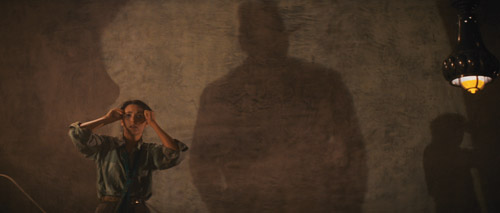
Indiana Jones: The Complete Adventures – Blu-ray Disc

Raiders3

RAIDERS OF THE LOST ARK (1981)
****/**** Image A Sound A+ Extras B-
starring Harrison Ford, Karen Allen, Paul Freeman, Ronald Lacey

screenplay by Lawrence Kasdan
directed by Steven Spielberg

INDIANA JONES AND THE TEMPLE OF DOOM (1984)
***½/**** Image A+ Sound A+ Extras C+
starring Harrison Ford, Kate Capshaw, Ke Huy Quan, Amrish Puri

screenplay by Willard Huyck & Gloria Katz
directed by Steven Spielberg

INDIANA JONES AND THE LAST CRUSADE (1989)
**½/**** Image A+ Sound A+ Extras C
starring Harrison Ford, Sean Connery, Denholm Elliot, Alison Doody
screenplay by Jeffrey Boam
directed by Steven Spielberg

INDIANA JONES AND THE KINGDOM OF THE CRYSTAL SKULL (2008)
**½/**** Image A Sound A+ Extras C-
starring Harrison Ford, Cate Blanchett, Karen Allen, Shia LaBeouf

screenplay by David Koepp
directed by Steven Spielberg

by Walter Chaw Let’s talk about hats–fedoras, in particular, and how they evolved from the image of the hard-boiled detective in the American noir cycle into the chapeau-of-choice for Coppola’s gangsters in the anti-hero ’70s. How Harrison Ford’s Deckard from Blade Runner was originally conceived with one of the hats to go with his trench coat before Raiders of the Lost Ark made an American icon out of Ford’s swashbuckling archaeologist Indiana Jones, and how that didn’t stop child-killing child-molester Freddy Krueger from getting a fedora (singed and blood-stained, but so was Indy’s) in 1984–the same year, as it happens, that Steven Spielberg and George Lucas turned their American icon into the star of his own horror movie with Indiana Jones and the Temple of Doom. The relationship between Americans and the hats their heroes wear is a complicated one. A Freudian would offer that hats are tumescent–the loci of masculine power, a metaphor for the penis/head–and that losing a hat is the equivalent of castration. My favourite example of that theory in practice is Joel McCrea losing his in a field of windmills to the trilling, mocking laughter of ladylove Laraine Day in Foreign Correspondent. The Coen Brothers make it a throughline in Miller’s Crossing, too, as Tom loses and reclaims his hat in cycles of power and powerlessness. I think it means something in the fourth Indiana Jones flick that evil Russkie Spalko tips the brim of Indy’s hat in an attempt to read his mind instead of knocking it off entirely.

La Grande Illusion (1937) [StudioCanal Collection] – Blu-ray Disc

Grandillusion1

Grand Illusion
****/**** Image A Sound A- Extras B+
starring Jean Gabin, Dita Parlo, Pierre Fresnay, Marcel Dalio
screenplay by Jean Renoir and Charles Spaak
directed by Jean Renoir

by Bryant Frazer If you watch it cold, the opening scenes of La Grande Illusion (hereafter Grand Illusion) make for a confounding experience. The film opens in a French canteen, equipped with bar and phonograph player, where an aristocratic captain calls a working-class lieutenant to accompany him on a routine reconnaissance mission. One short dissolve later, without even the narrative pleasantry of a stock-footage flight over enemy territory, we’re in a German canteen, equipped with bar and phonograph player, where an aristocratic captain announces that he’s shot down an enemy plane. Another fade-out, and the Frenchmen are quickly welcomed at the German dinner table. The German captain even apologizes for the French lieutenant’s broken arm.

Jaws (1975) – Blu-ray + DVD + Digital Copy

****/**** Image A Sound A- Extras A+
starring Roy Scheider, Robert Shaw, Richard Dreyfuss, Lorraine Gary
screenplay by Peter Benchley and Carl Gottlieb, based on the novel by Benchley
directed by Steven Spielberg

by Walter Chaw What’s not mentioned in very many conversations about Jaws is the pleasure it takes in work. That it’s one of the most influential films of all time–a picture commonly identified as the one responsible for the studio summer-blockbuster mentality–is a given by now. The miracle of it, though, is that it gets better every time you see it. I have the movie memorized at this point; I can recite it like a favourite song. I still jump when Ben Gardner appears in the hole in the hull of his boat, and I still laugh when Hooper helps himself to Brody’s uneaten dinner. More than a fright flick, Jaws is a beautifully rendered character piece, establishing Spielberg as–a little like Stephen King, oddly enough–a master of the easy moment. (They’re artists I’ve conflated in my head for their popularity with and influence on a generation of people my age.) It’s a little nasty, too, Jaws is, in throwaway moments like the one on the beach where, after a giant fin appears in the water, Spielberg cuts to a group of old men picking up their binoculars. They’re there to looky-loo; they’re expecting carnage. It’s not a Hitchcockian moment of audience critique (though it functions that way), but a brilliant character beat expressed with Spielberg’s savant-like visual genius. But above all, Jaws is about function and work–not unlike Star Wars, the final nail in the New American Cinema, will be two years later.

Premium Rush (2012)

Premiumrush

***/****
starring Joseph Gordon-Levitt, Michael Shannon, Dania Ramirez, Jamie Chung
screenplay by David Koepp & John Kamps
directed by David Koepp

by Angelo Muredda Those who had hoped Joseph Gordon-Levitt’s presence in The Dark Knight Rises signalled some kind of Tim Drake extravaganza only to make do with his dour Robin surrogate John Blake ought to perk up, for Premium Rush is here. David Koepp’s unabashedly silly, good-natured courier thriller is curiously light on thrills, its daytime climax of a bike race in the park about as low-stakes as Harvey Keitel’s hot pursuit of a pickpocket simian in Monkey Trouble. What it lacks in dramatic heft, though, it more than makes up for in its fleetness and tight grasp on cartoon physics, as well as its smart use of Michael Shannon as an unstable roadblock and Gordon-Levitt as just the blunt instrument to push past him, a chiselled boy wonder who knows his way around a fixie, i.e., the lightweight single-gear bike to which he’s practically glued.

The Island of Dr. Moreau (1996) [Unrated Director’s Cut] – Blu-ray Disc

Islandofdrmoreaucap1

**½/**** Image B Sound B+ Extras F
starring Marlon Brando, Val Kilmer, David Thewlis, Fairuza Balk
screenplay by Richard Stanley and Ron Hutchinson
directed by John Frankenheimer

by Walter Chaw This is a tough one. As an avowed if guarded fan of director John Frankenheimer, his involvement with The Island of Dr. Moreau is something like a gobsmacker. Sure, he’d ventured into genre before with the ridiculous Prophecy, while, arguably, his two best films–The Manchurian Candidate and Seconds, his masterpiece–are genre pieces, too. But I think at the time, bringing in Frankenheimer three days into a troubled shoot to replace that assclown Richard Stanley was more an act of expediency than of ingenuity. If New Line thought they were getting a closer, they were right; if they thought they were getting someone who could corral the downward-spiralling Val Kilmer, they were less right (“Will Rogers never met Val Kilmer,” Frankenheimer famously said). What they probably weren’t expecting was that Frankenheimer would turn in something that, though critically-savaged at the time, had some legs. No, The Island of Dr. Moreau isn’t a whole, falling apart as it does in the last half-hour or so, but it is the sort of movie that hints at larger issues and boasts enough indelible moments to deserve another look. Truth is, only movies this odd and discomfiting earn this amount of misdirected ire. It’s not to say there’s not a lot wrong with the film, but rather to suggest that the chief criticisms of it being strange and “a mess” aren’t among them.

Barbarella (1968) – Blu-ray Disc

Barbarella (1968) – Blu-ray Disc

***/**** Image A Sound A-
starring Jane Fonda, John Phillip Law, Marcel Marceau, Ugo Tognazzi
screenplay by Terry Southern and Roger Vadim, based on the comic by Jean Claude Forest and Claude Brulé
directed by Roger Vadim

by Bryant Frazer Barbarella begins in the fur-lined cockpit of a space-faring starcraft, fabulously appointed with a statue of a moon goddess and, inexplicably, what looks to be a full-sized replica of A Sunday Afternoon on the Island of La Grand Jatte. Despite the high-flown frivolity of its conception and the infectiously groovy theme song, this tableau does not represent the most quintessentially with-it of all possible sci-fi worlds. That changes when the astronaut who has floated into view starts pulling off the different panels of her moon-suit to reveal, underneath the shapeless layers of scuba-like gear, a naked strawberry-blonde with slender, delicate fingers and legs that don’t quit.

Total Recall (2012)

Totalrecall2012

**/****
starring Colin Farrell, Kate Beckinsale, Jessica Biel, Bill Nighy
screenplay by Kurt Wimmer and Mark Bomback, based on a screenplay by Ronald Shusett & Dan O’Bannon and the short story “We Can Remember It for You Wholesale” by Philip K. Dick
directed by Len Wiseman

by Walter Chaw For about forty minutes, maybe less, Len Wiseman’s ironically forgettable Total Recall redux demonstrates energy, inventiveness, and proper respect for Blade Runner‘s production design, at least, if not for its predecessor. By the end, it’s just a bigger-budget Lockout that not only doesn’t do anything with the Philip K. Dick source material, but is also wholly incapable of trumping the absolute, tripping-balls perversity of the Paul Verhoeven original. It’s a problem that not even resurrecting the three-titted hooker can solve, especially since her appearance in this Total Recall highlights not the mutagenic strangeness of Mars but the oddness of…Australia? It’s Colin Farrell this time around as everyman Douglas Quaid, stepping in for Ah-nuld of course and, in so doing, making the film’s one possible narrative reality that Quaid is actually a Bourne-like super-agent less a possibility. Farrell is in fact too good at being ordinary–the long introduction that establishes Quaid’s boring workaday existence is arguably the best thing about the whole thing. There’s real pain there when he doesn’t get a desired promotion, real desperation in his coming home to a sleeping wife before going out again to drink cheap beer with his assembly-line buddy. The result of Farrell’s being kind of a really great actor is that he (like Guy Pearce in Lockout) instantly reveals the vehicle and its execution to be not nearly good enough, its aspirations not nearly high enough. And whatever questions the picture asks in the pursuit of metafiction, well, Farrell is capable of conveying more.

Priest (2011) [Unrated] – Blu-ray Disc

Priest (2011) [Unrated] – Blu-ray Disc

***/**** Image A Sound A Extras B
starring Paul Bettany, Karl Urban, Cam Gigandet, Christopher Plummer
screenplay by Cory Goodman, based on the graphic novel series by Min-Woo Hyung
directed by Scott Stewart

by Walter Chaw I’m completely unfamiliar with the Min-Woo Hyong graphic novels on which visual-effects guy Scott Stewart’s Priest is based, and the biggest surprise of the picture isn’t that the guy who did the abominable Legion managed to make something so watchable, but that Priest made me want to track down Hyong’s work. Before seeing this movie, I just sort of assumed that the comic was another weird west thing along the lines of Vertigo’s Preacher; after, I’m led to believe that it’s a canny little mélange of cyberpunk, weird west, and horror comics, with some solid Ghost in the Shell manga tossed into the mix. There’s not a minute of the film, mind, that’s without a clear antecedent–not one second that passes without a namecheck of not only stuff like Blade Runner (on the “Final Cut” of which Stewart served as an uncredited techie during his time at ILM) and, most obviously, Alien/Aliens, but also The Searchers as tortured, titular Priest (Paul Bettany) declares that if his vamp-abducted niece Lucy (Lily Collins) becomes infected, it would be his pleasure (?) to dispatch her.

Beasts of the Southern Wild (2012)

Beastsofthesouthernwild

**/****
starring Quvenzhané Wallis, Dwight Henry
screenplay by Lucy Alibar and Benh Zeitlin, based on Alibar’s play “Juicy and Delicious”
directed by Benh Zeitlin

by Angelo Muredda The trailer for Beasts of the Southern Wild promises a harmless experience, but woe to anyone who goes in expecting a triumphal horn concert only to find Benh Zeitlin’s accomplished yet exasperating debut, a libertarian wolf in a fuzzy Aurochs suit. That the film is far trickier than its marketing hook suggests is at once refreshing and troubling, given what it actually has up its sleeve. An oyster banquet pitched on a burial site, it’s the sort of ethnographic celebration of a disenfranchised people that ends with the unspoken maxim, “And then they all died like men, and faded into legend.”

Camelot (1967) (DigiBook) – Blu-ray Disc

***/**** Image A- Sound A Extras B-
starring Richard Harris, Vanessa Redgrave, Franco Nero, David Hemmings
screenplay by Alan Jay Lerner, based on his play and The Once and Future King by T.H. White
directed by Joshua Logan

by Jefferson Robbins Joshua Logan’s Camelot sucker-punched audiences, I suspect, and did so in slow-motion. Maybe the source musical, by Alan Jay Lerner and Frederick Loewe, did as well. Mention the legend of King Arthur and our first notions are of magic and righteous triumph; we forget the betrayal and Fall. The overall air of the film is stabs of paradise framed by battle and tears, with most of the misery encroaching from offstage. Yet when the King’s dream finally dies, it dies viscerally. Find late in Camelot Arthur (Richard Harris) hiding from the collapse of his new social order in the wooded bower where he once studied with his vanished tutor Merlyn. He imagines soaring as a bird, as he did while Merlyn’s pupil, but his spirit-animal is interrupted by a hunter. It’s Mordred (David Hemmings), the fruit of Arthur’s forgotten sins, and his entry with bow and arrow reasserts the brutality that will pull down the kingdom.

The Amazing Spider-Man (2012)

Amazingspiderman

**/****
starring Andrew Garfield, Emma Stone, Rhys Ifans, Sally Field
screenplay by James Vanderbilt
directed by Marc Webb

by Walter Chaw SPOILER WARNING IN EFFECT. The only reason for choosing (500) Days of Summer helmer Marc Webb to steer the Spider-Man property in a new direction is the hope that Webb would somehow inject into it a twee, precious, emo-romantic pheromone irresistible to Zooey Deschanel-brand nerd-chicks. Think: Twilight for girls who aren’t illiterate. It’s not a bad movie in and of itself, but I’m ambivalent about its nominal success, just because rebooting a franchise that’s still so fresh (Sam Raimi’s Spider-Man 3 was a mere five years ago) proves a terrible distraction. As much as I like Andrew Garfield, the new Peter Parker, I spent a lot of time comparing his performance to Tobey Maguire’s in the same role (ditto Emma Stone (the new Gwen Stacey) and Kirsten Dunst (the former Mary Jane)) and wondering what Raimi would have done with a Lizard (Rhys Ifans) voiced/motion-captured by Dylan Baker, had he been allowed to finally pay off that thread. I spent a lot of time, too, distracted by cool emo touches, like having Peter decorate his room with a lovely, vintage Rear Window poster, ostensibly because this Parker is soulful enough a 17-year-old to not only have seen the film but also perhaps modelled his own photography jones after that film’s shutterbug protagonist. But what about Rear Window‘s hero being a voyeur? A scene early on in The Amazing Spider-Man where Parker snaps a surreptitious photo of Gwen hints at a draft of the screenplay that maybe wanted to deal with Parker as a real, honest-to-goodness fucked-up kid. Sad that only moments now and again suggest any kind of depth or greater purpose. Sad, too, that the movie’s not otherwise exciting or innovative.

Deliverance (1972) [Deluxe Edition] – DVD/(DigiBook) – Blu-ray Disc

****/****
DVD – Image B Sound C Extras B
BD – Image A- Sound A- Extras B+
starring Jon Voight, Burt Reynolds, Ned Beatty, Ronny Cox
screenplay by James Dickey, based on his novel
directed by John Boorman

by Walter Chaw Deliverance is mesmerizing. Emerging fully formed from the rich, black loam of the best period of filmmaking definitely in the United States and possibly in the history of cinema, it pistons its roots unerringly into the darkest corners of our species’ memory. In the second-most memorable moment of the film (the one where kind-hearted city-slicker Drew (Ronny Cox) eases into a guitar/banjo duel with a local kid (Billy Redden)), Boorman dangles the possibility that there could be civility between the spoilers and the spoiled before retracting it for the remainder of the picture’s running time. If Boorman is our pre-eminent keeper of the Arthurian legend, it’s useful to wonder in this particular quest undertaken what are the dark spirits of the wood, and what is the grail? The final image of the piece, after all, suggests a corruption of the Excalibur iconography offered from some fathomless underneath. The essential Western phallus is perverted in Deliverance into the promise that the primal will never be repressed for long.