Dawn of the Planet of the Apes (2014)

Dawnoftheplanetoftheapes

****/****
starring Andy Serkis, Jason Clarke, Gary Oldman, Keri Russell
screenplay by Rick Jaffa & Amanda Silver and Mark Bomback
directed by Matt Reeves

by Walter Chaw Matt Reeves’s remarkable Dawn of the Planet of the Apes (hereafter Dawn) isn’t the best sequel since The Empire Strikes Back, but it is the best sequel since The Dark Knight. It’s uncomplicated but beautifully executed–so pure and genuinely felt that its conclusions about the unavoidable zero-sum game of tribalism land are not didactic but poetic. That certain sense of Tennyson bleeds into the overgrown post-apocalyptic landscape, all torpid acedia in its human ruins and in a tree-bound ape village that represents a sort of circular hopelessness. We recognize it as the beginning of a successor civilization that is unfortunately exactly like the beginnings of the civilization on which it’s being built. Dawn‘s best trick is in balancing our sympathies in this way. We cast our lot with heroic Caesar (Andy Serkis, in a motion-capture performance that is one of the great silent-movie turns, ever), who’s pushing against a Cheney-manqué in Koba (Toby Kebbell). Caesar gratifies our instinct for the underdog: it’s easier to identify with Adam than with Nero. And then Reeves shifts to a human refuge and populates it with people, specifically Malcolm (Jason Clarke) and Ellie (Keri Russell), working on a peaceful solution against the more bellicose and paranoid of their number (Kirk Acevedo and Gary Oldman). No fair guessing which philosophy wins out–it’s the only one that ever seems to.

Breaking the Waves (1996) [The Criterion Collection] – Dual-Format Edition

Breakingthewaves1

****/**** Image A Sound A Extras A-
starring Emily Watson, Stellan Skarsgård, Katrin Cartlidge, Udo Kier
screenplay by Lars von Trier and David Pirie & Peter Asmussen
directed by Lars von Trier

by Bryant Frazer Breaking the Waves can make you queasy from its opening moments, when director Lars von Trier’s name appears with the title superimposed over it, the title card swaying gently on screen as if it were photographed at sea. The effect is less subtle on home video than it is on a big screen, where you’re not as aware of the edges of the frame, but the message is the same: suddenly, you’re adrift, unmoored, alone.

Her (2013) – Blu-ray + DVD + Digital HD

Her1

****/**** Image A Sound A Extras B
starring Joaquin Phoenix, Amy Adams, Rooney Mara, Scarlett Johansson
written and directed by Spike Jonze

by Walter Chaw Two moments early on in Spike Jonze’s Her. The first when our hero, Theodore (Joaquin Phoenix), initiates his new operating system, Samantha (voiced by Scarlett Johansson), and is asked to characterize his relationship with his mother; the second when, in flashback, Theodore and his ex, Catherine (Rooney Mara), pretend to choke each other. They’re waypoints Jonze establishes for his piece: in one direction, there’s Blade Runner and its questions of proximate humanity; in the other, there’s Eternal Sunshine of the Spotless Mind and its mad love. Jonze establishes, too, that this will be a work of science-fiction owing its parentage to the best sources, that its premise will be fantastic but grounded in characters and their place in the world. Of all the compliments I can think to pay this film, the best is that Her is at least the equal of its waypoints. More, when its solution recalls the metaphysical coda to the great The Incredible Shrinking Man, it’s the equal of that as well.

Grey Gardens (1976) [The Criterion Collection] – Blu-ray Disc

Greygardens1 Greygardens1

GREY GARDENS
****/**** Image A Sound A Extras A-

directed by David Maysles, Albert Maysles, Ellen Hovde, Muffie Meyer and Susan Froemke

THE BEALES OF GREY GARDENS (2006)
***/****
directed by Albert Maysles & David Maysles

by Jefferson Robbins “It’s very difficult to keep the line between the past and present.” That cast-off remark from Edith “Little Edie” Bouvier Beale early in Grey Gardens, the documentary molded from her enclosed and deluded life, is a cornerstone truth in so many sad domestic stories like hers. Every Gothic romance novel knows it, with their living ghosts rattling around grand old manses much like Little Edie’s 19th-century East Hampton estate–not least Nathaniel Hawthorne’s The Marble Faun, a work she returns to over and over. It’s an affliction, this unstuckness in time, and it besets the aged and the ill until nostalgia becomes, essentially, the place where they live. Her mother, Edith Ewing “Big Edie” Bouvier Beale, the more insightful of the pair, recognizes it in her daughter as well as herself. “I’ve certainly got ideas about living in the wrong time,” the matriarch says from the stained twin bed at Grey Gardens she seldom bestirs herself to leave. And then one of her many cats defecates in a corner, sheltering behind the vivid oil portrait of Big Edie in her beautiful, younger years.

Persona (1966) [The Criterion Collection] – Dual-Format Edition

Persona1

PERSONA
****/**** Image A Sound A Extras A

starring Bibi Andersson, Liv Ullman
written and directed by Ingmar Bergman

LIV & INGMAR
**½/****
directed by Dheeraj Akolkar

by Bryant Frazer In early 1965, under the influence of the French New Wave, half dead from pneumonia and subsequent antibiotic poisoning, and depressed by more than just the view from his Stockholm hospital bed, Ingmar Bergman cobbled together some ideas for a small movie about two women. Addled by the administrative headaches of his position as the head of Sweden’s Royal Dramatic Theatre–and probably discouraged by the frosty reception that greeted his recent comedy and first colour film, All These Women–he felt a small movie was the only kind he would be able to make. And so he started putting together, in his head, a modest drama. He imagined two women comparing hands. One of them, he decided, would be talking, and the other would be silent. It went from there.

La Notte (1961) [The Criterion Collection] – Blu-ray Disc

Lanotte1

****/**** Image A+ Sound A Extras B
starring Marcello Mastroianni, Jeanne Moreau, Monica Vitti, Bernhard Wicki
written and directed by Michelangelo Antonioni

by Walter Chaw The second film in a loose quartet of Modernist, existentially-despairing–some would say brutal–Michelangelo Antonioni pictures, La Notte is the one I would identify, if pressed, as the best among Lavventura, Leclisse, and Red Desert. I’d even go so far as to call it Antonioni’s best movie overall: the one that most completely encompasses the filmmaker’s worldview and puts into sharpest relief the tools with which he expresses it. He’s at the height of his powers here. I would argue that although his Blow-Up both defined foreign film as a genre for American audiences (while proving instrumental in defeating the Production Code, heralding the level of acceptance and permissiveness that made the American ’70s in film possible) and is indisputably his most influential work (indeed, it’s among the most influential films of all time), it’s La Notte that offers the cleanest insight into who and what Antonioni is as an artist.

The Wind Rises (2013) + Frozen (2013)

Frozen

THE WIND RISES
****/****
written and directed by Hayao Miyazaki

FROZEN
**½/****
screenplay by Jennifer Lee, inspired by Hans Christian Andersen’s “The Snow Queen”
directed by Chris Buck and Jennifer Lee

Editor’s Note: This review pertains to the original Japanese-language version of The Wind Rises.

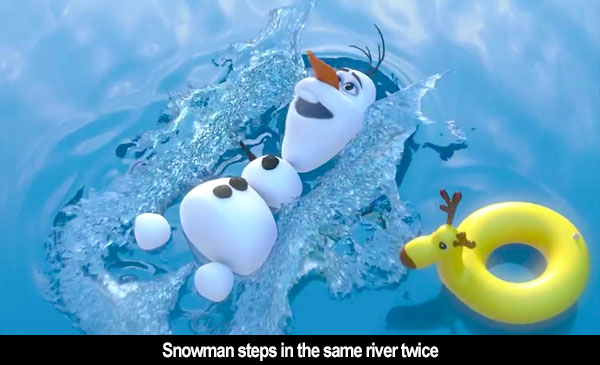
by Walter Chaw Hayao Miyazaki’s alleged swan song The Wind Rises is mature, romantic, grand storytelling that just happens to be something like a romanticized biography of Jiro Horikoshi, the aeronautical engineer behind the design of the Mitsubishi A5M, which led, ultimately, to the Zero. Indeed, for a Western audience, watching Jiro’s dreams of squadrons of Zeros buzzing over fields of green is chilling, and advance critics seemed unable to distinguish the Japanese war machine from the film’s focus on a life lived in pursuit of dreams. In truth, separating these two aspects of the picture–the proximate and the historical–is self-defeating. (Dismissing the movie out of hand is equally blinkered.) One without the other, The Wind Rises loses anything like substance, resonance, importance. It would fall on the one side into gauzy bullshit, on the other into Triumph of the Will. As is, it’s something more akin to Studio Ghibli’s own Grave of the Fireflies in its humanizing of a man whose dreams were corrupted into something terrible. Einstein would be one of the West’s potential Horikoshi corollaries–and if Miyazaki had done Albert’s biography, I’d expect to see mushroom clouds illustrating his fantasies of relativity. For Horikoshi, Miyazaki provides upheavals and disasters as highlight to each of his life events: He first meets his wife in a train crash; in a lilting epilogue, when Jiro bids farewell to his dead wife, Miyazaki offers fields of devastation and a village in flames. Throughout, Miyazaki presents earthquakes, rainstorms, sudden bursts of wind as reminders of…what? The inevitability of change? The portents of war? The cycles of life and death? All of that; but what compels is the idea of helplessness in the face of larger forces–that although we chase our dreams, we’re never really in control of our destinies.

Weekend (1967) [The Criterion Collection] – Blu-ray Disc

Weekend1

WEEK END
****/**** Image A- Sound B Extras B
starring Mireille Darc, Jean Yanne, Georges Staquet, Juliet Berto
written and directed by Jean-Luc Godard

by Angelo Muredda “The horror of the bourgeois can only be overcome with more horror.” So says a militant cannibal as he stands over the remains of one such bourgeois husk late in Weekend, Jean-Luc Godard’s farewell to the alienated pop art and American genre gerrymandering of his early period. As the line about horrors piled upon horrors implies, Weekend is nasty, as valedictory addresses go–a scorched-earth attack on France under Charles de Gaulle that finds nearly all of its citizens massacred in car crashes of their own design and converted into consumable products, namely food. The humanism of minor tragedies like Vivre sa vie and the heedless joy of Frank Tashlin homages like Une femme est une femme has here curdled into a new, ugly form. Although its title suggests a world of leisure and free play, one doesn’t enjoy Weekend so much as one endures it.

Eyes Without a Face (1960) [The Criterion Collection] – Blu-ray Disc

Eyeswithoutaface1

Les yeux sans visage
****/**** Image A Sound A Extras C

starring Pierre Brasseur, Alida Valli, François Guérin, Edith Scob
screenplay by Pierre Boileau, Thomas Narcejac, Jean Redon and Claude Sautet, based on the novel by Jean Redon
directed by Georges Franju

by Walter Chaw Five films changed the conversation in 1960. They were the fire, though the embers were stoked in the years leading up to them. Looking for signposts in the Eisenhower Fifties, you find the juvenile-delinquent cycle, plus the outré horror flicks of England’s Hammer Studios, or Japan’s tokusatsu, or France’s Nouvelle Vague. More directly, you find a pair of films based on works by the team of Pierre Boileau and Thomas Narcejac, Diabolique and Vertigo. But in 1960, there was this quintet, each the product of parallel genesis, each proof after a fashion of a Jungian collective unconscious, perhaps, certainly that things long-simmering inevitably boil over. There’s an idea in my head, put there by Ethan Mordden’s Medium Cool, that everything that happened in the arts in the United States throughout the Fifties points to what was about to happen in our culture in the Sixties. Mordden is the source of my favourite teaching point when it comes to the two eras: that in the Fifties, if you didn’t listen to Mother, society was doomed; and in 1960, if you listened to Mother, you were Psycho.

Her (2013)

Her

****/****
starring Joaquin Phoenix, Amy Adams, Rooney Mara, Scarlett Johansson
written and directed by Spike Jonze

by Walter Chaw Two moments early on in Spike Jonze’s Her. The first when our hero, Theodore (Joaquin Phoenix), initiates his new operating system, Samantha (voiced by Scarlett Johansson), and is asked to characterize his relationship with his mother; the second when, in flashback, Theodore and his ex, Catherine (Rooney Mara), pretend to choke each other. They’re waypoints Jonze establishes for his piece: in one direction, there’s Blade Runner and its questions of proximate humanity; in the other, there’s Eternal Sunshine of the Spotless Mind and its mad love. Jonze establishes, too, that this will be a work of science-fiction owing its parentage to the best sources, that its premise will be fantastic but grounded in characters and their place in the world. Of all the compliments I can think to pay this film, the best is that Her is at least the equal of its waypoints. More, when its solution recalls the metaphysical coda to the great The Incredible Shrinking Man, it’s the equal of that as well.

Inside Llewyn Davis (2013)

Insidellewyndavis

****/****
starring Oscar Isaac, Carey Mulligan, John Goodman, Justin Timberlake
written and directed by Joel Coen & Ethan Coen

by Walter Chaw I love the Coen Brothers, despite my suspicion that most of their movies don’t think much of me at all. What’s often read as disdain for their characters I’ve read mainly as antipathy for their audience: I believe they like their characters just fine, it’s just that they could give a shit about your opinion of what happens to them. I love the Coens for their literary acumen, for their fine ability to understand not simply the form of genre–and, in their adaptations, of authors–but the entire function as well. They don’t just adapt Cormac McCarthy and Charles Portis novels, they adapt those writers’ entire bodies of work. O Brother, Where Art Thou? is a remarkable retelling of The Odyssey, for instance, because in addition to following the outlines of the poem, it adapts its themes and storytelling strategies; it’s a dissection and a representation and glorious, of course. They return now to The Odyssey–or, at least, to the character of Odysseus–in Inside Llewyn Davis, a picture set in 1961, among the bohos and coffee shops of a Greenwich Village on the verge of Bob Dylan and the counterculture, and it’s populated with lost souls in overlapping underworlds. Transpose that passage from Homer where Odysseus fills troughs with sheeps’ blood to draw the undead (and finds his poor deceased mother there at her drink) to scenes in Pappi’s (Max Casella) infernal nightclub as proto-hipsters and neo-beatniks assemble blandly on the edge of a trembling something while performers bleed out before them. In rituals for new gods, after all, there must be lambs to slaughter.

SDFF ’13: Borgman

Borgman

****/****
starring Jan Bijvoet, Hadewych Minis, Jeroen Perceval, Sara Hjort Ditlevsen
written and directed by Alex van Warmerdam

by Walter Chaw Screening at the SDFF and now travelling with the Alamo Fantastic Fest, Alex van Warmerdam’s Borgman gets the Yorgos Lanthimos Award for Most Devastating Absurdist Metaphor for Familial Dysfunction. Smart as hell and unapologetically surreal, its central motivating image is a tableaux vivant of Henry Fuseli’s “The Nightmare,” tipping off not just the ethos of the film, but also that there may be running threads concerning mothers (Fuseli was Mary Wollstonecraft’s lover), monsters (Mary being the mother of Mary “Frankenstein” Shelley), the empowerment of women (the mother again), nightmares, of course, and maybe Romanticism, if only in the picture’s awareness and perversion of nature. Demanding a specific kind of active spectatorship, Borgman is a complex film with heat, and somewhere in the middle of it there’s a performance within a performance that ends with a declaration of intent that stands as one of the most existentially chilling things in cinema this year.

A Perfect World (1993) – Blu-ray Disc

Perfectworld2

****/**** Image B+ Sound A-
starring Kevin Costner, Clint Eastwood, Laura Dern, T.J. Lowther
screenplay by John Lee Hancock
directed by Clint Eastwood

by Walter Chaw Time and distance have conspired to replace Clint Eastwood’s Unforgiven with A Perfect World in my mind as his best film and one of the best movies of the ’90s. The two occur within a year of each other and mark, with In the Line of Fire between them, a renaissance of the Eastwood brand that had taken a few licks of late with embarrassments like Pink Cadillac, The Rookie, City Heat, Heartbreak Ridge, and on and on. While I was growing up, Eastwood was a Dirty Harry joke and the guy who acted with Orangutans. The first time I saw him in anything was in Bronco Billy, which, frankly, isn’t the first time you want to see anyone in anything. What Unforgiven did for me was inspire a curiosity about Sergio Leone and, with that, a new reason to respect Eastwood’s legacy; my first time through A Perfect World disturbed my notion of who Kevin Costner was (baseball player/cowboy) at the height of his power and sway in Hollywood, and I was distracted. Every time I’ve revisited A Perfect World since (and I’ve been compelled to revisit it at least once every few years), as Costner’s star has faded and Eastwood’s elder statesmanhood behind the camera has somehow dwarfed his iconhood in front of it, I feel the melancholy nostalgia of the film more and more. It’s an American masterpiece. I make that distinction because it’s distinctly American; and I mean it when I say that it’s as fine an essay of the dying of an age as anything in Cormac McCarthy’s Border Trilogy.

SDFF ’13: The Fifth Season

Fifthseason

La cinquième saison
****/****
starring Aurelia Poirier, Django Schrevens, Sam Louwyck, Gill Vancompernolle
written and directed by Peter Brosens & Jessica Woodworth

by Walter Chaw It begins as a puzzle, the active-engagement kind where a film, maybe an art film not very good and certainly not lacking in pretension, wears all the hopes of its creators on its sleeve. But then, out of nowhere, Peter Brosens and Jessica Woodworth’s The Fifth Season (La cinquième saison) ties together all the pretty pictures into an entirely honourable updating of a few of the ideas from, but most importantly the atmosphere of, Robin Hardy’s The Wicker Man. Truth be told, the pictures are more than just pretty: they’re stunning at times, and it’s easy to be mesmerized by them–by their surrealism and meticulous framing, and, at the end of it all, by their gorgeous absurdity. This is rapturous filmmaking that in its first minutes watches two teens kiss, tentatively, in the cold and the woods, their breath trembling the soft down on each other’s faces. We feel, with them, the discovery of something new. The Fifth Season is a film about textures, but rather than just be a film about textures, it does something that maybe Terrence Malick’s movies do, certainly Bela Tarr’s: it makes its form comment on its function.

SDFF ’13: Blue Ruin

Blueruin

****/****
starring Macon Blair, Devin Ratray, Amy Hargreaves, Kevin Kolack
written and directed by Jeremy Saulnier

by Walter Chaw Six years after his surprisingly poignant, unexpectedly deft, and, of course, funny debut Murder Party, multi-hyphenate Jeremy Saulnier (he writes, directs, and photographs his movies) returns with something very much like a genre masterpiece with Blue Ruin, the best Coen Bros. noir since they were making them. Grim in exactly the way that can be delightful, it’s paced beautifully, written beautifully, and performed, that’s right, beautifully. Saulnier’s intelligent script is a model of restraint and a strong sense of humour. Macon Blair’s reluctant avenging angel Dwight is someone I’ve never met before in a movie, and when Dwight seeks out old pal Ben (Devin Ratray) for help at some point, well, I’d never met him before, either. It’s fair to say that nothing that happens in Blue Ruin happens the way I thought it would happen, if it happens at all. Note an early moment in the picture where Dwight sets up an ambush and doesn’t pay it off, or that standard thing in movies now where the hero goes to a drugstore to pick up the supplies they need to perform self-surgery, which here ends with…that would be telling. All the requirements are there for a grand satire, it’s true, yet Blue Ruin isn’t that. Instead, it’s a film that understands exactly what it is and what space it occupies, and at the end it’s not merely an extraordinary character piece (Blair’s turn would be star-making in a just universe), it’s also a nimble thriller full of outrageous fortune and stunning reversals meted out perfectly between its breathless moments and the moments where it breathes.

To Be or Not to Be (1942) [The Criterion Collection] – Blu-ray Disc

Tobeornottobe2

****/**** Image A+ Sound A- Extras A
starring Carole Lombard, Jack Benny, Robert Stack, Felix Bressart
screenplay by Edwin Justus Mayer, based on a story by Melchior Lengyel
directed by Ernst Lubitsch

by Walter Chaw Ernst Lubitsch took chances, none greater than To Be or Not to Be. Released in the first months of America’s involvement in WWII, in that initial flurry of propaganda that saw the Nazis as murderous, animalistic, inhuman Hun, Lubitsch chose instead to portray them as ridiculous, as human–to make a comedy, a farce…and a masterpiece, as it happens. It’s a crystallization of his work in that way: He’s always more interested in foible than in oppressive arcs of personal failure–if Nazis can be seen to be possessed of the same faults as the rest of us, the same vanities, the same fears. Make no mistake, To Be or Not to Be is no olive branch. Seventy years on, it remains among the most withering satires of totalitarian governments and the politics of groupthink, but it suggests that Nazism is just one of many insufficient sops to the insecurities hardwired into us–that we’re all just thin projections strutting and fretting our hour on the proverbial stage, each susceptible to things that would give relief from the pain of lack of self-confidence and identity. It’s a film that seeks to explain why people create cults of personality. That it sets itself amongst a theatre troupe performing “Hamlet”, itself a play that houses another play within itself (holding a mirror up to nature, indeed), makes total sense in a picture that, through this absurdity, seeks to highlight greater absurdities. Of all his great films (and when push comes to shove, I’d say Trouble in Paradise is and likely always will be my favourite Lubitsch), To Be or Not to Be is inarguably his greatest.

MHHFF ’13: Shorts Program #4

Mmhhffshorts

Next Exit **/**** (UK, 14 mins., d. Benjamin Goodger) A light bit of nothing, Next Exit is a little Ludditism along the lines of that one episode of the American “The Office” where Michael Scott follows the bad instructions of his GPS directly into a lake. The performances are good, the direction is fairly pedestrian, and the story, about a girl who accepts a ride home from a pub one night, has a couple of decent twists but is ultimately more mildly clever than disturbing or compelling. In its short time, it does manage to cover the bases in terms of going out of cell-phone range and the suggestion of a cyclical ending, but it fails mostly in terms of generating much in the way of horror or comedy. Mostly, I had trouble with the idea that anyone would think a hotel–or a hospital, or anything–is located in the middle of the woods.

Slacker (1991) [The Criterion Collection] – Blu-ray Disc

Slacker1

****/**** Image A Sound A Extras A+
starring Richard Linklater, Rudy Basquez, Jean Caffeine, and a whole bunch of people
written and directed by Richard Linklater

by Jefferson Robbins Before it became a lazily-applied shorthand for my generation in particular, Slacker was a film about doom. It’s pervasive throughout this seemingly casual, meticulously constructed, 24-hour baton-pass through bohemian Austin, Texas, in which characters confront intimations of death, their own or that of the species in general, and respond with rhetoric, bemusement, a fatalistic shrug, or a joyride. Writer-director Richard Linklater awakens from vivid dreams on a bus in the opening scene, then unspools his vision to a Buddha-silent cab driver (Rudy Basquez). His most memorable dreams, he reports, often feature sudden death: “There’s always someone gettin’ run over or something really weird.” Fair enough to wonder if we’re not dreaming along with him, in some dress rehearsal for Waking Life, when he quickly happens upon a mother (Jean Caffeine) sprawled in a residential Austin boulevard, freshly driven over by her disturbed son (Mark James).

Autumn Sonata (1978) [The Criterion Collection] – Blu-ray Disc

Autumnsonata2

Höstsonaten
****/**** Image A- Sound A Extras A
starring Ingrid Bergman, Liv Ullmann, Lena Nyman, Halvar Björk
written and directed by Ingmar Bergman

by Bryant Frazer By 1978, Ingmar Bergman was in trouble. The director had fled his native Sweden two years earlier after an arrest on charges of tax evasion. (He would be completely exonerated in 1979, but his mood was no doubt grim until then.) He visited Paris and Los Angeles, then settled in Munich, where he would shoot his first English-language film, the 1920s Berlin-set The Serpent’s Egg, a Dino de Laurentiis co-production co-starring David Carradine and Bergman stalwart Liv Ullmann. The Serpent’s Egg was a box-office flop in Sweden, a critical and commercial failure internationally, and most of all a big artistic disappointment for Bergman himself–a decided stumble for a director riding high on the success of 1970s titles like the harrowing Cries and Whispers, which enjoyed huge success in the U.S. in the unlikely care of Roger Corman’s New World Pictures, and the audience-friendly The Magic Flute. At the same time, Bergman was embarking on what would prove to be an unhappy tenure at Munich’s Residenztheater, where he managed to mount eleven productions before being fired in 1981. In this turbulent context, the very Bergmanesque Autumn Sonata can be seen as a kind of comfort film–a deliberate return to roots. Someone once described it as “Bergman does Bergman,” and the gag stuck. Bergman himself eventually quoted the remark, calling it “witty but unfortunate. For me, that is.”

Bastards (2013)

Bastards

Les salauds
****/****
starring Vincent Lindon, Chiara Mastroianni, Julie Bataille, Lola Creton
screenplay by Jean-Pol Fargeau and Claire Denis
directed by Claire Denis

by Angelo Muredda A Claire Denis film through and through, Bastards is nevertheless a brilliant departure for one of the most distinctive artists in world cinema–an indignant revenge thriller with, of all things, a straightforward plot. Of course, the plot is scrambled, doled out in the runic fragments that have become Denis’s stock-in-trade. We open, for instance, in the rain, as a throbbing Tindersticks track underscores a series of beautiful but inscrutable nocturnal images: glimpses of a man forlornly staring out his window, languorous tracking shots of a nude young woman in heels roaming through a deserted street, and finally a tableau of a dead man’s body splayed out beneath a fire escape, surrounded by paramedics in the background as a woman, probably his wife, is draped in a tinfoil blanket in the fore. Although films like L’Intrus have primed us to accept such shards as part of an impressionistic array of visual information, adding up to a textured view of nighttime Paris as a hopelessly lonely place, in Bastards the pieces fit together in a precise way we’re simply not allowed to know until we’ve arrived through the movie’s own idiosyncratic channel, and at its own deliberate pace. That makes it one of the most elegantly constructed of Denis’s eleven features–a grim noir story broken into its component parts, then reassembled into a haunted funhouse image of itself.