

Please note, the film and Blu-ray portions of this review were originally published on October 7, 2012.-Ed.

****/****
BD – Image A Sound B Extras A
4K UHD – Image A Sound A Extras A-
starring Robert Redford, Dustin Hoffman, Jack Warden, Jason Robards
screenplay by William Goldman, based on the book by Carl Bernstein and Bob Woodward
directed by Alan J. Pakula
by Walter Chaw The final film in director Alan J. Pakula’s loose “paranoia trilogy,” All the President’s Men does the impossible by making heroes of newspaper reporters and a thriller out of telephone calls and follow-up interviews. Based on Bob Woodward and Carl Bernstein’s exposé of the Watergate Scandal and President Richard Nixon’s involvement in felonious dirty tricks, it’s more than just a cunningly-crafted docudrama–it’s a key film in the best era of the medium’s history. It’s a picture that highlights the period’s mistrust in our leadership while establishing highly unconventional heroes for whom the stakes couldn’t possibly be higher. And though we know how it all works out, it seems more poignant for our knowing how everything works out.
Impeaching a sitting President didn’t save any lives in Vietnam, didn’t prevent other Vietnams; it didn’t cure rampant corruption in government, didn’t stop the impeachment of another President, didn’t shame anyone into respecting the Oval Office, and now newspapers are almost dead. Everything is worse. The film isn’t the story of a success, it’s the story of absolute, systemic failure and the promise not that it’s going to happen again, but that Watergate didn’t present much of a speedbump on our road to virulent partisanship and a perpetual state of ideological warfare. All the President’s Men is about men trying to avert the end of days. Even as they champion their nobility and ideals, there is the sense, unmistakable, that the atrocity is that such things can happen at all. It’s The Exorcist, really. No one wins.
Woodward (Robert Redford) and Bernstein (Dustin Hoffman) are grunt writers for the WASHINGTON POST under the tutelage of editor Ben Bradlee (Jason Robards). Pakula takes great pains to reproduce exactly the POST’s operation from set-up all the way down to transplanting actual trash from the newsroom to the set. He understands that for this All the President’s Men to work, it must feel like a movie about work–in much the same way Jaws did the year before and Star Wars will a year later. In fact, taken another way, the New American Cinema could be discussed in terms of its veneration of mendacity. The westerns were dirty, the sci-fi was dirty, the horror was really dirty, and the dramas, from The French Connection to The Godfather to Fat City to Cockfighter, were about people in miserable professions using the tools of their trade to discover, too late, that they weren’t the masters of their destiny. Look at the detective movies from this period (Chinatown, Night Moves, The Parallax View, Electra Glide in Blue, The Conversation, Klute), of which All the President’s Men is one: Nobody knows anything and, after further investigation, they know even less. All the President’s Men isn’t an exception to the rule, isn’t a strange anomaly among the decade’s masterpieces, so much as it approaches its nihilism from a more societal gestalt. The universe in which it exists is post-apocalyptic; Woodward and Bernstein haven’t discovered anything we didn’t already suspect. The secret to All the President’s Men‘s enduring power isn’t that we’re surprised Nixon was a rat–it’s that we recognize these victories as Pyrrhic, because everything is a lie.
The film follows Woodward and Bernstein as they’re given a shit assignment to cover a break-in at Democratic headquarters in the Watergate hotel and gradually unearth a larger conspiracy intended to cover it up. There’s an undeniable thrill as they, step-by-step, track the conspiracy back to the White House; undeniable tension as it becomes clear through whispers and backward glances that their lives might be at stake and that the bad guys, no fantasy this time, are the people we’ve elected to the highest offices in our land. An offense, an abomination, carried by one of William Goldman’s two truly great screenplays and extraordinary performances by, without exception, every single actor in the piece.
Consider a scene where our heroes interview a very nervous bookkeeper (Jane Alexander) in her living room, and how Pakula takes his time with how they look at each other–the way that objects begin to loom like Hitchcockian teacups. Consider another scene, later, when Woodward tries to get a non-denial confirmation of a fact in their story shot entirely as a tight close-up of Woodward on the phone, a couple of cutaways to his pencil scratching his pad. It’s a moment, and there are others, that proves Redford can act, though he’s not asked to (or chooses not to) much. Hoffman, all nervous energy–call it a dry run for his turn in Marathon Man (Goldman’s other great screenplay; don’t let anyone tell you otherwise)–cements himself as the more typical ’70s protagonist. It’s the decade of the swarthy little guy, after all, and if you happen to be Warren Beatty instead of Al Pacino, you have to eat a shotgun or be a hairdresser. All the President’s Men is essential, exhilarating, and the kind of total downer you only realize is a downer when you can’t shake it for weeks. The world is beyond saving, it says. It’s one of the last great films of its era that has anyone who thinks it deserves saving.

THE BLU-RAY DISC
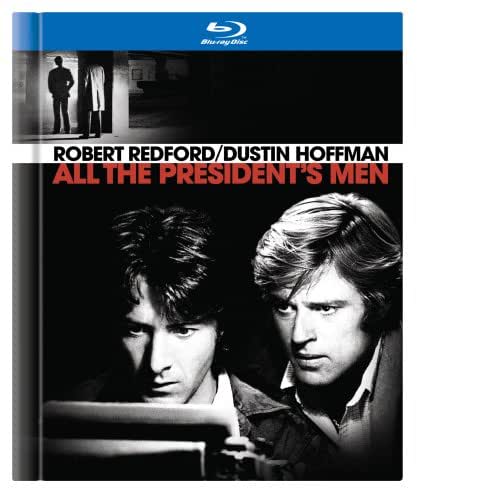
Warner’s DigiBook Blu-ray release presents All the President’s Men in a lovely 1.78:1, 1080p transfer on a dual-layer disc. There’s exquisitely natural detail throughout, and though the palette looks quite yellowed, more like the Seventies of memory than of reality, I’m not convinced it’s outside the intent of Pakula or his DP, the great Gordon Willis. Blacks are dense but generally refrain from crushing, even in the Deep Throat underground-parking encounters, which lack shadow detail by design. It all looks authentic, is what I’m saying. The attendant 2.0 DTS-HD MA mono track is clear and loud and everything you could hope for, delivering its payload of overlapping dialogue with absolute fidelity. It occurs to me that All the President’s Men, in its cadence and its rapport between the two leads, is very much in the screwball tradition–imagine what Howard Hawks would have done with this. I appreciate, too, that David Shire’s score (the composer of my favourite ’70s score (for The Conversation, natch)) sounds nice and full.
Redford delivers a thoughtful audio commentary to start off the special features, filling in gaps throughout and updating information, including the identity, now revealed, of Mark Felt as Deep Throat. He speaks kindly of Hoffman’s myriad neuroses, particularly at this moment in his career, and as he dissects the peculiarities and difficulties of working with Woodward and Bernstein, he sort of covertly confirms the Method difficulties the rest of the cast had working with Hoffman and Redford. Redford–a director himself, of course–even offers insight into Willis’s process, which, in the end, might be the most invaluable aspect of this yakker. Originally compiled for the 2006 DVD, a batch of standard-def featurettes begins with the retrospective making-of “Telling the Truth about Lies” (30 mins.). I love Goldman’s protestations of purity, identifying the guy as a better salesman of his personal mythology than anything else. And there’s Willis again. If only Pakula hadn’t met so ignoble and sudden an end on the L.I.E.–his loss is deeply felt here.
“Woodward and Bernstein: Lighting the Fire” (18 mins.) is a nice conversation about the state of journalism then and now but, sadly, it’s already due for an update. “Out of the Shadows: The Man Who Was Deep Throat” (16 mins.) delves into why Felt did what he did, with the omnipresent and endlessly self-promoting Woodward getting all romantic up in there. “Pressure and the Press” (10 mins.) is a vintage behind-the-scenes piece that, despite its vestigial quality, is the type of thing I like to watch anyway, if only for the narration. A Dinah Shore interview with Robards (7 mins.) is hard-to-watch effluvium that nonetheless tickled a faint memory of this show deep in my storage database, while a fun old trailer (2 mins.) rounds out the electronic media. The DigiBook is 35 stiff pages of production photos, Watergate timelines, and bios for the main players. I looked, in vain, for an author credit.


THE 4K UHD DISC
by Bill Chambers The late, great cinematographer Gordon Willis lived long enough to take umbrage at the Blu-ray release of All the President’s Men reviewed above. In 2011, he lamented to Jeffrey Wells, of all people, that the studio never consulted either him or the most recent DVD (which he considered a fairly accurate reproduction of the movie’s look) in remastering the film for its next-gen debut. Willis felt the midtones were wrong and the contrast was dialled up too high. “They get on those fucking dials,” he told Wells. “It’s a disease. Their idea for a Blu-ray is to make it for guys who are watching football.” It’s a peculiar criticism, i.e., “too much black crush,” coming from someone nicknamed “The Prince of Darkness,” perhaps, but there is a world of difference between the digital contrast boosting that was faddish in those early years of the Blu-ray format (even Criterion wasn’t immune to it, nor were we at FFC immune to sometimes endorsing it) and the kind of envelope-pushing experiments in low-key lighting that Willis engaged in.
I kept Willis’s remarks in mind as I audited Warner’s new 4K edition of All the President’s Men and came away feeling fairly confident that he would approve of the studio’s choices this time around. One thing that’s immediately startling: it opens with the old Saul Bass “W” logo (in black-and-white, no less) instead of the animated Warner shield (in colour), as seen on Blu-ray and DVD. We are also greeted by the picture’s original aspect ratio (1.85:1) for the first time since the 1994 LaserDisc, and by a less-than-timid grain structure, though it doesn’t read like snow as sometimes happens when grain interacts with high dynamic range–particularly if the original film stock was fast or pushed during development. (In the case of All the President’s Men, the exposure was pushed one “stop.”) The 2160p transfer, enabled for Dolby Vision/HDR10 playback, is otherwise pristine, and the drop-off to black is deep without being blunt. When Woodward and Bernstein pay one of their night visits to Betty Milland (Valerie Curtin) at around the 1:05 mark, they’re no longer submerged in the inky darkness behind them, and you can actually make out some shrubbery to the left of Robert Redford as well as the contours of Dustin Hoffman’s brown hair. These details were virtually erased on BD.

This is not to say the movie is brighter in 4K, just that shadow detail has been restored to the image; Deep Throat still cuts a striking, Lugosi-esque figure, introduced as he is with a band of light across his eyes, but now the rest of his face is legible, too, pulling those scenes back from the brink of outlandishness. Willis did not address the Blu-ray’s oversaturated colours–which appear to be what spurred Wells to contact him in the first place–or the fashionable teal-and-orange bias of its palette. Both, however, are largely absent from this incarnation. Although the Deep Throat encounters maintain a teal sheen, thus contradicting the deep blues of the theoretically reference-grade DVD, there are enough examples of true blue throughout the UHD presentation–including in the sartorial choices of Deep Throat himself–to suggest that it’s accurately graded. And where the POST’s newsroom became somewhat objectionable-looking on Blu-ray, owing to said oversaturation, here the fire-engine red, forest green, and, yes, royal blue accents charm, proving it’s possible to avoid garishness while embracing bold hues–though maybe that was impossible before the advent of HDR.
Highlights are relatively restrained but do lend verisimilitude to the overhead fluorescents at the POST and any illumination cutting through the shadowy DC exteriors. As for the 2.0 DTS-HD MA track, it’s the same mix heard on Blu-ray but mastered at over double the bitrate. While this might be a placebo effect, it seems to sound clearer and fuller than before; the already-outstanding reproduction of newsroom acoustics is that much more uncanny. Joining the extras Walter already covered (which return in SD) are two new featurettes, “All the President’s Men: The Film and Its Influence” (8 mins., HD) and “Woodward and Bernstein: A Journalism Masterclass” (8 mins., HD), in which CNN anchors Dana Bash and Jake Tapper discuss the seismic impact the film and the reporting that inspired it had on them and journalism in general. In an impressive display of modesty, Tapper doesn’t take any credit for his own role in hastening his profession’s demise. This is the definitive All the President’s Men–get it before Bari Weiss disappears it. Available in standard and steelbook packaging, with a digital code tucked inside the keepcase.
- BD
138 minutes; PG; 1.78:1 (1080p/MPEG-4); English 2.0 DTS-HD MA (Mono), French DD 1.0, Spanish DD 1.0, Portuguese DD 1.0, Italian DD 1.0, German DD 1.0, Japanese DD 1.0; English SDH, French, Spanish, Portuguese, German, Italian, Swedish, Finnish, Japanese subtitles; BD-50; Region-free; Warner - 4K
138 minutes; PG; 1.85:1 (2160p/MPEG-H, Dolby Vision/HDR10); English 2.0 DTS-HD MA (Mono), French DD 1.0, Latin Spanish DD 1.0, Castilian Spanish DD 1.0, German DD 1.0; English SDH, French, Spanish, German SDH, Danish, Dutch, Finnish, Mandarin subtitles; BD-100; Region-free; Warner


